Why Does Music Give You Chills? The Brain Science of Goosebumps from a Song
That shiver during a great song is frisson. How surprise, dopamine and the brain’s reward system turn music into goosebumps, and why not everyone feels it.
Short answer
Music gives you chills because it plays with the brain’s prediction and reward systems. While you listen, your brain constantly guesses what comes next. When a song suddenly swells, adds a new voice or takes an unexpected turn, that surprise triggers a burst of emotional arousal. Brain-imaging studies show that during musical chills the reward system, the same circuits involved in food and love, becomes active and releases dopamine, both in the build-up and at the peak. The aroused nervous system then raises the tiny hairs on your skin, producing goosebumps and a shiver down the spine. Scientists call this feeling frisson.
In this article (7)
The orchestra goes quiet. A single voice rises, the drums come in, and suddenly a wave of tingling runs up your arms and down your spine. The hairs on your skin stand up. Many people know this feeling, yet it is strange: why would sounds, mere vibrations in the air, make our bodies react as if we were cold or afraid? Neuroscience now has a fairly detailed answer.
Frisson: the scientific name for musical chills
Researchers call this experience frisson, from the French word for “shiver”. It typically lasts a few seconds and includes:
- goosebumps on the arms, neck or back,
- a shiver or tingling running along the spine,
- sometimes a lump in the throat or tears.
It is not the same as being cold. Frisson is an emotional response: the body reacts to a strong feeling the music has stirred.
The brain is a prediction machine
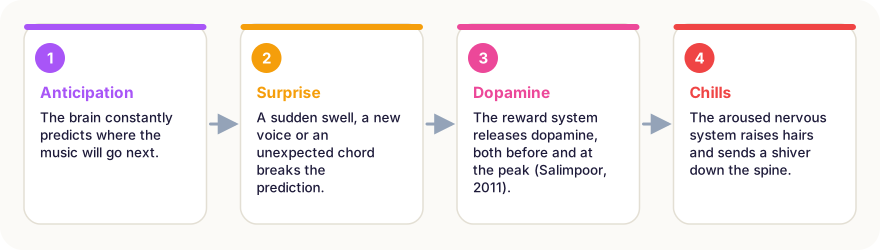
When you listen to music, your brain is not passive. Based on everything you have heard before, it constantly predicts what will come next: which note, which chord, when the beat will drop. Music plays with these expectations, sometimes confirming them and sometimes breaking them.
When a song does something unexpected but satisfying, such as a sudden swell after a quiet passage, the brain registers a prediction error. That surprise triggers a burst of arousal in the nervous system, the same system that controls the hairs on our skin. In our hairy ancestors, raised hair helped keep warm or look bigger in the face of danger. Today, all that remains is goosebumps.
Dopamine: the reward of a song
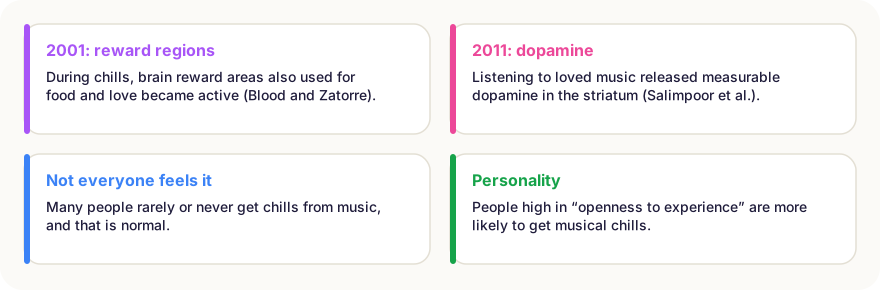
The key evidence comes from brain-imaging studies. In 2001, Anne Blood and Robert Zatorre at McGill University scanned the brains of musicians while they listened to pieces that reliably gave them chills. During the chills, regions of the brain’s reward system, also involved in responses to food, sex and some drugs, became more active, while regions linked to fear became quieter.
In 2011, Valorie Salimpoor and colleagues went a step further. Using PET scans, they showed that listening to favourite music releases measurable dopamine in the striatum, a central part of the reward system. Remarkably, dopamine was released in two phases:
- in one part of the striatum during the anticipation before the peak,
- in another part at the moment of the peak itself, when the chills arrived.
So the pleasure of music is partly the pleasure of waiting for something good, and then getting it.
What triggers the chills?
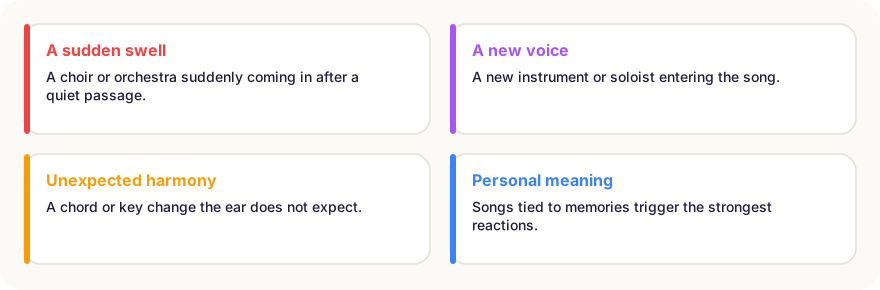
Studies of the passages that trigger frisson point to a few recurring musical features:
| Trigger | Example | Why it works |
|---|---|---|
| Sudden swell in volume | A full choir entering after a soft verse | Strong contrast breaks expectations |
| A new voice or instrument | A solo singer or violin entering | Novelty grabs attention |
| Unexpected harmony | A surprising chord or key change | Prediction error, then resolution |
| Wide pitch range | A singer reaching a high note | Signals emotional intensity |
| Personal memories | A song from an important moment of life | Emotion and memory amplify the response |
Lyrics also matter. A meaningful line arriving at the right moment can trigger chills on its own. And context counts: a song heard live in a crowd often produces stronger reactions than the same song through small speakers.
Why doesn’t everyone get chills?
Not everyone experiences frisson. Surveys suggest a large share of people get musical chills occasionally, while many others rarely or never do. Both are entirely normal.
Some research has linked a greater tendency to feel chills with the personality trait openness to experience: people who are curious, imaginative and drawn to art and new ideas. Other studies suggest that people who frequently feel chills may have stronger connections between auditory areas of the brain and regions that process emotion. A small number of people have musical anhedonia: they understand music perfectly well but feel no particular pleasure from it.
Why would evolution make music feel so good?
No one knows for sure why humans evolved such a strong response to music. One idea is that music hijacks systems that evolved for other purposes, such as reacting to sudden sounds or emotional voices. Another is that shared music and dance helped bond groups together: singing and moving in sync with others creates a sense of togetherness, and a brain that rewards music would encourage it.
What is clear is that musical chills are not a quirk. They show how deeply sound is connected to the oldest emotional and reward systems of the brain.
In short
- Musical chills are called frisson: goosebumps and shivers caused by emotion, not cold.
- The brain constantly predicts music; satisfying surprises trigger arousal.
- During chills, the brain’s reward system is active, as shown in 2001.
- Favourite music releases dopamine, both before and at the peak (2011).
- Swells, new voices, unexpected harmonies and personal memories are common triggers.
- Many people rarely or never feel chills from music, and that is normal.
Frequently asked questions
What is frisson?
Frisson, from the French word for ‘shiver’, is the scientific name for musical chills: a pleasurable wave of goosebumps, tingling and shivers that some music triggers.
Is it normal not to get chills from music?
Yes. Studies suggest that a substantial share of people rarely or never experience musical chills. It does not mean they enjoy music less; their emotional response simply takes other forms.
Why do sad songs give chills?
Sad music often contains slow build-ups, emotional voices and moving harmonies. It can evoke strong feelings in a safe setting, and the brain’s reward system can respond to that emotional intensity with chills.
Can other things besides music give chills?
Yes. Moving speeches, films, poems, art or awe-inspiring sights can trigger the same response. Music is simply one of the most reliable triggers.
Sources
- Blood & Zatorre (2001) – Intensely pleasurable responses to music correlate with activity in brain regions implicated in reward and emotion, PNAS
- Salimpoor et al. (2011) – Anatomically distinct dopamine release during anticipation and experience of peak emotion to music, Nature Neuroscience
This article is based on peer-reviewed research and publications from trusted institutions, and it is reviewed regularly. How we work →
You might also wonder
All in Brain & Mind →
Why Do We Have Phobias? How Intense Fears Form and How They Are Treated
Why are so many people terrified of spiders, heights or needles? How phobias form, which types are most common and why exposure therapy works so well.

Why Do We Laugh? The Surprising Science of Laughter
Most laughter has nothing to do with jokes. Why we laugh far more with others, why laughter is contagious, how it relieves pain, and why apes laugh too.

Why Do We Procrastinate? It’s About Feelings, Not Laziness
Procrastination isn’t a time-management problem: it’s a way of escaping bad feelings. What science says about why we delay and the tricks that help.

Why Does Time Fly When You’re Having Fun? The Psychology of Time
An hour with friends vanishes while a boring meeting drags on. Why our sense of time stretches and shrinks, and why holidays seem long afterwards.

Can You Remember Things That Never Happened? How False Memories Form
Memory is not a video recording. Classic experiments show how a single word can change what people remember, and how vivid false memories can be created.

Why Do We Cry? The Science of Emotional Tears
Humans are the only animals known to cry emotional tears. The three kinds of tears, why we cry when sad or happy, and whether crying really helps.