What Were Triceratops Horns For? Fighting, Display and Defence Against T. rex
Triceratops had three horns and a huge bony frill. Were they weapons against T. rex, for fighting rivals or for attracting mates? What fossils reveal.
Short answer
Triceratops horns and frill probably had several uses. Healed wounds on fossil skulls suggest that Triceratops locked horns and fought each other, much like deer or antelope, possibly over mates or territory. The horns and big frill were also likely visual signals, a way to show off to rivals and potential mates and to recognise members of their own species. They may also have helped in defence: Tyrannosaurus rex bite marks have been found on Triceratops bones, and some show signs of healing, meaning the plant-eater survived the attack. The horns changed dramatically as Triceratops grew, curving backwards in juveniles and pointing forwards in adults.
In this article (7)
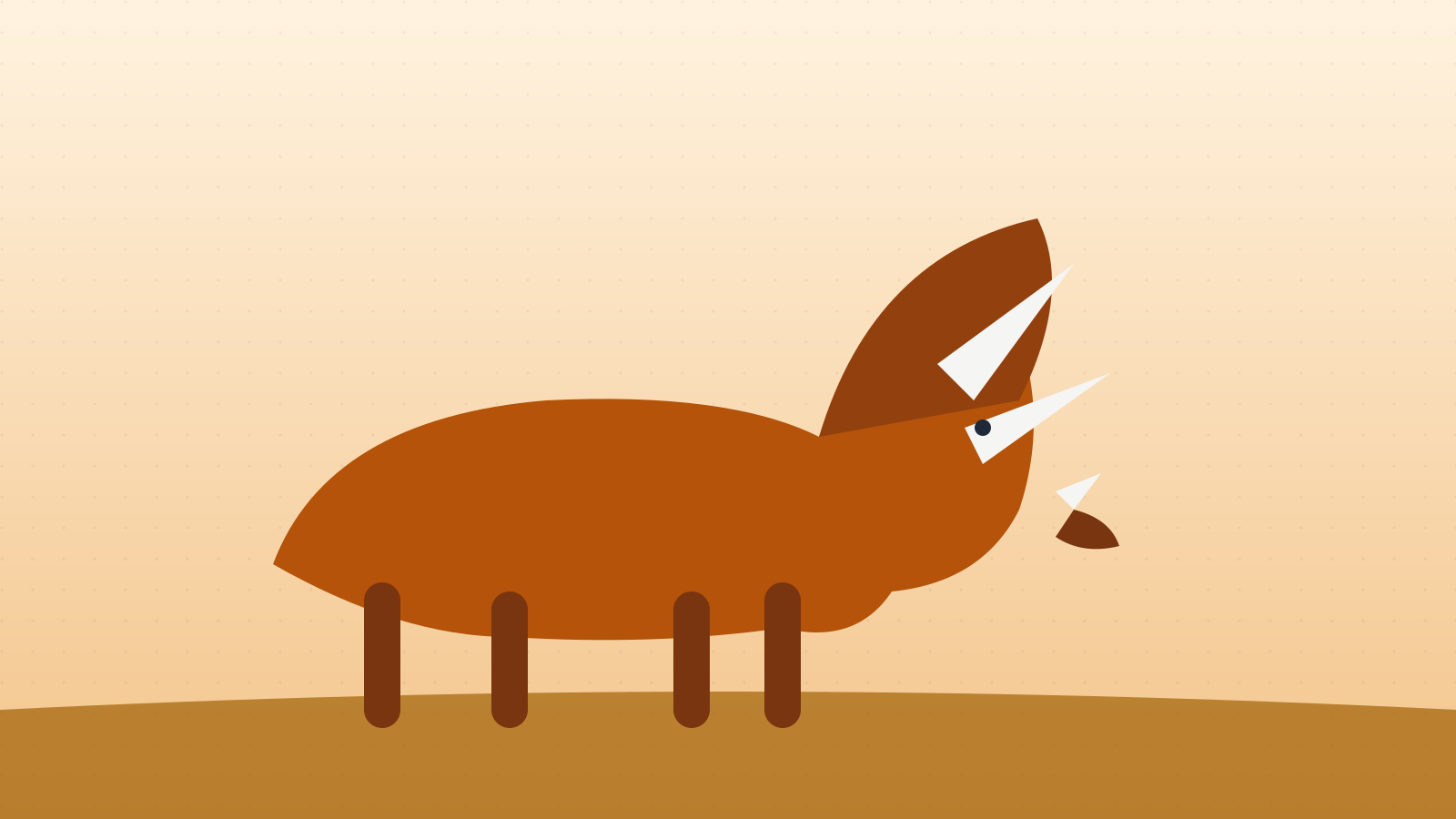
With its two long brow horns, a short nose horn and a huge bony shield behind its head, Triceratops is one of the most recognisable dinosaurs. It appears in films, toys and museum halls around the world, often facing off against its famous neighbour, Tyrannosaurus rex. But what were those horns and that frill actually for? Palaeontologists have been arguing about it for more than a century, and fossils are slowly giving answers.
Meet Triceratops
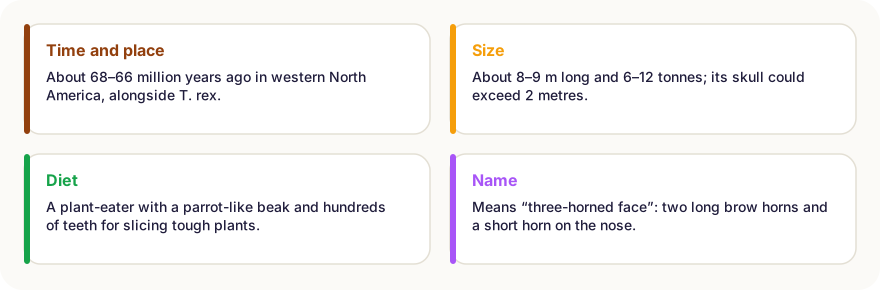
Triceratops means “three-horned face”. It lived about 68 to 66 million years ago in western North America, at the very end of the age of dinosaurs, alongside T. rex. It belonged to the ceratopsians, a group of horned, beaked plant-eaters.
| Feature | Details |
|---|---|
| Length | About 8–9 m |
| Weight | About 6–12 tonnes |
| Skull | Could exceed 2 m, among the largest skulls of any land animal |
| Horns | Two brow horns up to about 1 m, one short nose horn |
| Diet | Plants, cropped with a parrot-like beak and sliced by hundreds of teeth |
| Neighbours | Tyrannosaurus rex, Edmontosaurus, Ankylosaurus |
Triceratops is one of the most common dinosaurs in the Hell Creek Formation of the United States, which means many skulls, from babies to large adults, have been found. That makes it ideal for studying how its horns grew and how they were used.
Idea 1: fighting each other
Many living animals with horns or antlers, such as deer, antelope and wild goats, use them mainly to fight members of their own species, competing for mates or territory. Did Triceratops do the same?
In 2009, Andrew Farke and colleagues compared injuries on the skulls of Triceratops and Centrosaurus, a related horned dinosaur with a large nose horn and short brow horns. They found that Triceratops skulls had significantly more healed wounds on the cheek bones and frill, exactly where the horns of an opponent would strike if two animals locked horns head-on. Centrosaurus, with a different horn shape, did not show the same pattern.
The conclusion: Triceratops very likely used its long brow horns in head-to-head combat, pushing and twisting against rivals. Models and experiments with replica skulls have shown that their horns could interlock in several ways, much like the horns of modern bovids.
Idea 2: showing off
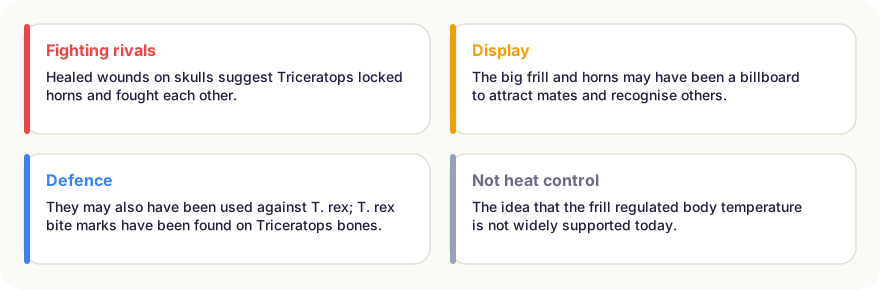
The frill of Triceratops was solid bone, but in many other horned dinosaurs it had large openings and was too thin to make a good shield. That suggests the frill’s main job was not protection but display.
Big, eye-catching structures help animals:
- attract mates, like a peacock’s tail,
- intimidate rivals without needing to fight,
- recognise their own species among many similar horned dinosaurs.
Horned dinosaur species differed mostly in the shape of their horns and frills, while their bodies were quite similar. That is just what we would expect if these features were signals used to tell species apart and to impress others. The frill may even have been brightly coloured, though colour rarely fossilises.
An older idea, that the frill acted like a radiator to regulate body temperature, is not widely supported today.
Idea 3: defence against T. rex
Triceratops and T. rex really did live side by side, and fossils record their encounters. Triceratops bones with T. rex tooth marks have been found, including a hip bone with dozens of bite marks, apparently from feeding. More tellingly, a Triceratops brow horn has been found with a bite that healed, meaning the animal survived the attack.
So horns probably served in defence too. A 6- to 12-tonne animal with metre-long horns would have been a dangerous target, even for the largest predator of its time. Still, fossil evidence shows that combat between Triceratops was a regular part of life, whereas fights with T. rex were probably rarer.
How the horns changed with age
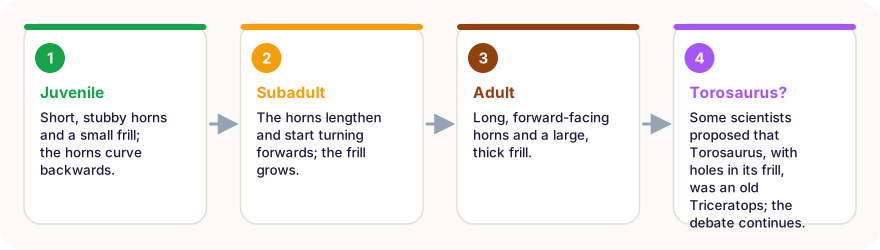
Because so many Triceratops skulls exist, scientists can follow how the head changed from youth to adulthood:
- In juveniles, the brow horns were short and curved backwards.
- In subadults, they grew longer and began to straighten.
- In adults, the horns pointed forwards, and the frill became broad and thick.
This dramatic change suggests that horns mattered most in adult life, for display and combat, rather than in childhood. Young animals probably relied on staying close to the herd or hiding.
The Torosaurus question
Another horned dinosaur from the same rocks, Torosaurus, had an even larger frill with two big holes in it. In 2010, John Scannella and Jack Horner proposed a surprising idea: Torosaurus was not a separate dinosaur, but the fully mature form of Triceratops, whose frill thinned and developed holes in old age.
Other palaeontologists disagree, pointing to differences in bone texture and to Torosaurus specimens that seem young. The debate is not settled, but it shows how much dinosaurs could change as they grew, and how easily one species might be mistaken for two.
In short
- Triceratops means “three-horned face” and lived about 68–66 million years ago with T. rex.
- Healed wounds on skulls show Triceratops fought each other by locking horns.
- Horns and frill were probably also display signals to attract mates and recognise their own kind.
- T. rex bite marks, some healed, suggest the horns also helped in defence.
- Horns curved backwards in juveniles and pointed forwards in adults.
- Whether Torosaurus was an old Triceratops is still debated.
Frequently asked questions
Did Triceratops fight T. rex?
They lived at the same time and place, and Triceratops bones with T. rex tooth marks have been found. Some bites healed, which shows that at least some Triceratops survived attacks, so they likely did defend themselves.
How big was Triceratops?
Adults were about 8 to 9 metres long and weighed roughly 6 to 12 tonnes, about the size of a large elephant or bigger, with a skull that could exceed 2 metres.
What did Triceratops eat?
It was a plant-eater. It used its sharp, parrot-like beak to crop tough plants such as ferns, cycads and palms, and rows of hundreds of teeth to slice them.
Is Torosaurus just an old Triceratops?
In 2010, some scientists proposed that Torosaurus, which has holes in its frill, was the fully mature form of Triceratops. Others disagree, and the question has not been settled.
Sources
- Farke, Wolff & Tanke (2009) – Evidence of combat in Triceratops, PLoS ONE
- Scannella & Horner (2010) – Torosaurus Marsh 1891, is Triceratops Marsh 1889 (Ceratopsidae: Chasmosaurinae): synonymy through ontogeny, Journal of Vertebrate Paleontology
This article is based on peer-reviewed research and publications from trusted institutions, and it is reviewed regularly. How we work →
You might also wonder
All in Dinosaurs →
How Did Dinosaurs Lay Eggs? Nests, Incubation and Surprising Soft Shells
All dinosaurs hatched from eggs. How they built nests, how long eggs took to hatch, which dinosaurs sat on them and why some shells were soft.
Are Birds Dinosaurs? Why Your Pigeon Is a Living Theropod
Birds did not just evolve from dinosaurs – they are dinosaurs. Feathers, wishbones and nesting fossils show how a T. rex relative became today’s birds.
How Are Fossils Formed? From Bone to Stone in Millions of Years
Fossils form when remains are buried fast and minerals slowly replace them. Why fossilisation is so rare, the main types of fossil and how they are dated.
What Killed the Dinosaurs? The Asteroid, the Evidence and the Volcanoes
66 million years ago an asteroid hit Mexico and ended the age of dinosaurs. How scientists found the clues: iridium, shocked quartz and a buried crater.
What Colour Were Dinosaurs? How Scientists Read Colour From Fossils
For a long time dinosaur colours were guesswork. Now microscopic pigment capsules in fossil feathers reveal ginger stripes, black wings and countershading.
What Did Velociraptor Really Look Like? Smaller, Feathered and Nothing Like the Films
The real Velociraptor was turkey-sized and covered in feathers. What fossils reveal about its size, its sickle claw and the famous ‘Fighting Dinosaurs’ fossil.