What Killed the Dinosaurs? The Asteroid, the Evidence and the Volcanoes
66 million years ago an asteroid hit Mexico and ended the age of dinosaurs. How scientists found the clues: iridium, shocked quartz and a buried crater.
Short answer
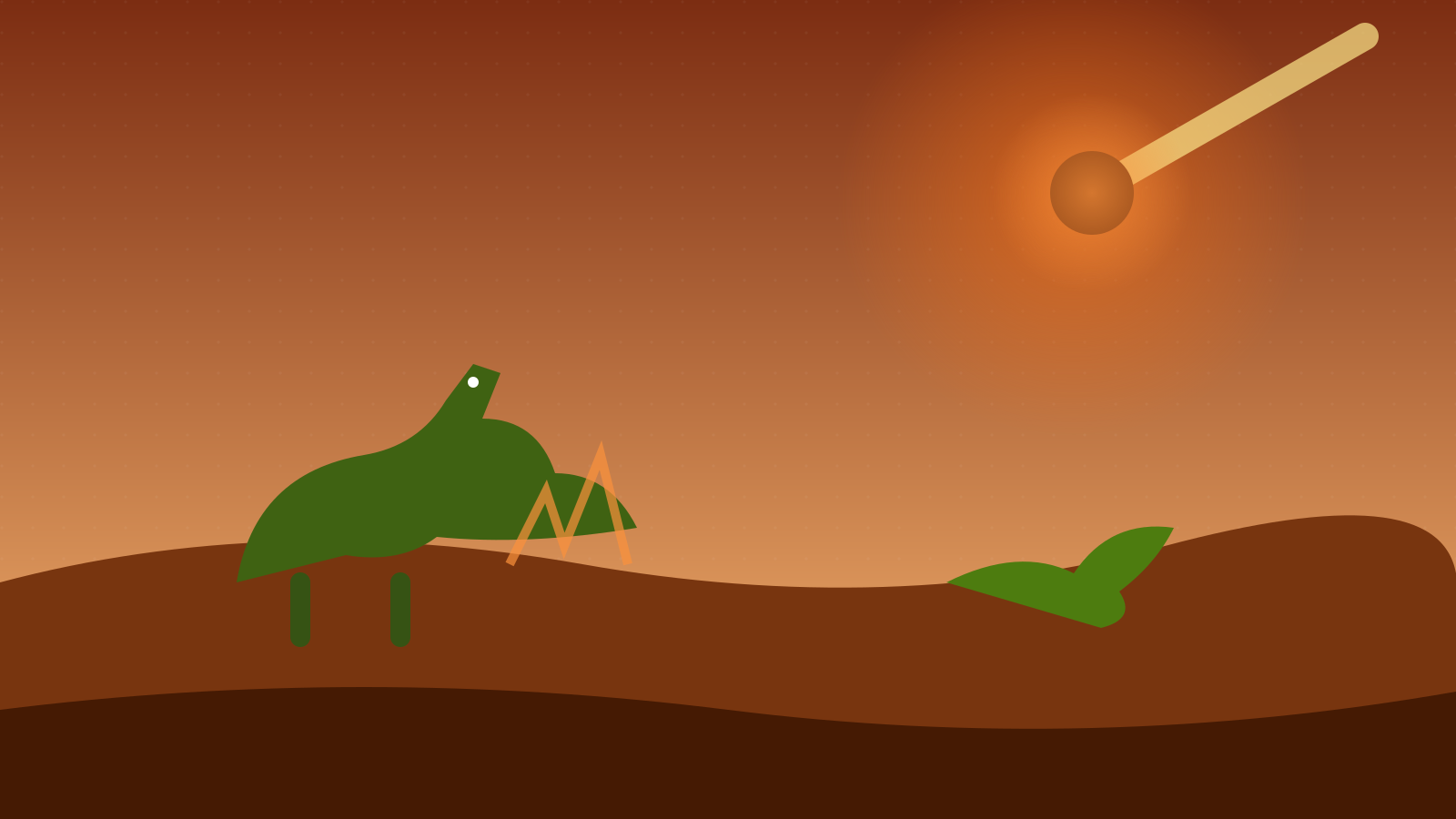
Most scientists agree that the dinosaurs were wiped out about 66 million years ago when an asteroid roughly 10 kilometres wide struck what is now Mexico’s Yucatán Peninsula, creating the Chicxulub crater. The impact triggered fires, tsunamis and, most importantly, a long ‘impact winter’ as dust and sulphur in the atmosphere blocked sunlight and photosynthesis collapsed. Around three-quarters of all species died out, including every dinosaur except the ancestors of birds. Huge volcanic eruptions in India were also changing the climate at the time, but the evidence points to the asteroid as the main cause.
In this article (6)
For more than 160 million years, dinosaurs ruled the land. Then, about 66 million years ago, they vanished from the fossil record almost overnight in geological terms. For a long time this was one of science’s great mysteries. Today we know a lot about what happened, and the story is as dramatic as any film.
A rock from space
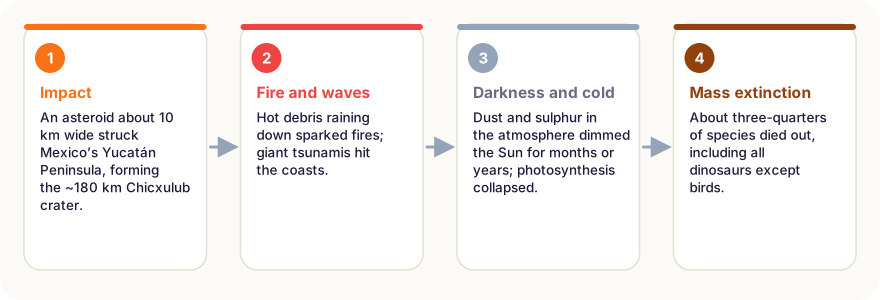
The leading explanation is simple to state: a giant asteroid hit the Earth. It was roughly 10 kilometres across and struck what is now the Yucatán Peninsula in Mexico, at a speed of many kilometres per second. The impact released more energy than billions of atomic bombs and left a crater about 180 kilometres wide, known as Chicxulub.
What happened next
Near the impact, the destruction was immediate. But the global effects were what doomed the dinosaurs.
- Fire: debris thrown into space fell back through the atmosphere, heating the air and sparking fires in many regions.
- Tsunamis: the impact into shallow sea sent giant waves around the Gulf of Mexico and beyond.
- Darkness and cold: the most deadly effect. Dust, soot and sulphur gases spread through the atmosphere and blocked sunlight. Temperatures fell sharply and photosynthesis collapsed for months or longer, an “impact winter”.
Without plants growing, food chains fell apart. Plant-eaters starved, and then the meat-eaters that fed on them. About three-quarters of all species on Earth disappeared, in the sea as well as on land.
How we know: the clues
The asteroid idea was proposed in 1980 by the physicist Luis Alvarez, his geologist son Walter Alvarez and colleagues. They had been studying a thin layer of clay that marks the boundary between the Cretaceous and the following period, found in rocks in Italy, Denmark and New Zealand.
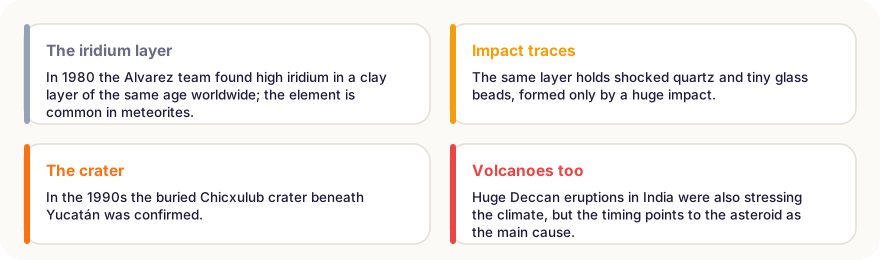
- Iridium. The clay contained far more of the metal iridium than normal. Iridium is rare in Earth’s crust but common in asteroids. A worldwide layer rich in iridium suggested that a huge object from space had spread its dust across the planet.
- Impact traces. The same layer contains shocked quartz, grains of mineral deformed by enormous pressures, and tiny glass beads, called spherules, formed from molten rock thrown into the sky.
- The crater. At first no crater was known. In the early 1990s, scientists confirmed that a buried structure under Yucatán, first spotted by oil-company geophysicists, was an impact crater of the right age.
In 2010, a team of 41 scientists led by Peter Schulte reviewed all the evidence and concluded that the Chicxulub impact triggered the mass extinction.
What about the volcanoes?
At about the same time, massive volcanic eruptions in India, forming the Deccan Traps, were pouring out lava and gases for hundreds of thousands of years. Some scientists argue they played a big role, stressing ecosystems before and after the impact. The debate continues about how much they contributed, but most researchers see the asteroid as the main trigger, with the volcanoes as a possible accomplice.
The survivors
Not everything died. Many small animals survived: mammals, lizards, snakes, crocodiles, turtles, frogs and, crucially, some birds. Survivors tended to be small, able to hide in burrows or water, and able to eat a varied diet such as seeds, insects or dead matter. With the large dinosaurs gone, mammals spread into new niches, eventually leading to us.
In short
- About 66 million years ago an asteroid about 10 km wide hit Mexico’s Yucatán Peninsula.
- It left the Chicxulub crater, about 180 km wide.
- Fires, tsunamis and above all an impact winter caused a mass extinction.
- About three-quarters of species died out, including all non-bird dinosaurs.
- The evidence includes a global iridium layer, shocked quartz and the buried crater.
- Deccan volcanoes may have added stress, but the asteroid was the main cause.
Frequently asked questions
How big was the asteroid that killed the dinosaurs?
It is estimated to have been about 10 kilometres across, roughly the size of a city. It left a crater about 180 kilometres wide, now buried beneath the Yucatán Peninsula and the Gulf of Mexico.
Did all dinosaurs die at once?
The extinction was geologically sudden. The worst effects of the impact winter probably lasted months to years, although ecosystems took far longer to recover.
Why did some animals survive?
Survivors tended to be small, able to shelter in burrows or water, and able to eat a varied diet such as seeds, insects or dead material. Large animals that needed lots of fresh food fared worst.
Could volcanoes have killed the dinosaurs?
The Deccan Traps eruptions in India released huge amounts of gas around the same time and stressed the climate. But a 2010 review by 41 scientists concluded that the timing and the global iridium layer point to the asteroid as the main trigger.
Sources
- Alvarez, L. W. et al. (1980). Extraterrestrial cause for the Cretaceous-Tertiary extinction. Science
- Schulte, P. et al. (2010). The Chicxulub asteroid impact and mass extinction at the Cretaceous-Paleogene boundary. Science
This article is based on peer-reviewed research and publications from trusted institutions, and it is reviewed regularly. How we work →
You might also wonder
All in Dinosaurs →
Are Birds Dinosaurs? Why Your Pigeon Is a Living Theropod
Birds did not just evolve from dinosaurs – they are dinosaurs. Feathers, wishbones and nesting fossils show how a T. rex relative became today’s birds.
How Are Fossils Formed? From Bone to Stone in Millions of Years
Fossils form when remains are buried fast and minerals slowly replace them. Why fossilisation is so rare, the main types of fossil and how they are dated.
Are Pterosaurs Dinosaurs? The Flying Reptiles That Weren’t
Pterosaurs flew over the dinosaurs’ heads, but they were not dinosaurs. How they flew on one-finger wings, and why some were as tall as giraffes.
How Big and Fast Was T. rex? Size, Bite Force and Top Speed
T. rex was about 12 metres long, weighed 8 tonnes or more and had the strongest bite of any land animal. But could it outrun a car? What the science says.
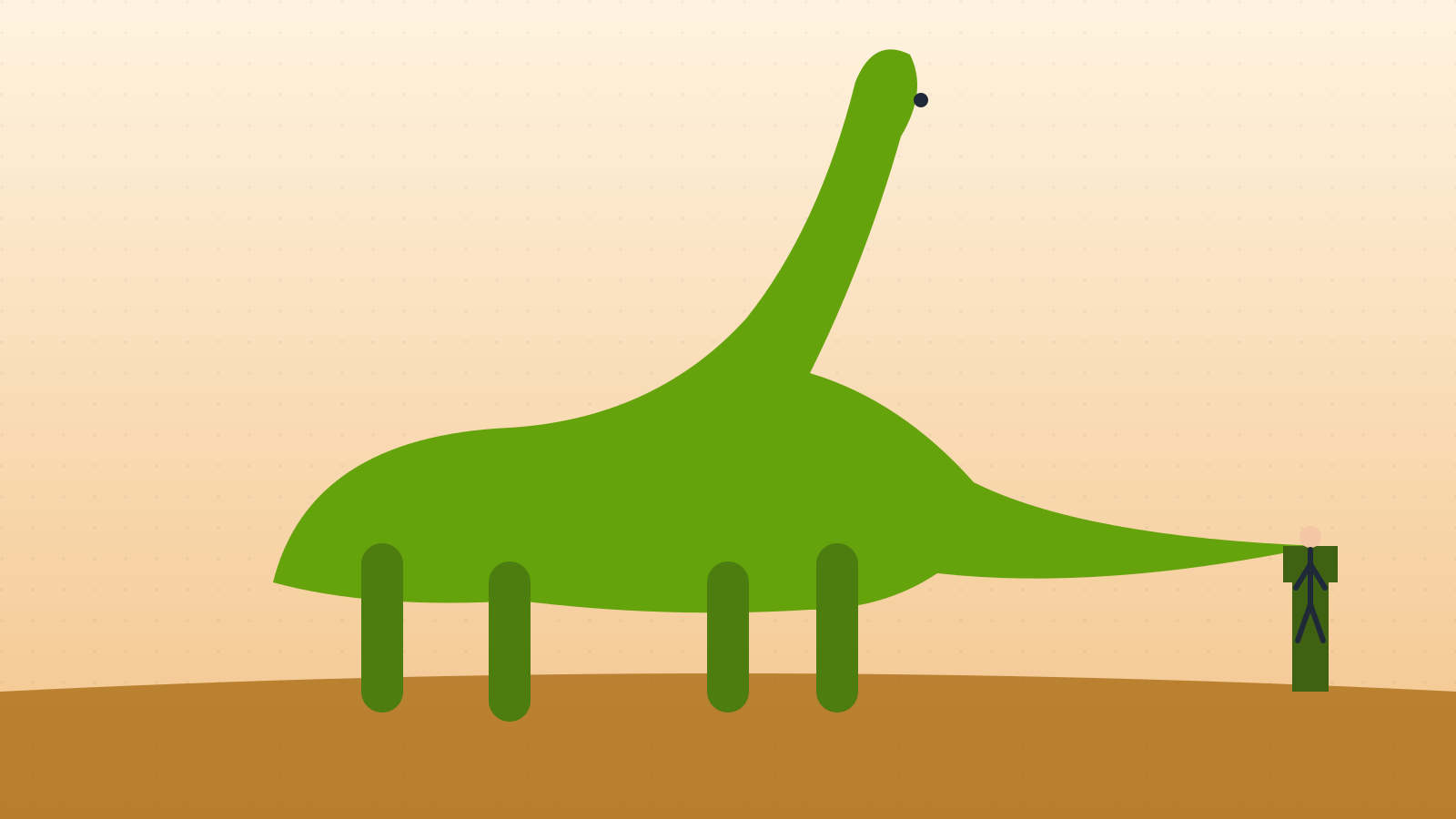
What Was the Biggest Dinosaur? The Titanosaurs That Outweighed Planes
Patagotitan and Argentinosaurus were up to 37 metres long and weighed around 60–70 tonnes. How scientists estimate their size and how sauropods grew so huge.
How Do Bats See in the Dark? Echolocation Explained
Bats are not blind, but many hunt in total darkness by listening to echoes. How echolocation works, how fast bats call, and how moths fight back.