Are Pterosaurs Dinosaurs? The Flying Reptiles That Weren’t
Pterosaurs flew over the dinosaurs’ heads, but they were not dinosaurs. How they flew on one-finger wings, and why some were as tall as giraffes.
Short answer
No. Pterosaurs, the flying reptiles often called pterodactyls, were not dinosaurs, although they were close cousins. Both belong to a larger group called archosaurs, which also includes crocodiles, but pterosaurs formed their own separate branch. They appeared about 225 million years ago and were the first vertebrates to evolve powered flight, long before birds. Their wings were made of skin stretched from a hugely elongated fourth finger to the body and legs, not of feathers. The largest, such as Quetzalcoatlus, had wingspans of about 10 to 11 metres. Pterosaurs died out with the non-bird dinosaurs 66 million years ago.
In this article (6)
In almost every dinosaur film and picture book, flying reptiles soar over the heads of Tyrannosaurus and Triceratops. We often call them dinosaurs too. But scientists don’t. Pterosaurs were a separate group of animals, and their story is just as remarkable.
Cousins, not dinosaurs
To be a dinosaur, an animal has to belong to a particular branch of the reptile family tree, defined by its ancestry and by features such as the shape of the hip and the way the legs are held under the body. Pterosaurs sit on a neighbouring branch.
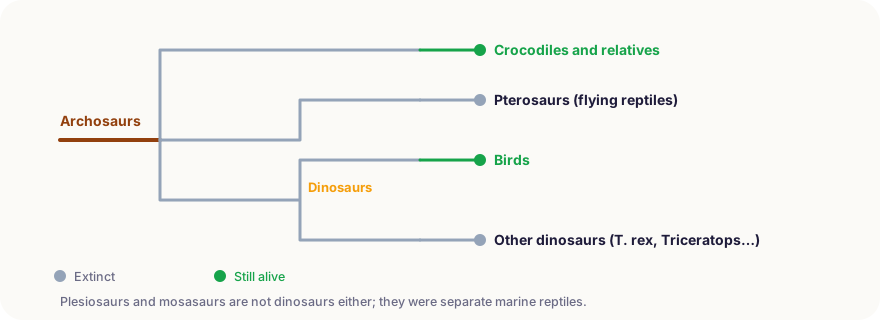
Both belong to the archosaurs, the “ruling reptiles”, which also include crocodiles. Within that group, dinosaurs and pterosaurs are thought to be close relatives, but each forms its own lineage. The same goes for the great sea reptiles of the time: plesiosaurs, ichthyosaurs and mosasaurs were not dinosaurs either.
The first vertebrates to fly
Pterosaurs first appear in the fossil record about 225 million years ago, in the Late Triassic, around the same time as the first dinosaurs. They were the first animals with backbones to evolve powered, flapping flight. Only insects did it earlier. Birds came tens of millions of years later, and bats much later still.
A wing made from one finger
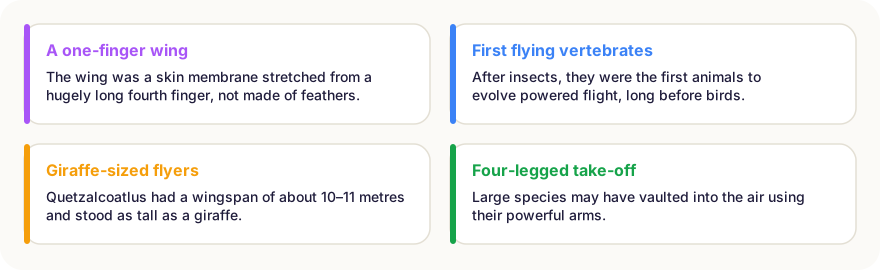
The pterosaur wing was unique. Each wing was a membrane of skin and muscle stretched between the body, the hind leg and a single, enormously long fourth finger. The other three fingers stayed small, with claws for gripping. Inside the membrane were stiffening fibres that helped control its shape.
That is very different from the other flyers:
- Bird wings are made of feathers attached to the arm and a fused hand.
- Bat wings are skin stretched between several long fingers.
Pterosaurs also had extremely light, hollow bones with thin walls, and air sacs similar to those of birds and many dinosaurs.
From sparrows to giraffes
Pterosaurs came in an astonishing range of sizes. Some had wingspans of less than half a metre. At the other extreme, Quetzalcoatlus, which lived in North America at the very end of the Cretaceous, had a wingspan of about 10–11 metres, like a small aircraft. Standing on the ground on all fours, it was as tall as a giraffe.
How could something so big get airborne? In 2010, palaeontologists Mark Witton and Michael Habib argued that giant pterosaurs could still fly well. Rather than running and flapping like a bird, they probably used a quadrupedal launch: crouching on all fours and vaulting into the air with their powerful arms, which carried the wings, before the first downstroke.
Fuzzy, colourful and doomed
Pterosaur fossils show that many were covered in fine filaments called pycnofibres, giving them a fuzzy coat. Many species had striking head crests, probably used for display. They ate fish, insects and small animals, and some may have hunted on the ground like storks.
Like the non-bird dinosaurs, pterosaurs disappeared in the mass extinction 66 million years ago. Today, the only flying descendants of that ancient reptile world are the birds, which are dinosaurs themselves.
In short
- Pterosaurs were flying reptiles, but they were not dinosaurs.
- Both groups are archosaurs, like crocodiles, but on separate branches.
- Pterosaurs were the first vertebrates to evolve powered flight, about 225 million years ago.
- Their wings were skin stretched from one hugely long fourth finger.
- Quetzalcoatlus had a wingspan of about 10–11 metres and was as tall as a giraffe.
- Pterosaurs died out 66 million years ago, along with the non-bird dinosaurs.
Frequently asked questions
Is a pterodactyl a dinosaur?
No. “Pterodactyl” is a popular name for pterosaurs, and Pterodactylus is one particular kind. Pterosaurs were flying reptiles that were related to dinosaurs but are classified separately.
Are swimming reptiles like plesiosaurs dinosaurs?
No. Plesiosaurs, ichthyosaurs and mosasaurs lived in the sea at the time of the dinosaurs, but they were separate groups of reptiles. Dinosaurs were land animals; their only flying branch is the birds.
Are birds descended from pterosaurs?
No. Birds descend from small feathered theropod dinosaurs. Pterosaurs and birds evolved flight independently, with very different wings.
How did huge pterosaurs take off?
Many scientists think big pterosaurs used a four-legged launch, vaulting into the air with their powerful arms, which carried the wings, rather than running and flapping like a bird.
Sources
- Witton, M. P. & Habib, M. B. (2010). On the size and flight diversity of giant pterosaurs, the use of birds as pterosaur analogues and comments on pterosaur flightlessness. PLoS ONE
- Encyclopaedia Britannica – Pterosaur
This article is based on peer-reviewed research and publications from trusted institutions, and it is reviewed regularly. How we work →
You might also wonder
All in Dinosaurs →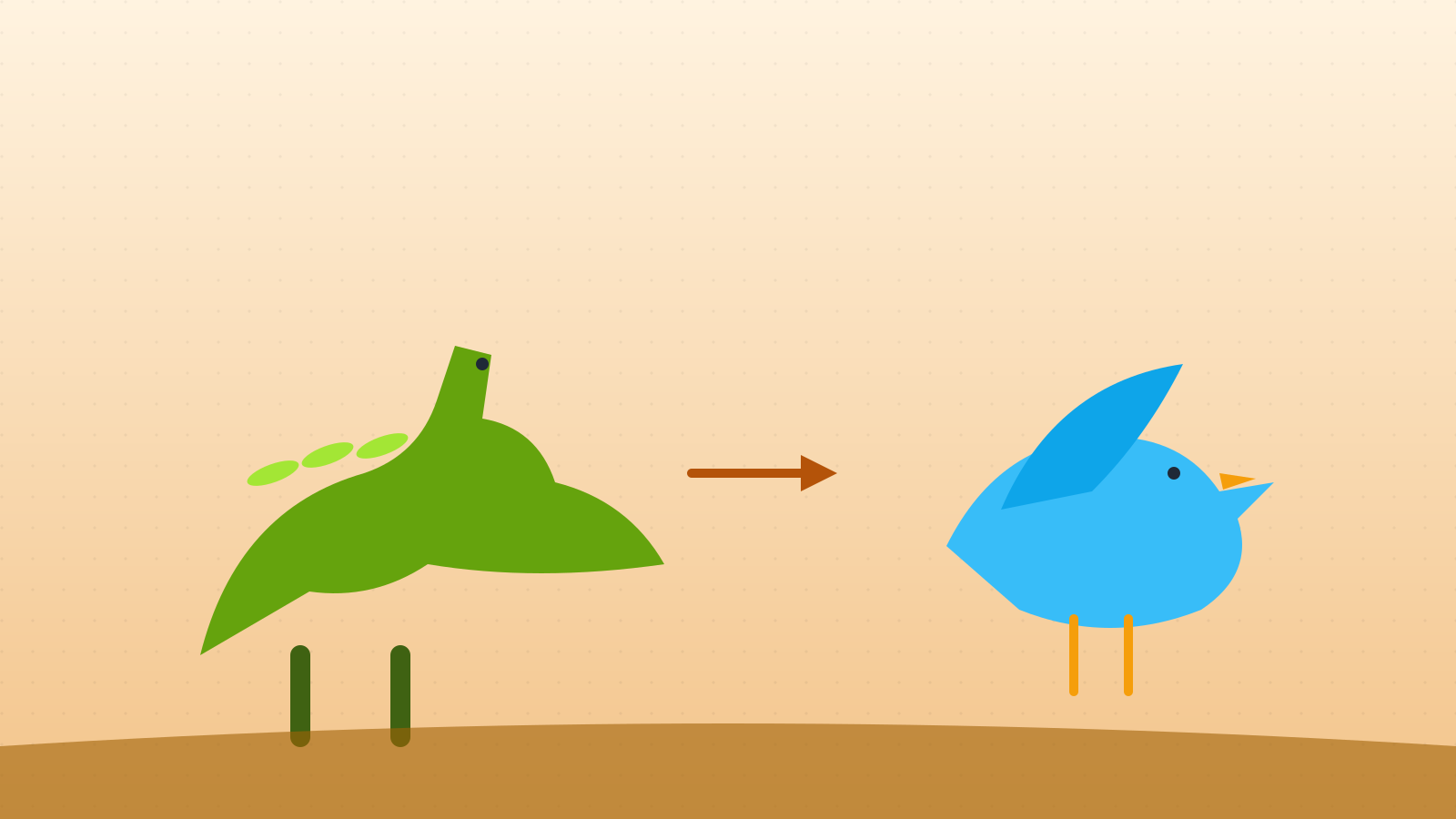
Are Birds Dinosaurs? Why Your Pigeon Is a Living Theropod
Birds did not just evolve from dinosaurs – they are dinosaurs. Feathers, wishbones and nesting fossils show how a T. rex relative became today’s birds.
How Are Fossils Formed? From Bone to Stone in Millions of Years
Fossils form when remains are buried fast and minerals slowly replace them. Why fossilisation is so rare, the main types of fossil and how they are dated.
What Killed the Dinosaurs? The Asteroid, the Evidence and the Volcanoes
66 million years ago an asteroid hit Mexico and ended the age of dinosaurs. How scientists found the clues: iridium, shocked quartz and a buried crater.
How Big and Fast Was T. rex? Size, Bite Force and Top Speed
T. rex was about 12 metres long, weighed 8 tonnes or more and had the strongest bite of any land animal. But could it outrun a car? What the science says.
What Was the Biggest Dinosaur? The Titanosaurs That Outweighed Planes
Patagotitan and Argentinosaurus were up to 37 metres long and weighed around 60–70 tonnes. How scientists estimate their size and how sauropods grew so huge.
How Do Bats See in the Dark? Echolocation Explained
Bats are not blind, but many hunt in total darkness by listening to echoes. How echolocation works, how fast bats call, and how moths fight back.