How Are Fossils Formed? From Bone to Stone in Millions of Years
Fossils form when remains are buried fast and minerals slowly replace them. Why fossilisation is so rare, the main types of fossil and how they are dated.
Short answer
Most fossils form when a plant or animal is buried quickly by mud, sand or volcanic ash after it dies, protecting it from scavengers and decay. The soft parts usually rot away, leaving hard parts such as bones, teeth and shells. Over thousands to millions of years, more layers of sediment pile on top and harden into rock, while minerals carried by groundwater seep into the remains and gradually fill or replace them, turning them to stone. Much later, erosion or digging can bring the fossil back to the surface. Because all these steps have to happen, only a tiny fraction of living things ever become fossils.
In this article (6)
Walk into a natural history museum and you can stand beneath the skeleton of an animal that died tens of millions of years ago. But those bones are no longer really bone. They have turned to stone. How does a living creature end up as a fossil, and why are fossils so precious?
Step by step: from body to fossil
There are several ways to make a fossil, but the most common follows a series of steps. Each one must go right.
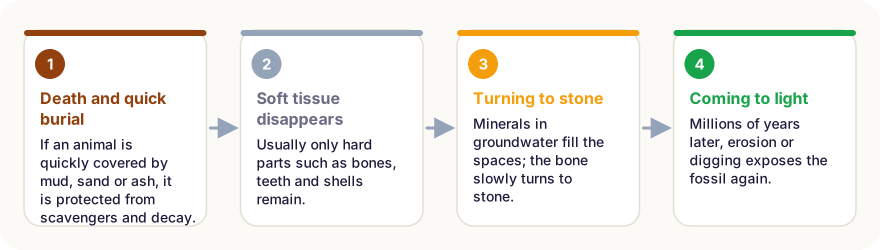
- Death and quick burial. An animal dies, often near water: in a river, lake, sea or swamp. To have any chance, it must be covered quickly by mud, sand or volcanic ash. Burial protects it from scavengers, weather and decay.
- Soft parts disappear. Skin, muscle and organs usually rot away. The hard parts, bones, teeth and shells, last much longer.
- Turning to stone. Over time, more layers of sediment pile on top and harden into rock. Groundwater carrying dissolved minerals such as silica or calcite seeps into the tiny spaces in the bones. The minerals crystallise and slowly fill or replace the original material. This is called permineralisation or petrification.
- Coming to light. Millions of years later, the rock may be lifted by movements of the Earth’s crust and worn away by wind, rain and rivers. A fossil appears at the surface, where, with luck, someone spots it before it erodes away.
Why fossils are rare
Most living things never become fossils. Nearly all dead plants and animals are eaten, decay or are scattered long before they can be buried. Animals that lived on dry land, far from water, had especially poor chances. Even buried remains can later be destroyed by heat, pressure or erosion. And many fossils still lie deep underground where no one will ever see them.
That is why every good fossil skeleton is a rare stroke of luck, and why our picture of ancient life has big gaps.
Not just bones: types of fossils
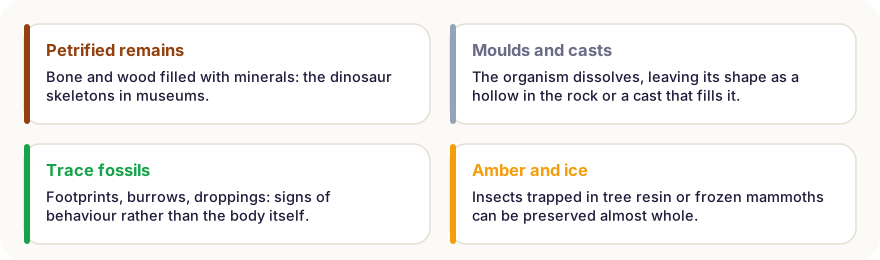
- Petrified remains: bones, teeth, shells and wood filled or replaced by minerals. Most dinosaur skeletons are this type.
- Moulds and casts: sometimes the original organism dissolves completely, leaving a hollow in the rock in its shape, a mould. If that hollow later fills with minerals, it forms a cast, a stone copy of the original.
- Trace fossils: footprints, trackways, burrows, eggs, tooth marks and fossilised dung, called coprolites. They show how animals moved, nested and fed.
- Exceptional preservation: insects trapped in amber, the hardened resin of ancient trees, or woolly mammoths frozen in permafrost can be preserved almost whole, sometimes with soft tissue.
How old is a fossil?
Fossils themselves are usually hard to date directly. Instead, scientists date the rock layers around them. Layers of volcanic ash contain minerals with radioactive elements, such as uranium and potassium, which decay at a known, steady rate. Dating the ash above and below a fossil gives a time window for when it lived.
And dinosaur DNA?
Sadly, there is no Jurassic Park. DNA breaks down over time. The oldest DNA recovered so far, from sediments in Greenland, is about two million years old, while the last non-bird dinosaurs died about 66 million years ago. However, scientists have found traces of original proteins and even pigment structures in some exceptional fossils, which have revealed the colours of a few feathered dinosaurs.
In short
- Most fossils form when remains are buried quickly by mud, sand or ash.
- Soft parts usually rot; hard parts like bones and teeth remain.
- Minerals in groundwater fill and replace the remains, turning them to stone.
- Erosion later brings some fossils back to the surface.
- Fossils are rare: almost all dead organisms decay before burial.
- Fossils are dated using the rock layers around them.
Frequently asked questions
How long does it take for a fossil to form?
There is no fixed time, but scientists generally call remains fossils when they are more than about 10,000 years old. Full mineral replacement of bone usually takes much longer, often millions of years.
Why are fossils so rare?
Most dead plants and animals are eaten, rot or are broken down before they can be buried. Even buried remains can be destroyed later by heat, pressure or erosion. Only a tiny fraction survive and are found.
How do scientists know how old a fossil is?
Usually by dating the rock layers around it. Volcanic ash layers above and below a fossil can be dated using the steady radioactive decay of elements such as uranium and potassium.
Can DNA survive in dinosaur fossils?
No reliable dinosaur DNA has ever been found. DNA breaks down over time, and the oldest DNA recovered so far is around two million years old, far younger than the last dinosaurs.
Sources
- Natural History Museum, London – How are fossils formed?
- Kjær, K. H. et al. (2022). A 2-million-year-old ecosystem in Greenland uncovered by environmental DNA. Nature
This article is based on peer-reviewed research and publications from trusted institutions, and it is reviewed regularly. How we work →
You might also wonder
All in Dinosaurs →
Are Birds Dinosaurs? Why Your Pigeon Is a Living Theropod
Birds did not just evolve from dinosaurs – they are dinosaurs. Feathers, wishbones and nesting fossils show how a T. rex relative became today’s birds.
What Killed the Dinosaurs? The Asteroid, the Evidence and the Volcanoes
66 million years ago an asteroid hit Mexico and ended the age of dinosaurs. How scientists found the clues: iridium, shocked quartz and a buried crater.
Are Pterosaurs Dinosaurs? The Flying Reptiles That Weren’t
Pterosaurs flew over the dinosaurs’ heads, but they were not dinosaurs. How they flew on one-finger wings, and why some were as tall as giraffes.
How Big and Fast Was T. rex? Size, Bite Force and Top Speed
T. rex was about 12 metres long, weighed 8 tonnes or more and had the strongest bite of any land animal. But could it outrun a car? What the science says.
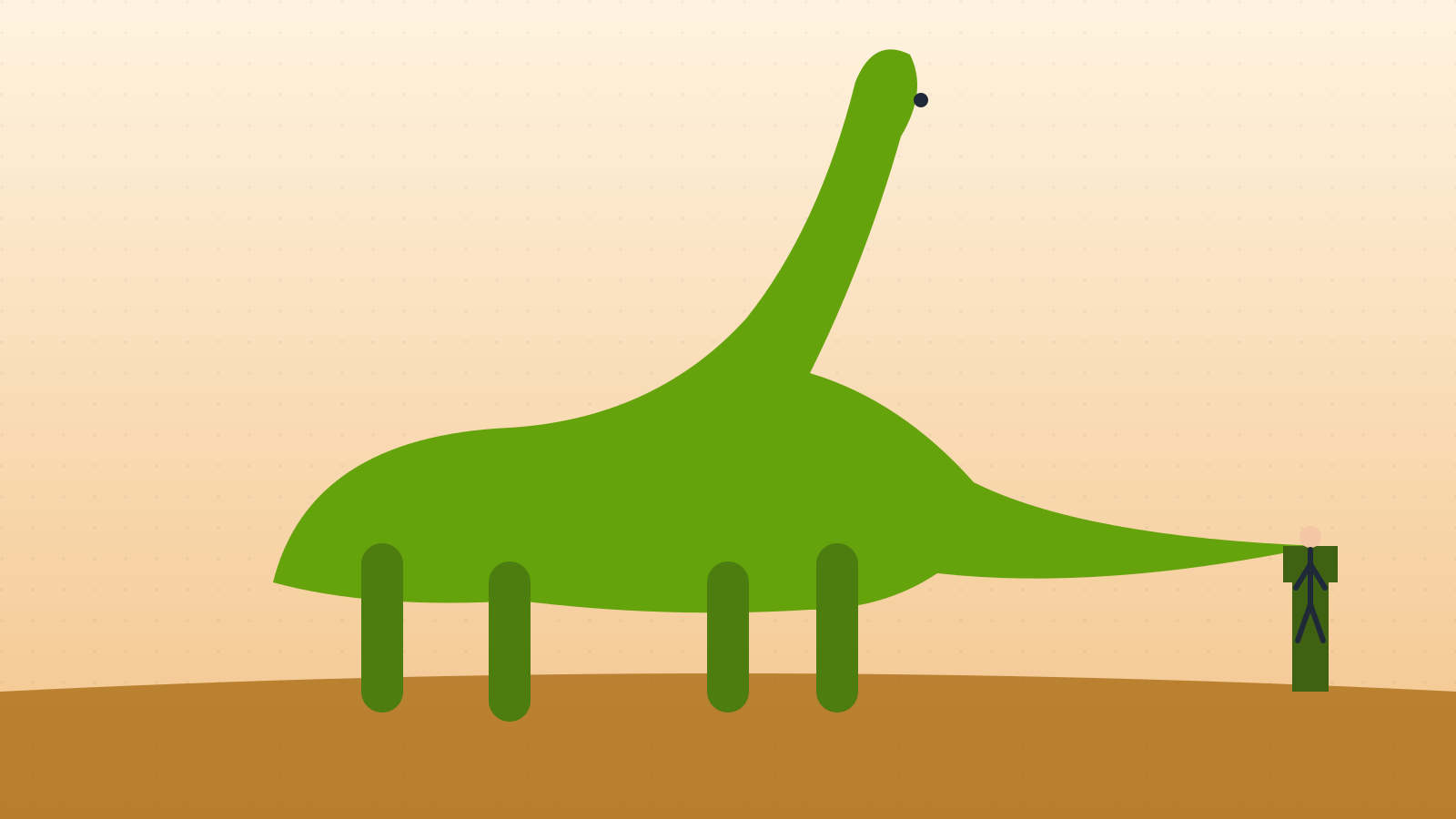
What Was the Biggest Dinosaur? The Titanosaurs That Outweighed Planes
Patagotitan and Argentinosaurus were up to 37 metres long and weighed around 60–70 tonnes. How scientists estimate their size and how sauropods grew so huge.
How Do Bats See in the Dark? Echolocation Explained
Bats are not blind, but many hunt in total darkness by listening to echoes. How echolocation works, how fast bats call, and how moths fight back.