What Was the Biggest Dinosaur? The Titanosaurs That Outweighed Planes
Patagotitan and Argentinosaurus were up to 37 metres long and weighed around 60–70 tonnes. How scientists estimate their size and how sauropods grew so huge.
Short answer
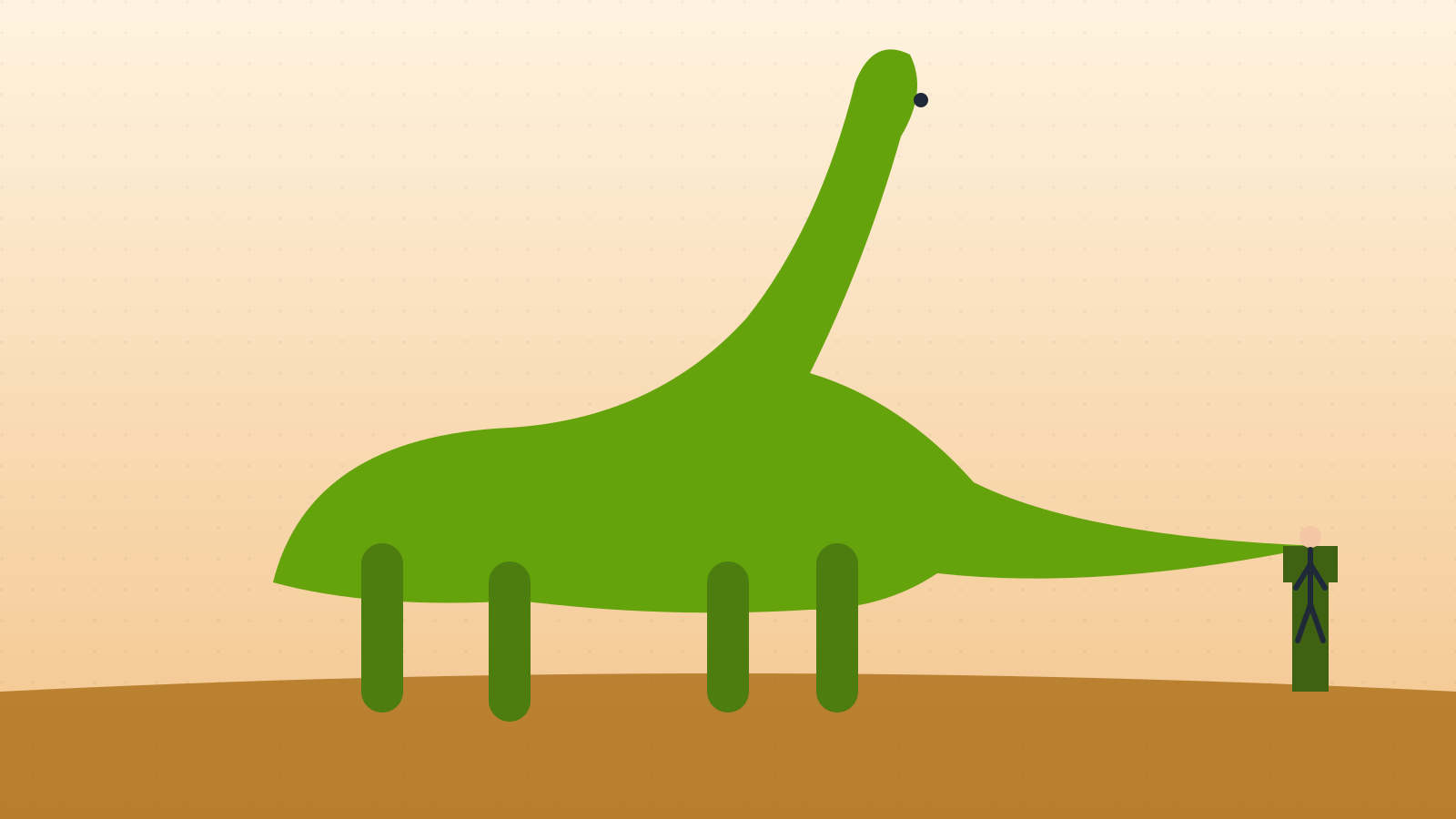
The biggest dinosaurs were giant long-necked plant-eaters called titanosaurs, which lived in South America around 100 million years ago. Patagotitan mayorum, described in 2017, was about 37 metres long and is estimated to have weighed around 60–70 tonnes; Argentinosaurus may have been similar or slightly larger. Because only parts of their skeletons have been found, scientists estimate their size by comparing bones such as the thigh bone and upper arm with more complete relatives. Sauropods could grow so large thanks to air-filled bones, long necks for feeding without moving, swallowing food unchewed and fast growth from small eggs.
In this article (5)
Imagine an animal so long that it would cover more than a third of a football pitch. So heavy that it weighed as much as ten African elephants. These giants were real, and they walked across what is now Argentina about 100 million years ago.
The titanosaurs
The biggest dinosaurs belonged to a group of sauropods, the long-necked, long-tailed plant-eaters that walked on four pillar-like legs. Among sauropods, the largest of all were the titanosaurs, most of which lived in the Southern Hemisphere during the Cretaceous period.
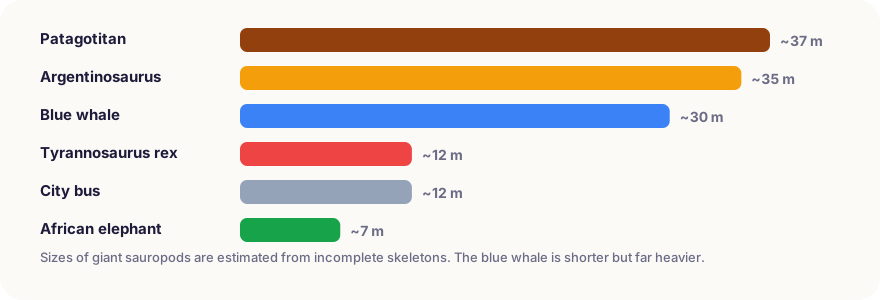
Patagotitan mayorum was found on a farm in Patagonia in 2012. The bones of at least six individuals were excavated, and in 2017 a team led by José Carballido formally described it. They estimated it was about 37 metres long and, using the thickness of its thigh bone and upper arm bone, weighed around 69 tonnes, with other methods giving somewhat lower values.
Argentinosaurus, described in 1993, is known from far fewer bones: some vertebrae, ribs and part of a leg. Its vertebrae alone are taller than a person. Estimates for its size are similar, around 35 metres and 60–80 tonnes, and it may have been as big as or bigger than Patagotitan.
Why the numbers are uncertain
No complete skeleton of a giant titanosaur has ever been found. Scientists estimate their size by comparing the bones they have with more complete relatives and by measuring the circumference of the thigh and upper arm bones. In living four-legged animals, the thickness of these bones is closely linked to body weight, because they carry the load. Different methods can give results that differ by tens of tonnes, so claims about the “biggest dinosaur ever” change as new fossils and techniques appear.
How did they get so big?
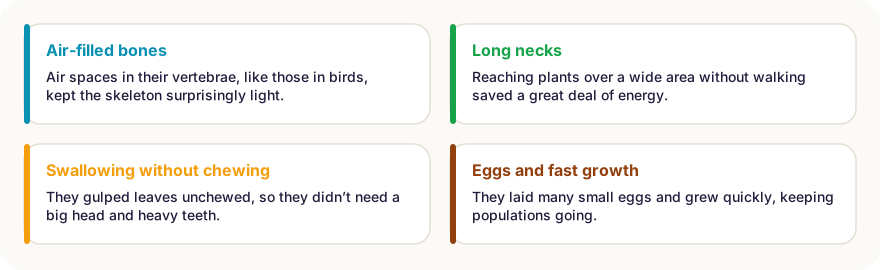
A major 2011 review led by palaeontologist Martin Sander looked at why sauropods, and only sauropods, reached such sizes on land. Several features worked together:
- Air-filled bones. Like birds, sauropods had air sacs connected to their lungs, which extended into their vertebrae. That made the skeleton much lighter and their breathing very efficient.
- A long neck. Standing still and sweeping its head over a wide area, a sauropod could reach huge amounts of food while spending little energy walking.
- No chewing. Sauropods stripped leaves and swallowed them whole, leaving digestion to their enormous guts. A small head without heavy chewing teeth made a long neck possible.
- Eggs and fast growth. Sauropods laid many small eggs and grew extremely fast. Unlike large mammals, they did not need years of pregnancy and parental care, so populations could recover quickly.
Bigger than a whale?
Titanosaurs were longer than any animal alive today, but probably not heavier than the biggest of all. The blue whale can reach about 30 metres and is thought to weigh well over 150 tonnes. Water supports its body, which allows a much greater mass than would be possible on land. The blue whale may be the heaviest animal that has ever lived.
In short
- The biggest dinosaurs were titanosaurs, long-necked plant-eaters from South America.
- Patagotitan was about 37 metres long and roughly 60–70 tonnes.
- Argentinosaurus may have been similar in size, but is known from fewer bones.
- Size estimates rely on bone measurements and comparison with relatives, so they are uncertain.
- Air-filled bones, long necks, swallowing without chewing and fast growth made giants possible.
- The blue whale is shorter but probably much heavier than any dinosaur.
Frequently asked questions
What was the biggest meat-eating dinosaur?
Spinosaurus may have been the longest meat-eater, at around 14–15 metres, while Tyrannosaurus rex and Giganotosaurus were among the heaviest, at roughly 8 tonnes or more. Estimates vary between studies.
How do scientists weigh a dinosaur?
One common method uses the thickness of the thigh bone and upper arm bone, which in living animals is closely linked to body mass. Another builds a 3D model of the skeleton and adds flesh around it.
Why don’t land animals that big exist today?
No single answer is agreed. Mammals have to care for large babies for a long time and cannot use the bird-like air sacs that lightened sauropods. Today’s climate and plant life may also limit very large land animals.
Could a sauropod hold its neck upright?
Scientists still debate how high sauropods held their necks. Many think the neck was held forward and moved in a wide arc, letting the animal feed over a large area without walking.
Sources
- Carballido, J. L. et al. (2017). A new giant titanosaur sheds light on body mass evolution among sauropod dinosaurs. Proceedings of the Royal Society B
- Sander, P. M. et al. (2011). Biology of the sauropod dinosaurs: the evolution of gigantism. Biological Reviews
This article is based on peer-reviewed research and publications from trusted institutions, and it is reviewed regularly. How we work →
You might also wonder
All in Dinosaurs →
Are Birds Dinosaurs? Why Your Pigeon Is a Living Theropod
Birds did not just evolve from dinosaurs – they are dinosaurs. Feathers, wishbones and nesting fossils show how a T. rex relative became today’s birds.
How Are Fossils Formed? From Bone to Stone in Millions of Years
Fossils form when remains are buried fast and minerals slowly replace them. Why fossilisation is so rare, the main types of fossil and how they are dated.
What Killed the Dinosaurs? The Asteroid, the Evidence and the Volcanoes
66 million years ago an asteroid hit Mexico and ended the age of dinosaurs. How scientists found the clues: iridium, shocked quartz and a buried crater.
What Colour Were Dinosaurs? How Scientists Read Colour From Fossils
For a long time dinosaur colours were guesswork. Now microscopic pigment capsules in fossil feathers reveal ginger stripes, black wings and countershading.
What Did Velociraptor Really Look Like? Smaller, Feathered and Nothing Like the Films
The real Velociraptor was turkey-sized and covered in feathers. What fossils reveal about its size, its sickle claw and the famous ‘Fighting Dinosaurs’ fossil.
When Did Dinosaurs Live? Triassic, Jurassic and Cretaceous Explained
Dinosaurs appeared about 230 million years ago and ruled for over 160 million years. A simple guide to the Triassic, Jurassic and Cretaceous.