What Did Velociraptor Really Look Like? Smaller, Feathered and Nothing Like the Films
The real Velociraptor was turkey-sized and covered in feathers. What fossils reveal about its size, its sickle claw and the famous ‘Fighting Dinosaurs’ fossil.
Short answer
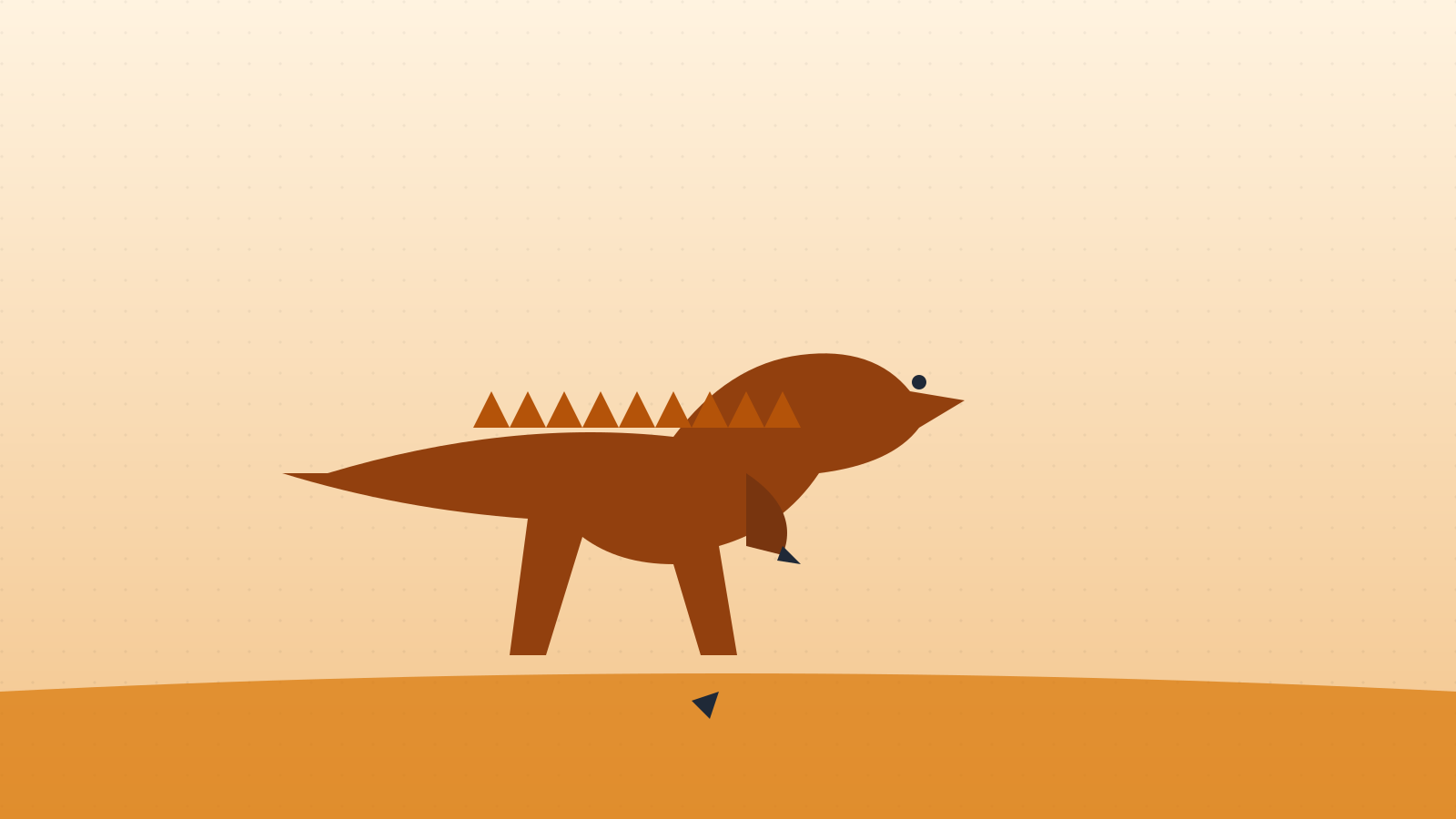
The real Velociraptor was much smaller than the film version: about 2 metres long including its long tail, roughly half a metre tall at the hip and around 15 kilograms, about the size of a large turkey. It lived about 75 to 71 million years ago in the dry, sandy landscapes of what is now Mongolia and China. Fossils show that it was covered in feathers: in 2007, scientists found quill knobs, bumps where large feathers anchored, on a Velociraptor forearm bone. It had a large curved claw on each foot, probably used to pin down prey. The raptors in Jurassic Park were based more on its larger relative Deinonychus.
In this article (5)
Thanks to Jurassic Park, Velociraptor became one of the most famous dinosaurs in the world: a scaly, human-sized, super-intelligent pack hunter that could open doors. The real animal, revealed by its fossils, was rather different, and in many ways even more interesting.
Film versus fossil
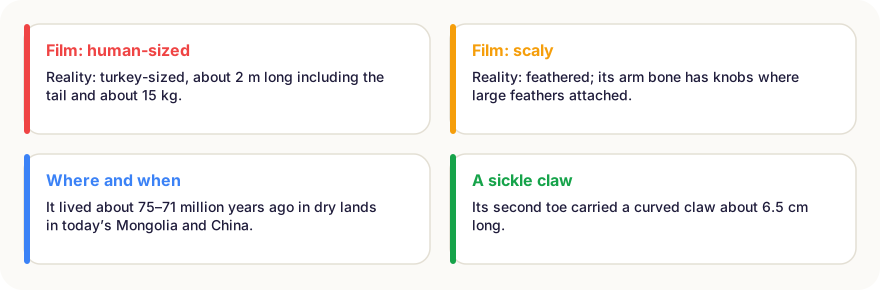
Velociraptor mongoliensis was named in 1924 from fossils found in the Gobi Desert. Its name means “swift seizer”. Since then, many more skeletons have been found, giving a clear picture of the animal:
- Size: about 2 metres long, most of it tail, about half a metre tall at the hip, and roughly 15 kilograms: about the size of a large turkey or a coyote.
- Time and place: it lived about 75 to 71 million years ago, in the Late Cretaceous, in the dry, sandy landscapes of what is now Mongolia and northern China.
- Head: a long, low skull with a slightly upturned snout and around 26 to 28 sharp, serrated teeth on each side of the upper jaw.
The raptors in the film were much bigger, closer to the size of Deinonychus, a relative from North America that grew to about 3 metres long. Michael Crichton, author of the novel, borrowed the more famous name.
Covered in feathers
The biggest difference between film and reality is the feathers. Many close relatives of Velociraptor have been found in China with fossilised feathers preserved around their bodies. But was Velociraptor itself feathered?
In 2007, palaeontologists Alan Turner, Peter Makovicky and Mark Norell examined a Velociraptor forearm bone, the ulna, and found a row of small bumps called quill knobs. In living birds, these are the points where the large wing feathers are anchored to the bone by ligaments. Their presence showed that Velociraptor had large feathers on its arms, forming wing-like structures.
Velociraptor could not fly; its arms were too short and its body too heavy. Its feathers may have been used for display, keeping warm, brooding eggs and helping with balance while running or pinning prey. Its ancestors may once have been able to glide or fly.
The sickle claw
Each foot had a large, curved claw on the second toe, about 6.5 centimetres long along its curve, held off the ground while walking. For a long time it was imagined as a slashing weapon for disembowelling large prey. Studies of similar claws now suggest it worked more like the talons of modern birds of prey, used to grip and pin down smaller animals while the raptor tore at them with its jaws.
The Fighting Dinosaurs
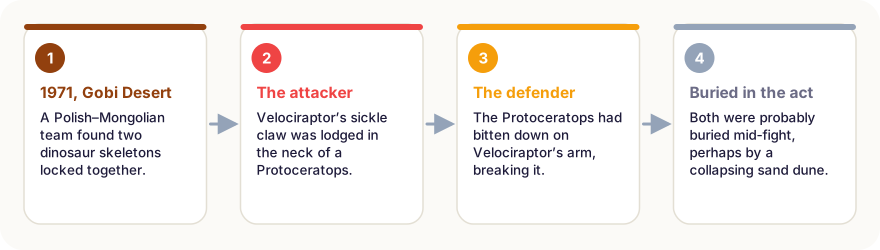
In 1971, a Polish–Mongolian expedition in the Gobi Desert found one of the most famous fossils in the world. A Velociraptor and a Protoceratops, a sheep-sized plant-eater, are locked together. The raptor’s sickle claw is lodged in the Protoceratops’s neck, while the Protoceratops has clamped its beak on the raptor’s right arm. Both were probably buried alive, mid-fight, perhaps when a sand dune collapsed or a sandstorm struck. It is one of the clearest pieces of evidence that Velociraptor actively hunted.
In short
- The real Velociraptor was about 2 m long and 15 kg, roughly turkey-sized.
- It lived 75–71 million years ago in today’s Mongolia and China.
- Quill knobs on its arm bone show it had large feathers.
- It could not fly; feathers were probably for display, warmth and balance.
- Its sickle claw likely pinned prey, like a bird of prey’s talon.
- The 1971 “Fighting Dinosaurs” fossil shows it locked in combat with a Protoceratops.
Frequently asked questions
Could Velociraptor fly?
No. Although it had feathers and wings on its arms, its arms were too short and its body too heavy for flight. It probably descended from ancestors that could glide or fly, or used its feathers for display, warmth and balance.
Were Velociraptors smart?
For a dinosaur, Velociraptor had a relatively large brain for its body size, as did other small theropods. But claims that they could open doors, as in the films, are pure fiction.
Did Velociraptors hunt in packs?
There is no direct evidence. Some trackways and fossils of related dinosaurs suggest they may have gathered in groups, but pack hunting like wolves has not been shown.
What does the name Velociraptor mean?
It means “swift seizer” or “swift thief” in Latin. The species Velociraptor mongoliensis was named in 1924 from fossils found in the Gobi Desert of Mongolia.
Sources
- Turner, A. H., Makovicky, P. J. & Norell, M. A. (2007). Feather quill knobs in the dinosaur Velociraptor. Science
- Encyclopaedia Britannica – Velociraptor
This article is based on peer-reviewed research and publications from trusted institutions, and it is reviewed regularly. How we work →
You might also wonder
All in Dinosaurs →
Are Birds Dinosaurs? Why Your Pigeon Is a Living Theropod
Birds did not just evolve from dinosaurs – they are dinosaurs. Feathers, wishbones and nesting fossils show how a T. rex relative became today’s birds.
How Are Fossils Formed? From Bone to Stone in Millions of Years
Fossils form when remains are buried fast and minerals slowly replace them. Why fossilisation is so rare, the main types of fossil and how they are dated.
What Killed the Dinosaurs? The Asteroid, the Evidence and the Volcanoes
66 million years ago an asteroid hit Mexico and ended the age of dinosaurs. How scientists found the clues: iridium, shocked quartz and a buried crater.
What Colour Were Dinosaurs? How Scientists Read Colour From Fossils
For a long time dinosaur colours were guesswork. Now microscopic pigment capsules in fossil feathers reveal ginger stripes, black wings and countershading.
When Did Dinosaurs Live? Triassic, Jurassic and Cretaceous Explained
Dinosaurs appeared about 230 million years ago and ruled for over 160 million years. A simple guide to the Triassic, Jurassic and Cretaceous.
Are Pterosaurs Dinosaurs? The Flying Reptiles That Weren’t
Pterosaurs flew over the dinosaurs’ heads, but they were not dinosaurs. How they flew on one-finger wings, and why some were as tall as giraffes.