What Colour Were Dinosaurs? How Scientists Read Colour From Fossils
For a long time dinosaur colours were guesswork. Now microscopic pigment capsules in fossil feathers reveal ginger stripes, black wings and countershading.
Short answer
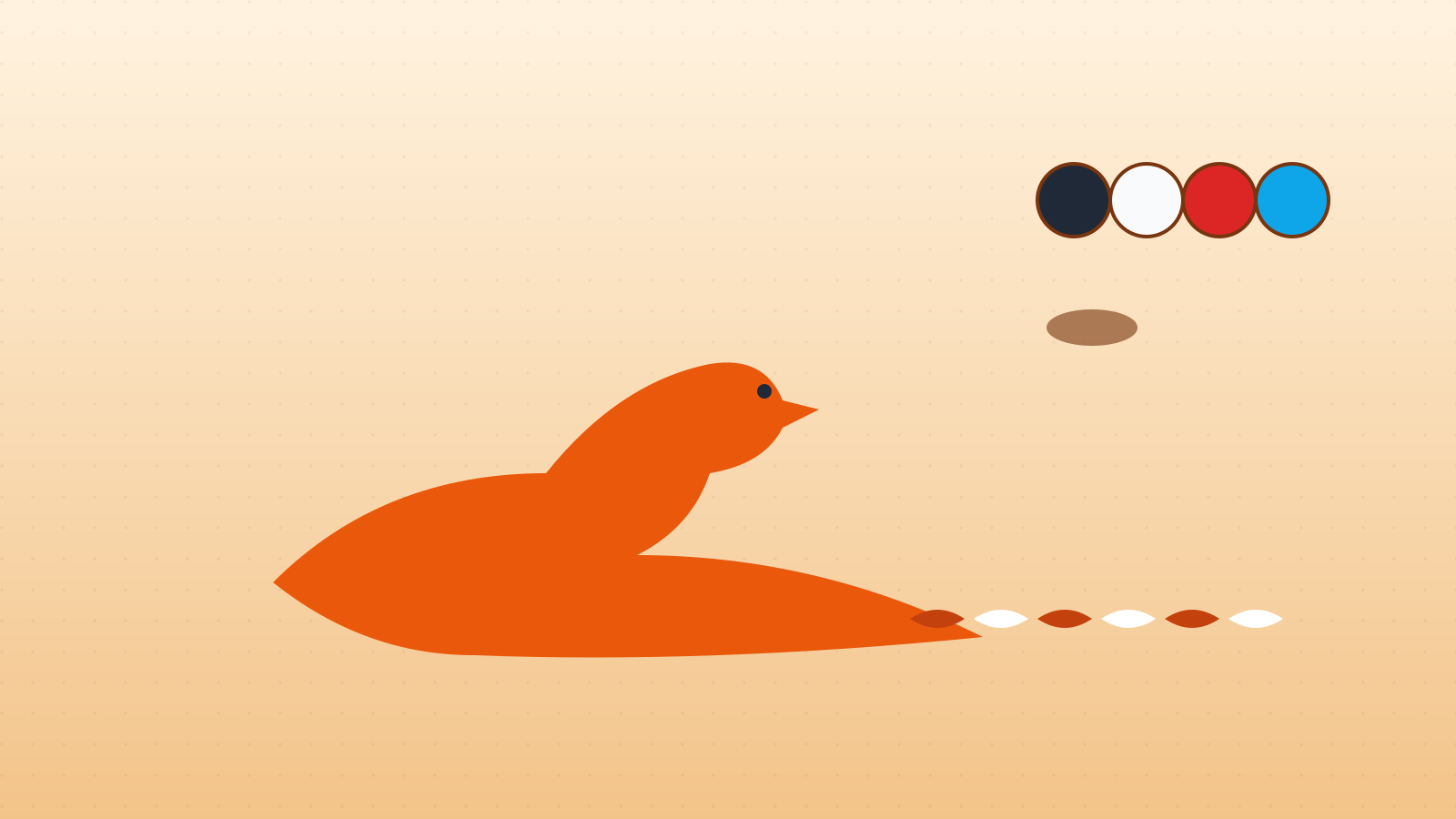
For some dinosaurs, scientists now know their colours. Since 2010, researchers have studied exceptionally preserved feathered fossils with electron microscopes and found melanosomes, tiny capsules that contain the pigment melanin. Their shape reveals the colour: long, sausage-shaped melanosomes hold black and grey eumelanin, while small, round ones hold reddish-brown phaeomelanin. By comparing these shapes with living birds, scientists showed that Sinosauropteryx had a ginger-and-white striped tail, Anchiornis had black-and-white wings and a reddish crest, and Microraptor had glossy, iridescent black feathers. Other pigments, such as the bright reds and yellows of carotenoids, usually do not survive.
In this article (5)
Every dinosaur picture you have ever seen involved a guess. Bones tell us an animal’s shape and size, but not its colour. For over 150 years, artists painted dinosaurs green, grey or brown, mostly by comparison with crocodiles and lizards. Then, in 2010, scientists found a way to read the colours of some dinosaurs directly from their fossils.
Pigment capsules in fossil feathers
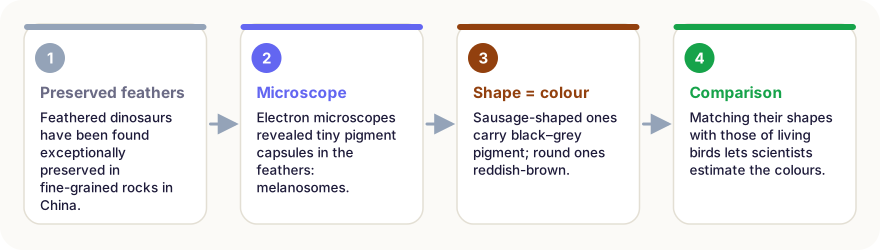
The key is melanin, the pigment that colours human hair and skin and many bird feathers. In animals, melanin is packed into tiny capsules called melanosomes, less than a thousandth of a millimetre long. Melanosomes come in different shapes:
- Long, sausage-shaped melanosomes contain eumelanin, which produces black and grey colours.
- Small, round melanosomes contain phaeomelanin, which produces reddish-brown, ginger and rusty colours.
- Feathers with no melanosomes are usually white.
- Some arrangements, like flattened melanosomes in neat layers, produce iridescent sheens.
In the fine-grained rocks of northeastern China, many small feathered dinosaurs have been found with their feathers preserved as dark films. Under an electron microscope, scientists discovered that these films are packed with fossil melanosomes. By measuring their shapes and comparing them with those of living birds, they could estimate the original colours.
Dinosaurs in colour
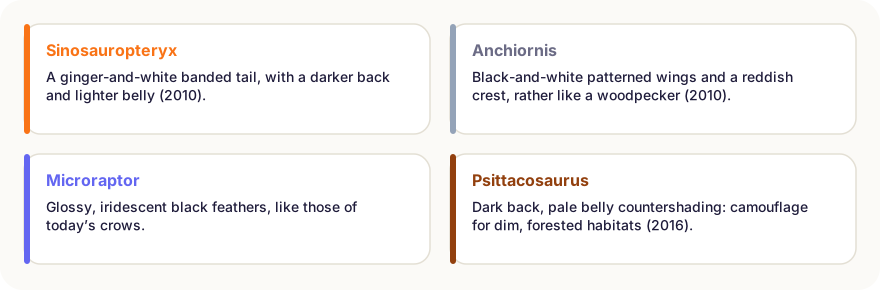
- Sinosauropteryx: in 2010, a team led by Fucheng Zhang found that this small predator had a striped tail of alternating ginger-brown and white bands, a darker back and a lighter belly.
- Anchiornis: the same year, a team led by Quanguo Li reconstructed the whole plumage of this crow-sized dinosaur: mainly grey and black, with white wing feathers tipped in black and a reddish crest, looking rather like a modern woodpecker.
- Microraptor: in 2012, the four-winged Microraptor was shown to have glossy, iridescent black feathers, like a crow or starling.
- Psittacosaurus: in 2016, Jakob Vinther and colleagues studied the preserved skin of this small horned dinosaur and found countershading: a dark back and pale belly. That pattern helps animals hide by cancelling out shadows, and the details suggested it lived in a forest with diffuse light.
What we still don’t know
Colour reconstructions have limits. Melanin is durable, so blacks, greys and reddish-browns can be detected. But many bright colours in modern birds, like the reds of cardinals or the yellows of canaries, come from carotenoid pigments obtained from food, which rarely survive fossilisation. Some colours also come from microscopic structures that may be distorted over millions of years. So reconstructions show only part of the picture.
And most dinosaurs, including T. rex, have never been found with the right kind of preserved skin or feathers. Their colours remain unknown.
Why colour matters
Colour tells us about behaviour and habitat. Striped tails and bold crests suggest display, perhaps to attract mates or recognise rivals. Camouflage patterns like countershading reveal where animals lived and that they had predators to hide from. And the fact that these patterns look so bird-like is another reminder that birds are living dinosaurs.
In short
- Dinosaur colours were long guesswork; bones don’t preserve colour.
- Fossil feathers and skin can contain melanosomes, tiny pigment capsules.
- Sausage-shaped melanosomes mean black or grey; round ones mean reddish-brown.
- Sinosauropteryx had a ginger-and-white striped tail; Anchiornis had black-and-white wings.
- Microraptor was iridescent black; Psittacosaurus was countershaded for camouflage.
- Bright carotenoid colours rarely survive, and T. rex’s colour is still unknown.
Frequently asked questions
Were dinosaurs green like in old films?
There is no evidence that most dinosaurs were green or grey. The few whose colours have been reconstructed show browns, gingers, black, white and patterns such as stripes and countershading.
Can we know the colour of T. rex?
Not yet. Colour reconstructions so far rely on preserved melanosomes in feathers or skin, and no T. rex fossil with suitable preserved skin pigment has been studied. Its colour remains unknown.
Why can’t fossils show bright colours?
Many bright colours in modern birds come from carotenoid pigments obtained from food, or from structures in feathers that rarely fossilise well. Melanin is much more durable, so it is mainly black, grey and reddish-brown colours that can be read.
Could dinosaurs see colour?
Probably yes. Birds and crocodiles, their closest living relatives, both have good colour vision, and many birds see ultraviolet light too. Colourful patterns may have been used for display.
Sources
- Zhang, F. et al. (2010). Fossilized melanosomes and the colour of Cretaceous dinosaurs and birds. Nature
- Li, Q. et al. (2010). Plumage color patterns of an extinct dinosaur. Science
- Vinther, J. et al. (2016). 3D camouflage in an ornithischian dinosaur. Current Biology
This article is based on peer-reviewed research and publications from trusted institutions, and it is reviewed regularly. How we work →
You might also wonder
All in Dinosaurs →
Are Birds Dinosaurs? Why Your Pigeon Is a Living Theropod
Birds did not just evolve from dinosaurs – they are dinosaurs. Feathers, wishbones and nesting fossils show how a T. rex relative became today’s birds.
How Are Fossils Formed? From Bone to Stone in Millions of Years
Fossils form when remains are buried fast and minerals slowly replace them. Why fossilisation is so rare, the main types of fossil and how they are dated.
What Killed the Dinosaurs? The Asteroid, the Evidence and the Volcanoes
66 million years ago an asteroid hit Mexico and ended the age of dinosaurs. How scientists found the clues: iridium, shocked quartz and a buried crater.
What Did Velociraptor Really Look Like? Smaller, Feathered and Nothing Like the Films
The real Velociraptor was turkey-sized and covered in feathers. What fossils reveal about its size, its sickle claw and the famous ‘Fighting Dinosaurs’ fossil.
When Did Dinosaurs Live? Triassic, Jurassic and Cretaceous Explained
Dinosaurs appeared about 230 million years ago and ruled for over 160 million years. A simple guide to the Triassic, Jurassic and Cretaceous.
Are Pterosaurs Dinosaurs? The Flying Reptiles That Weren’t
Pterosaurs flew over the dinosaurs’ heads, but they were not dinosaurs. How they flew on one-finger wings, and why some were as tall as giraffes.