When Did Dinosaurs Live? Triassic, Jurassic and Cretaceous Explained
Dinosaurs appeared about 230 million years ago and ruled for over 160 million years. A simple guide to the Triassic, Jurassic and Cretaceous.
Short answer
Dinosaurs lived during the Mesozoic Era, from about 252 to 66 million years ago, which is divided into three periods: the Triassic (252–201 million years ago), the Jurassic (201–145) and the Cretaceous (145–66). The first dinosaurs appeared around 230 million years ago, late in the Triassic, as small two-legged animals in what is now Argentina. After a mass extinction at the end of the Triassic, they spread and diversified, producing the giant sauropods of the Jurassic and the tyrannosaurs and horned dinosaurs of the Cretaceous. Non-bird dinosaurs died out 66 million years ago; birds, their descendants, are still here.
In this article (6)
“Jurassic” has become almost another word for dinosaurs, thanks to a famous film. But dinosaurs lived across a span of time so vast it is hard to imagine, and the animals in that film did not all live together. Here is a simple guide to the age of dinosaurs.
The Mesozoic Era
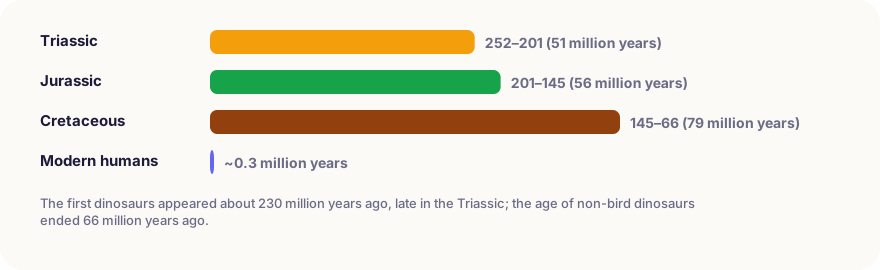
Geologists divide Earth’s history into eras and periods, based on changes in rocks and fossils. The age of dinosaurs is the Mesozoic Era, meaning “middle life”, which ran from about 252 to 66 million years ago. It has three periods:
- Triassic: about 252 to 201 million years ago.
- Jurassic: about 201 to 145 million years ago.
- Cretaceous: about 145 to 66 million years ago.
The Mesozoic began just after the largest mass extinction in Earth’s history, at the end of the Permian, which wiped out most species. It ended with the asteroid impact that killed the non-bird dinosaurs.
Triassic: small beginnings
The first dinosaurs appeared around 230 million years ago, late in the Triassic. Some of the earliest, such as Eoraptor and Herrerasaurus, come from rocks in Argentina. They were mostly small to medium-sized, lightly built animals that walked on two legs.
At first dinosaurs were not in charge. The Triassic world was dominated by other reptiles, including the ancestors of crocodiles, some of them large predators. Almost all land formed one huge supercontinent, Pangaea, with a hot, often dry climate.
Then, about 201 million years ago, a mass extinction at the end of the Triassic, probably linked to massive volcanic eruptions as Pangaea began to split, wiped out many competitors. The dinosaurs survived and took over.
Jurassic: the age of giants
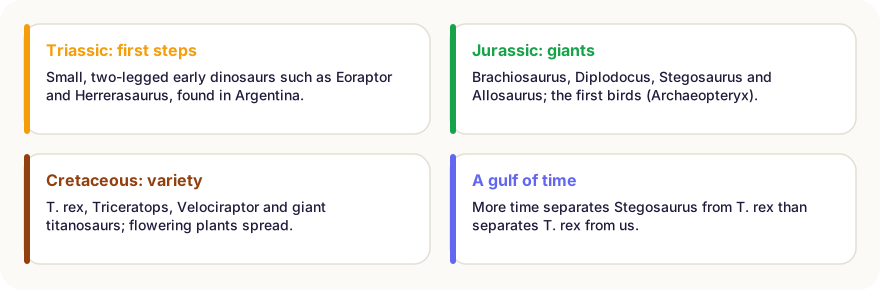
In the Jurassic, as Pangaea broke apart and the climate became more humid, dinosaurs diversified dramatically. Giant long-necked sauropods such as Brachiosaurus and Diplodocus browsed on conifers and ferns. Plated Stegosaurus and predators like Allosaurus roamed North America. And late in the Jurassic, around 150 million years ago, the first birds, such as Archaeopteryx, appeared.
Cretaceous: variety
The Cretaceous was the longest period of the Mesozoic. Flowering plants appeared and spread, changing landscapes and food webs. Dinosaurs reached their greatest variety: horned Triceratops, armoured ankylosaurs, duck-billed hadrosaurs, the giant titanosaurs of South America, small feathered predators like Velociraptor, and finally Tyrannosaurus rex. The period ended abruptly 66 million years ago.
A gulf of time
The time spans are almost impossible to grasp. Stegosaurus lived about 150 million years ago and T. rex about 67 million years ago. That means more time separates Stegosaurus from T. rex than separates T. rex from us. And our own species, Homo sapiens, has existed for only about 300,000 years.
In short
- Dinosaurs lived in the Mesozoic Era, about 252–66 million years ago.
- It has three periods: Triassic, Jurassic and Cretaceous.
- The first dinosaurs appeared about 230 million years ago, in today’s Argentina.
- After the end-Triassic extinction, dinosaurs became dominant.
- Jurassic: giant sauropods, Stegosaurus, Allosaurus and the first birds.
- Cretaceous: Triceratops, Velociraptor, T. rex and flowering plants; it ended 66 million years ago.
Frequently asked questions
Did humans and dinosaurs live at the same time?
No. The last non-bird dinosaurs died out about 66 million years ago, and the earliest members of our own species appeared only about 300,000 years ago. Only birds, which are dinosaurs, share the planet with us.
Did T. rex live in the Jurassic period?
No, despite the name of the film. T. rex lived at the very end of the Cretaceous, about 68–66 million years ago. Most of the dinosaurs in Jurassic Park are actually Cretaceous animals.
What did the world look like when dinosaurs appeared?
In the Triassic, almost all land was joined in one supercontinent, Pangaea. Over the Jurassic and Cretaceous it broke apart into the continents we recognise today.
Were dinosaurs the first big animals on land?
No. Before the dinosaurs, large reptiles and the ancestors of mammals, such as the sail-backed Dimetrodon, dominated land during the Permian period.
Sources
- Brusatte, S. L. et al. (2010). The origin and early radiation of dinosaurs. Earth-Science Reviews
- International Commission on Stratigraphy – International Chronostratigraphic Chart
This article is based on peer-reviewed research and publications from trusted institutions, and it is reviewed regularly. How we work →
You might also wonder
All in Dinosaurs →
Are Birds Dinosaurs? Why Your Pigeon Is a Living Theropod
Birds did not just evolve from dinosaurs – they are dinosaurs. Feathers, wishbones and nesting fossils show how a T. rex relative became today’s birds.
How Are Fossils Formed? From Bone to Stone in Millions of Years
Fossils form when remains are buried fast and minerals slowly replace them. Why fossilisation is so rare, the main types of fossil and how they are dated.
What Killed the Dinosaurs? The Asteroid, the Evidence and the Volcanoes
66 million years ago an asteroid hit Mexico and ended the age of dinosaurs. How scientists found the clues: iridium, shocked quartz and a buried crater.
What Colour Were Dinosaurs? How Scientists Read Colour From Fossils
For a long time dinosaur colours were guesswork. Now microscopic pigment capsules in fossil feathers reveal ginger stripes, black wings and countershading.
What Did Velociraptor Really Look Like? Smaller, Feathered and Nothing Like the Films
The real Velociraptor was turkey-sized and covered in feathers. What fossils reveal about its size, its sickle claw and the famous ‘Fighting Dinosaurs’ fossil.
Are Pterosaurs Dinosaurs? The Flying Reptiles That Weren’t
Pterosaurs flew over the dinosaurs’ heads, but they were not dinosaurs. How they flew on one-finger wings, and why some were as tall as giraffes.