How Big and Fast Was T. rex? Size, Bite Force and Top Speed
T. rex was about 12 metres long, weighed 8 tonnes or more and had the strongest bite of any land animal. But could it outrun a car? What the science says.
Short answer
Tyrannosaurus rex lived in western North America about 68 to 66 million years ago. Large adults were about 12 metres long and around 4 metres tall at the hips, and probably weighed 8 tonnes or more. Its bite was the strongest of any known land animal, estimated at 35,000 to 57,000 newtons, enough to crush bone. Despite the films, it was not a sprinter: computer models suggest its huge weight meant it could not truly run, with a top speed of perhaps around 20 kilometres per hour and a comfortable walking speed of about 4.6 kilometres per hour, similar to a person.
In this article (6)
It is the most famous dinosaur of all: the “tyrant lizard king”, star of museums and films. But how much of its popular image is true? Scientists have studied T. rex bones, footprints and computer models to work out how big it really was, how hard it bit and how fast it could move.
The fact file
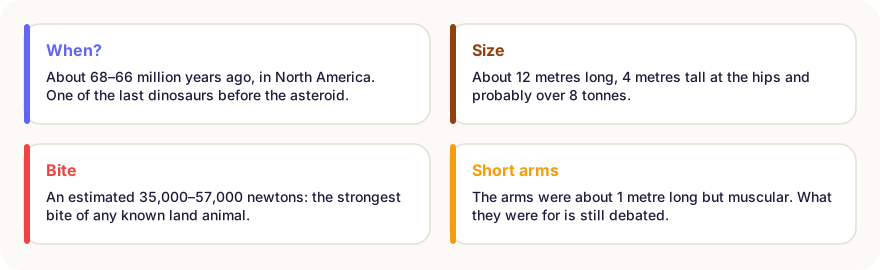
Tyrannosaurus rex lived in what is now western North America, about 68 to 66 million years ago. It was one of the last non-bird dinosaurs, alive right up to the asteroid impact. That means T. rex lived closer in time to us than to Stegosaurus, which died out around 80 million years before it appeared.
Large adults were about 12 metres long from snout to tail and about 4 metres tall at the hips. Estimates of their weight vary, but most fall at 8 tonnes or more, heavier than an African elephant. The skull alone was about 1.5 metres long.
The strongest bite on land
T. rex had about 60 thick, banana-sized teeth, serrated like steak knives. In 2012 Karl Bates and Peter Falkingham built a computer model of its skull and jaw muscles. They estimated its bite force at 35,000 to 57,000 newtons at the back teeth, the strongest of any known land animal, living or extinct. For comparison, an adult human bite is around 1,000 newtons.
Fossil evidence agrees. Bones of other dinosaurs show deep T. rex tooth punctures, and fossil dung contains crushed bone fragments. T. rex did not just tear flesh; it crunched bone.
Could it outrun a car?
In the original Jurassic Park film, a T. rex chases a jeep at high speed. The science says otherwise.
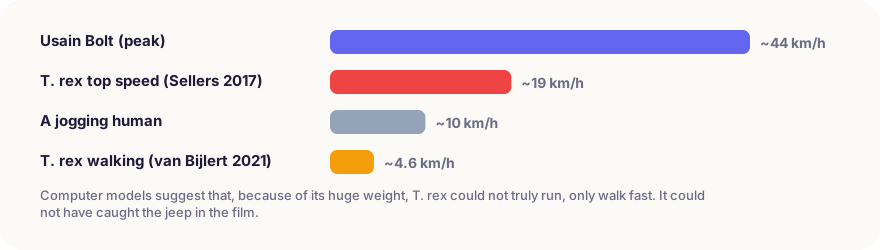
In 2017, a team led by William Sellers built a detailed computer model of T. rex’s skeleton and muscles and checked how much stress its bones could take. At higher speeds, the forces on the leg bones became too great: the bones would have broken. The model suggested a top speed of around 20 kilometres per hour, more like a brisk jog than a sprint, and that T. rex could not truly run, with both feet off the ground at once.
In 2021, a study led by Pasha van Bijlert estimated its comfortable walking speed by looking at how its heavy tail would have swung with each step. The answer: about 4.6 kilometres per hour, roughly the walking speed of a person. Other estimates vary, but a car on a road would leave T. rex far behind.
Arms, eyes and noses
T. rex’s arms were only about 1 metre long, tiny compared with its body, yet muscular and with two clawed fingers. What they were used for is still debated. Its eyes faced forward enough to give good depth perception, and its brain had large areas for smell. Its skin, from fossil impressions, was covered in small scales.
How long did it live?
Bones, like trees, can have growth rings. By counting them, scientists found that T. rex grew extremely fast as a teenager, gaining more than a tonne a year at its peak. Few individuals lived beyond about 30 years. The famous skeleton Sue, in Chicago’s Field Museum, died at around 30.
In short
- T. rex lived in North America about 68–66 million years ago.
- Adults were about 12 metres long and probably weighed 8 tonnes or more.
- Its bite force was about 35,000–57,000 newtons, the strongest of any land animal.
- Models suggest a top speed of only about 20 km/h and a walking speed of about 4.6 km/h.
- Its tiny arms were muscular, but their purpose is still debated.
- T. rex grew very fast and rarely lived beyond about 30 years.
Frequently asked questions
Why did T. rex have such short arms?
Nobody knows for sure. Ideas include holding struggling prey, helping the animal get up from the ground, or simply shrinking because the huge head did the hunting. The arms were short but strongly muscled.
Did T. rex have feathers?
Skin impressions from adult T. rex show small scales. Some smaller relatives had simple feathers, so young T. rex may have had some fuzz, but large adults were probably mostly scaly.
Was T. rex a hunter or a scavenger?
Most palaeontologists think it did both, like many modern predators. Healed bite marks on other dinosaurs show it attacked living animals, while it would also have eaten carcasses it found.
Could T. rex see well?
Yes. Its eyes faced forward more than in many dinosaurs, giving it good depth perception. Its brain also had large areas for smell, suggesting an excellent sense of smell.
Sources
- Bates, K. T. & Falkingham, P. L. (2012). Estimating maximum bite performance in Tyrannosaurus rex using multi-body dynamics. Biology Letters
- Sellers, W. I. et al. (2017). Investigating the running abilities of Tyrannosaurus rex using stress-constrained multibody dynamic analysis. PeerJ
- van Bijlert, P. A. et al. (2021). Natural Frequency Method: estimating the preferred walking speed of Tyrannosaurus rex based on tail natural frequency. Royal Society Open Science
This article is based on peer-reviewed research and publications from trusted institutions, and it is reviewed regularly. How we work →
You might also wonder
All in Dinosaurs →
Are Birds Dinosaurs? Why Your Pigeon Is a Living Theropod
Birds did not just evolve from dinosaurs – they are dinosaurs. Feathers, wishbones and nesting fossils show how a T. rex relative became today’s birds.
How Are Fossils Formed? From Bone to Stone in Millions of Years
Fossils form when remains are buried fast and minerals slowly replace them. Why fossilisation is so rare, the main types of fossil and how they are dated.
What Killed the Dinosaurs? The Asteroid, the Evidence and the Volcanoes
66 million years ago an asteroid hit Mexico and ended the age of dinosaurs. How scientists found the clues: iridium, shocked quartz and a buried crater.
What Colour Were Dinosaurs? How Scientists Read Colour From Fossils
For a long time dinosaur colours were guesswork. Now microscopic pigment capsules in fossil feathers reveal ginger stripes, black wings and countershading.
What Did Velociraptor Really Look Like? Smaller, Feathered and Nothing Like the Films
The real Velociraptor was turkey-sized and covered in feathers. What fossils reveal about its size, its sickle claw and the famous ‘Fighting Dinosaurs’ fossil.
When Did Dinosaurs Live? Triassic, Jurassic and Cretaceous Explained
Dinosaurs appeared about 230 million years ago and ruled for over 160 million years. A simple guide to the Triassic, Jurassic and Cretaceous.