How Did Dinosaurs Lay Eggs? Nests, Incubation and Surprising Soft Shells
All dinosaurs hatched from eggs. How they built nests, how long eggs took to hatch, which dinosaurs sat on them and why some shells were soft.
Short answer
As far as we know, all dinosaurs laid eggs, just as their living descendants, the birds, do. Fossil nests show a wide range of habits. Many large plant-eaters, such as titanosaurs, buried their eggs in warm soil or mounds of rotting plants, like crocodiles. Feathered oviraptorosaurs sat on open nests like birds, and some duck-billed hadrosaurs nested in large colonies. Studies of fossil embryos suggest that dinosaur eggs took roughly three to six months to hatch, much longer than bird eggs. A 2020 study also found that some early dinosaurs laid soft, leathery eggs, and that hard shells may have evolved more than once.
In this article (8)
Imagine a 30-metre-long sauropod, heavier than ten elephants, carefully laying eggs no bigger than a football. It sounds strange, but that is exactly what fossils show. Dinosaur eggs and nests, found on every continent, tell us a remarkable amount about how these animals reproduced, how they raised their young and how closely they were related to modern birds.
All dinosaurs hatched from eggs
As far as we know, every dinosaur laid eggs. That is not surprising: their closest living relatives, crocodiles and birds, both lay eggs, and birds are themselves living dinosaurs. Unlike many reptiles, no dinosaur is known to have given birth to live young.
Dinosaur eggs have been found by the thousands, sometimes in huge nesting grounds. At Auca Mahuevo in Argentina, for example, palaeontologists discovered vast fields of titanosaur eggs, some with tiny embryos still inside, preserved with traces of skin.
Surprisingly small eggs
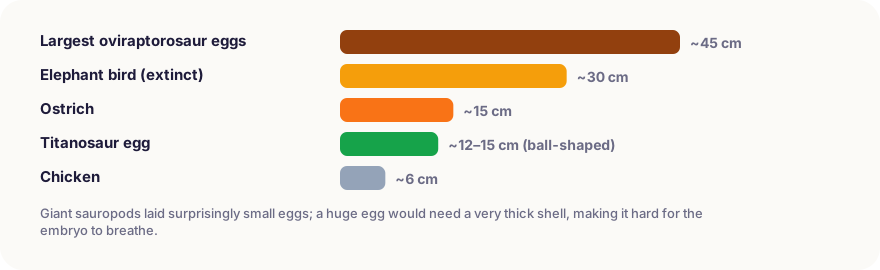
Even the biggest dinosaurs laid relatively small eggs. Titanosaur eggs were roughly round, about 12 to 15 centimetres across, and the longest known dinosaur eggs, from large oviraptorosaurs, were about 45 centimetres long but narrow.
There is a physical reason. The bigger an egg, the thicker its shell must be to avoid breaking, but a thick shell makes it harder for oxygen to get in and for the chick to break out. So instead of a few huge eggs, many large dinosaurs laid many small eggs, sometimes 20 to 40 per clutch, and their babies grew very fast after hatching.
Different dinosaurs, different nests
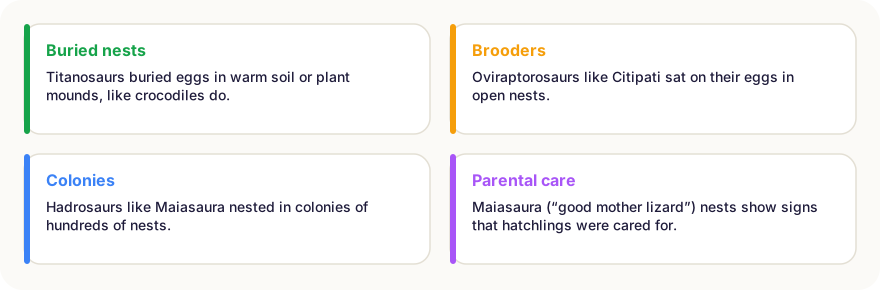
Fossil nests reveal a range of nesting strategies:
| Group | Nest type | Parental behaviour |
|---|---|---|
| Titanosaurs (giant sauropods) | Eggs buried in warm soil, sometimes near hot springs | Probably left the eggs; ground heat incubated them |
| Oviraptorosaurs (e.g. Citipati) | Open ring-shaped nests | Adults sat on the eggs, like birds |
| Hadrosaurs (e.g. Maiasaura) | Mound nests in large colonies | Young may have been cared for near the nest |
| Troodontids | Eggs half-buried in the ground | Adults probably brooded, possibly males |
| Birds (living dinosaurs) | Many types | Brooding and parental care are common |
Burying eggs, as crocodiles and turtles do, uses the warmth of the soil or rotting vegetation. Some titanosaur eggs in Argentina were laid in soils heated by geothermal activity, like natural incubators.
Brooding, sitting on the eggs, is the bird strategy. Several skeletons of the oviraptorosaur Citipati from Mongolia’s Gobi Desert were found crouched on top of their nests, arms spread over the eggs, exactly like a bird keeping its eggs warm. They seem to have been buried by a sandstorm or a collapsing dune.
The famous “egg thief” that wasn’t
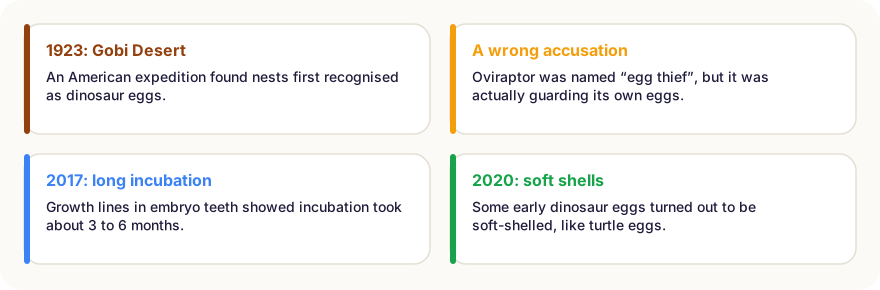
In 1923, an American Museum of Natural History expedition to the Gobi Desert found nests that were the first to be widely recognised as dinosaur eggs. A skeleton found on one nest was named Oviraptor, “egg thief”, because scientists assumed it had been caught raiding the eggs of Protoceratops.
In the 1990s, a fossil embryo found inside a similar egg turned out to be an oviraptorosaur. The animal had not been stealing eggs, but guarding its own. Its unfortunate name, under the rules of scientific naming, cannot be changed.
How long did eggs take to hatch?
Bird eggs hatch quickly: about three weeks for a chicken, and up to about 80 days for the largest birds. Were dinosaur eggs similar?
In 2017, Gregory Erickson and colleagues found a clever way to find out. Teeth grow in daily layers, like tree rings but much finer. By counting these lines in the teeth of fossil embryos, they estimated incubation times of about 3 months for the small horned dinosaur Protoceratops and about 6 months for the duck-billed Hypacrosaurus. Dinosaur eggs took much longer to hatch than bird eggs of similar size, closer to reptile eggs. Long incubation would have exposed nests to predators and floods for months.
Soft eggs: a recent surprise
Until recently, scientists assumed all dinosaur eggs had hard, mineral shells like bird eggs. But that left a puzzle: why were eggs from some groups, such as early sauropods and horned dinosaurs, so rarely found?
In 2020, a team led by Mark Norell published a study in Nature reporting that eggs of Protoceratops from Mongolia and of the early sauropodomorph Mussaurus from Argentina had soft, leathery shells, more like turtle eggs. Soft shells rarely fossilise, which explains why they were missed. The team concluded that the very first dinosaurs probably laid soft eggs, and that hard shells evolved several times in different groups. That conclusion is still debated, but the discovery changed how palaeontologists search for eggs.
From dinosaur eggs to bird eggs
Many features we see in birds, such as open nests, brooding, colourful eggs and a single functioning oviduct, appear step by step in the dinosaur family tree. Studies of pigments in fossil eggshells suggest that some dinosaurs, like many birds today, even laid blue-green or speckled eggs. When you look at a robin’s nest, you are seeing a reproductive strategy refined over more than 150 million years of dinosaur evolution.
In short
- As far as we know, all dinosaurs laid eggs, like their descendants, the birds.
- Even giant sauropods laid small eggs, about 12–15 cm across, in large clutches.
- Some dinosaurs buried their eggs; others, like Citipati, brooded them like birds.
- Oviraptor, the “egg thief”, was actually guarding its own nest.
- Embryo teeth show incubation took about 3 to 6 months.
- Some early dinosaurs laid soft-shelled eggs; hard shells may have evolved more than once.
Frequently asked questions
How big were dinosaur eggs?
Surprisingly small for such large animals. Even the giant sauropods laid roughly ball-shaped eggs about 12 to 15 centimetres across. The longest known eggs, from oviraptorosaurs, were up to about 45 centimetres long.
Did dinosaurs sit on their eggs?
Some did. Fossils of oviraptorosaurs such as Citipati were found sitting on their nests in a bird-like brooding posture. Many large dinosaurs, however, buried their eggs and let the warmth of the ground incubate them.
How long did dinosaur eggs take to hatch?
A 2017 study counted daily growth lines in the teeth of fossil embryos and estimated about 3 months for Protoceratops and about 6 months for the duck-billed Hypacrosaurus.
Did dinosaurs care for their young?
Some probably did. Nesting sites of the hadrosaur Maiasaura, whose name means ‘good mother lizard’, contain young animals of various sizes, suggesting they stayed near the nest and were looked after.
Sources
- Norell et al. (2020) – The first dinosaur egg was soft, Nature
- Erickson, Zelenitsky, Kay & Norell (2017) – Dinosaur incubation periods directly determined from growth-line counts in embryonic teeth, PNAS
This article is based on peer-reviewed research and publications from trusted institutions, and it is reviewed regularly. How we work →
You might also wonder
All in Dinosaurs →
What Were Triceratops Horns For? Fighting, Display and Defence Against T. rex
Triceratops had three horns and a huge bony frill. Were they weapons against T. rex, for fighting rivals or for attracting mates? What fossils reveal.
Are Birds Dinosaurs? Why Your Pigeon Is a Living Theropod
Birds did not just evolve from dinosaurs – they are dinosaurs. Feathers, wishbones and nesting fossils show how a T. rex relative became today’s birds.
How Are Fossils Formed? From Bone to Stone in Millions of Years
Fossils form when remains are buried fast and minerals slowly replace them. Why fossilisation is so rare, the main types of fossil and how they are dated.
What Killed the Dinosaurs? The Asteroid, the Evidence and the Volcanoes
66 million years ago an asteroid hit Mexico and ended the age of dinosaurs. How scientists found the clues: iridium, shocked quartz and a buried crater.
What Colour Were Dinosaurs? How Scientists Read Colour From Fossils
For a long time dinosaur colours were guesswork. Now microscopic pigment capsules in fossil feathers reveal ginger stripes, black wings and countershading.
What Did Velociraptor Really Look Like? Smaller, Feathered and Nothing Like the Films
The real Velociraptor was turkey-sized and covered in feathers. What fossils reveal about its size, its sickle claw and the famous ‘Fighting Dinosaurs’ fossil.