What Are Blood Types? A, B, AB, O and Rh Explained, Plus Who Can Donate to Whom
Blood types depend on tiny markers on red blood cells. What A, B, AB, O and Rh mean, how blood types are inherited and who can give blood to whom.
Short answer
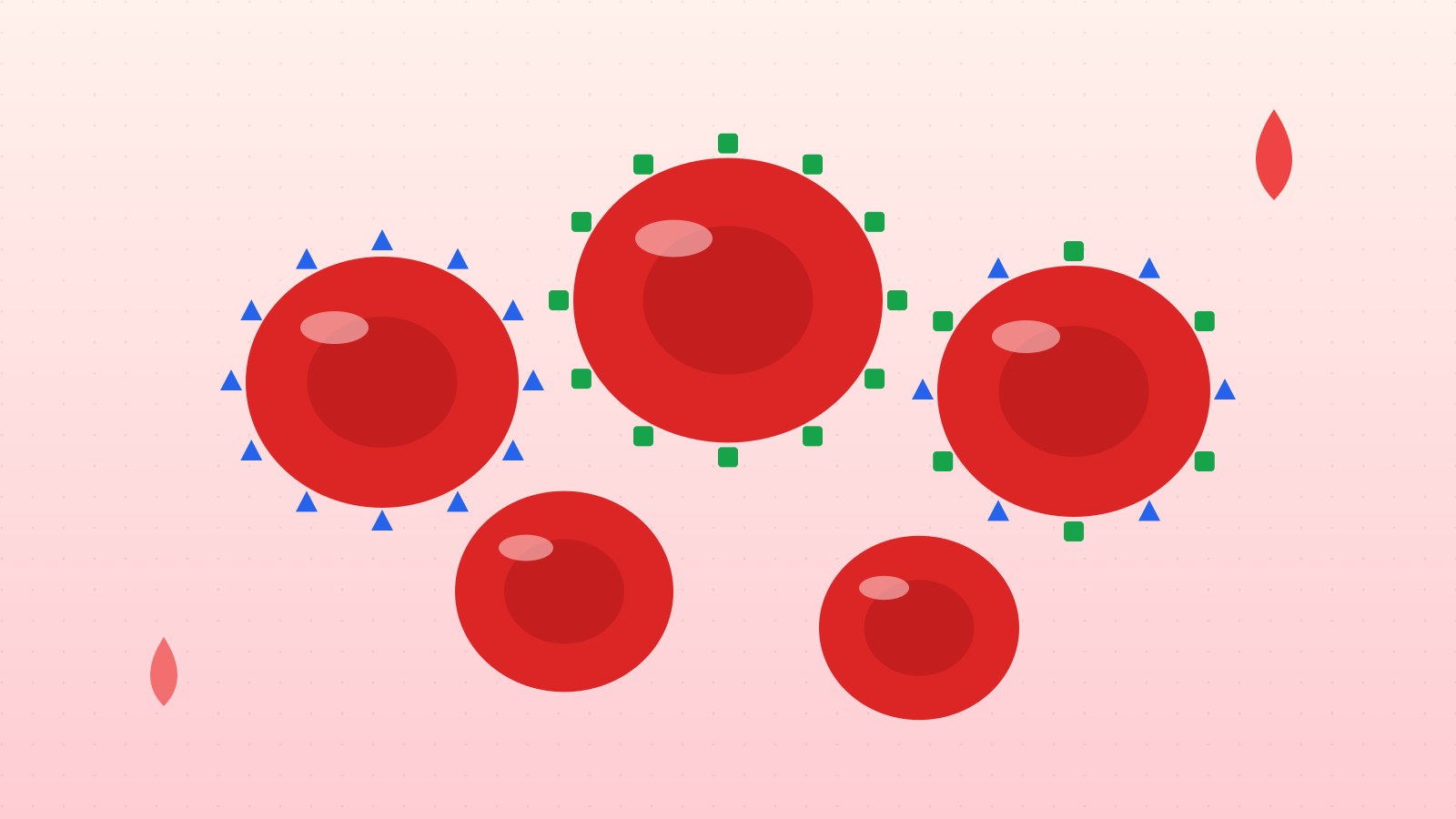
Blood types are categories based on markers called antigens on the surface of red blood cells. In the ABO system, type A blood has A antigens, type B has B antigens, type AB has both and type O has neither. The plasma also contains antibodies against the antigens a person lacks, which is why mixing the wrong blood types in a transfusion can be dangerous. The Rh system adds a plus or minus sign: Rh-positive blood carries the RhD antigen, Rh-negative blood does not. Together they give eight common blood types, from O+ to AB−. O-negative red cells can be given to almost anyone in emergencies, while AB-positive patients can receive red cells of any type.
In this article (9)
“What is your blood type?” It is one of the first questions asked in a hospital before surgery or a transfusion. Most people know their answer, A positive, O negative and so on, but fewer know what those letters and signs actually mean. Behind them lies one of the most important discoveries in medicine, one that turned blood transfusion from a deadly gamble into a routine, life-saving treatment.
Markers on red blood cells
Every red blood cell is covered in molecules, some of which act like name tags. These tags are called antigens. Your immune system learns which antigens belong to your body and attacks unfamiliar ones.
A blood type describes which of these antigens your red cells carry. According to the NIH’s overview of blood groups, scientists today recognise more than 40 blood group systems, but two matter most in everyday medicine: the ABO system and the Rh system.
The ABO system
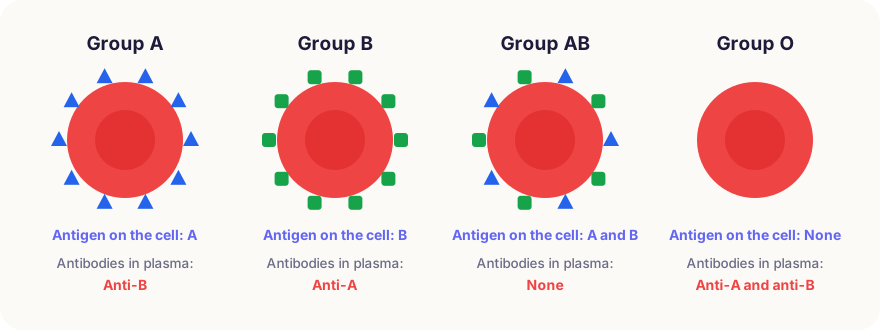
- Type A red cells carry A antigens. The plasma contains anti-B antibodies.
- Type B red cells carry B antigens. The plasma contains anti-A antibodies.
- Type AB red cells carry both A and B antigens. The plasma contains neither antibody.
- Type O red cells carry neither antigen. The plasma contains both anti-A and anti-B antibodies.
The key point is that the body makes antibodies against the ABO antigens it does not have. If a person with type A blood receives type B red cells, their anti-B antibodies attack the donated cells, causing them to clump and burst. This transfusion reaction can be life-threatening.
Positive or negative: the Rh factor
The plus or minus after your blood type refers to the Rh system, and in particular to the RhD antigen:
- Rh-positive (+) red cells carry the RhD antigen.
- Rh-negative (−) red cells do not.
Unlike ABO, people with Rh-negative blood do not normally have anti-D antibodies from birth. They can develop them if they are exposed to Rh-positive blood, for example through a transfusion or during pregnancy. Combining ABO and Rh gives the eight common blood types: O+, O−, A+, A−, B+, B−, AB+ and AB−.
Who can give blood to whom?
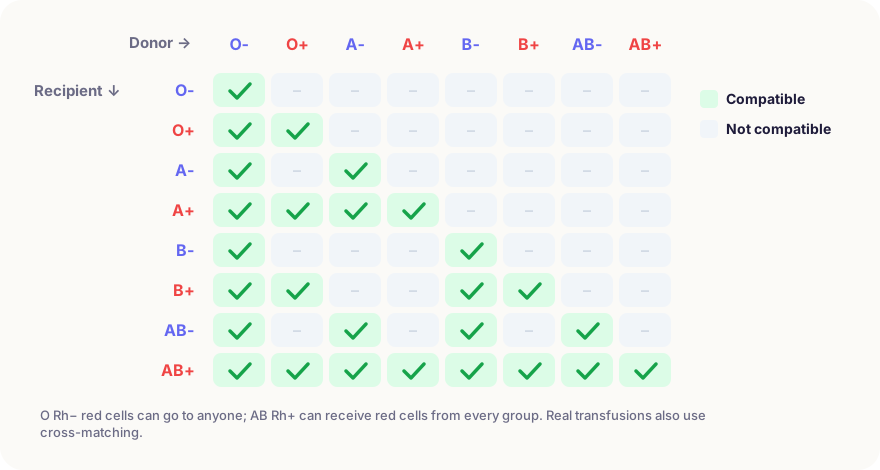
For red blood cell transfusions, the rule is simple: the donor’s cells must not carry an antigen that the recipient’s body would attack.
- O-negative red cells have no A, B or RhD antigens, so they can be given to almost anyone. That makes O− donors “universal red cell donors”, and O− blood is often used in emergencies when there is no time to test.
- AB-positive patients have no anti-A or anti-B antibodies and already carry RhD, so they can receive red cells of any type. They are “universal recipients”.
- For plasma, the logic is reversed: AB plasma contains no anti-A or anti-B antibodies, so AB donors are universal plasma donors.
In practice, hospitals give the same type whenever possible and also perform a crossmatch, mixing a sample of the donor’s blood with the patient’s, to check for reactions caused by other, less common blood group antigens.
| Blood type | Can give red cells to | Can receive red cells from |
|---|---|---|
| O− | Everyone | O− |
| O+ | O+, A+, B+, AB+ | O+, O− |
| A− | A−, A+, AB−, AB+ | A−, O− |
| A+ | A+, AB+ | A+, A−, O+, O− |
| B− | B−, B+, AB−, AB+ | B−, O− |
| B+ | B+, AB+ | B+, B−, O+, O− |
| AB− | AB−, AB+ | AB−, A−, B−, O− |
| AB+ | AB+ | Everyone |
How blood types are inherited
You inherit one ABO gene from each parent. The A and B versions are both “dominant”, while O is “recessive”: it only shows when there is no A or B. That leads to some surprises:
- A person with type A blood may carry the genes AA or AO.
- Two parents with type A and type B blood (for example AO and BO) can have children with any of the four ABO types.
- Two parents with type O blood (OO and OO) will almost always have type O children.
Rh works in a similar way: Rh-positive is dominant, so two Rh-positive parents can have an Rh-negative child if both carry a hidden negative gene.
The discovery that made transfusions safe
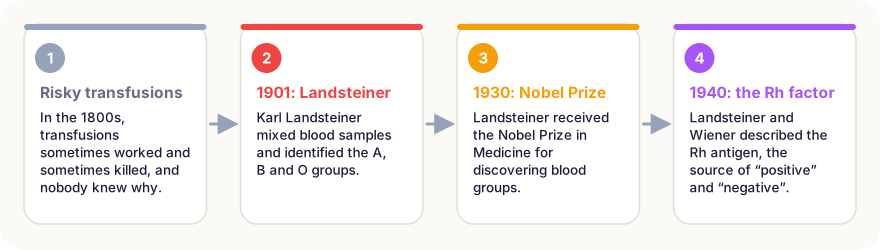
In the 19th century, doctors sometimes tried transfusing blood, but the results were unpredictable: some patients recovered, others died. In 1901, the Austrian physician Karl Landsteiner mixed the red cells and serum of different people and noticed that some combinations clumped and others did not. From this, he described the groups we now call A, B and O; AB was identified soon after by his colleagues. Landsteiner received the Nobel Prize in Physiology or Medicine in 1930. In 1940, he and Alexander Wiener described the Rh factor, named after the rhesus monkeys used in their experiments.
Blood types and pregnancy
The Rh factor is especially important in pregnancy. If an Rh-negative mother carries an Rh-positive baby, some of the baby’s blood can enter her circulation, usually during birth. Her body may then make anti-D antibodies, which in a later pregnancy can cross the placenta and attack the red cells of another Rh-positive baby. This condition, haemolytic disease of the newborn, used to be a major cause of infant death. Today it is largely prevented by giving Rh-negative mothers injections of anti-D immunoglobulin, which stops their immune system from becoming sensitised.
Why do blood types exist at all?
Scientists are still not sure why humans have different blood types. One leading idea is that they are linked to infectious diseases: some microbes use blood group molecules to attach to cells, so different types may give some protection against different diseases. This could explain why blood type frequencies vary across the world. For example, type O is especially common in parts of the Americas, while type B is more common in parts of Asia.
In short
- Blood types are based on antigens on red blood cells.
- ABO: A has A antigens, B has B, AB has both, O has neither.
- Rh: positive blood carries the RhD antigen, negative blood does not.
- O− is the universal red cell donor; AB+ can receive red cells from all types.
- Blood types are inherited; two parents can have a child with a different type.
- Karl Landsteiner discovered blood groups in 1901 and won the Nobel Prize in 1930.
Frequently asked questions
What is the rarest blood type?
Among the eight common types, AB-negative is usually the rarest, though frequencies differ between populations. Beyond ABO and Rh, there are extremely rare blood types, such as ‘Rh null’, found in only a handful of people worldwide.
Can blood type change?
Normally no; it is set by your genes. In rare cases, such as after a bone marrow transplant from a donor with a different type, a person’s blood type can change to match the donor’s.
Can parents with type A and B have a child with type O?
Yes. If both parents carry a hidden O gene (genotypes AO and BO), their child has a one-in-four chance of inheriting two O genes and having type O blood.
Does blood type affect diet or personality?
There is no good scientific evidence for ‘blood type diets’ or links between blood type and personality. Blood type matters mainly for transfusions, transplants and pregnancy.
Sources
- Dean (2005) – Blood Groups and Red Cell Antigens, National Center for Biotechnology Information (NIH)
- American Red Cross – Blood Types Explained
- The Nobel Prize – Karl Landsteiner, Physiology or Medicine 1930
This article is based on peer-reviewed research and publications from trusted institutions, and it is reviewed regularly. How we work →
You might also wonder
All in Human Body →
How Does the Heart Work? Chambers, Valves and the Electricity Behind Every Beat
Your heart beats about 100,000 times a day. How its four chambers, four valves and built-in electrical system move blood around your body.
How Does the Immune System Work? Your Body’s Defence Force, Explained Simply
Your immune system uses barriers, fast responders and cells that learn and remember. How it fights germs, how vaccines train it and what goes wrong.

Why Do Knuckles Crack? The Bubble Behind the Pop, and Whether It Causes Arthritis
Cracking your knuckles forms a gas cavity in the joint. What MRI scans revealed, why the same knuckle won’t crack twice in a row and whether it is harmful.

Why Do We Need Sleep? What Happens in Your Brain and Body Every Night
We spend about a third of our lives asleep. What sleep does for memory, the brain and immunity, how much you need at every age and what happens without it.

Why Do We Blush? The Science of a Very Human Reaction
Blushing is the only facial expression we cannot fake or hide. What happens in the body when we turn red, why does it start, and is it actually useful?

How Does Caffeine Keep You Awake? Adenosine, Half-Life and Sleep
Caffeine doesn’t give you energy; it blocks a sleepiness signal in the brain. How it works, how long it lasts, how much is safe and why it can ruin your sleep.