Why Do Knuckles Crack? The Bubble Behind the Pop, and Whether It Causes Arthritis
Cracking your knuckles forms a gas cavity in the joint. What MRI scans revealed, why the same knuckle won’t crack twice in a row and whether it is harmful.

Short answer
When you crack a knuckle, you pull the two bones of the joint slightly apart. The joint is sealed in a capsule filled with synovial fluid, which contains dissolved gases. Stretching the joint suddenly lowers the pressure inside, and a gas-filled cavity forms in the fluid; the popping sound happens at that moment. A 2015 MRI study filmed this cavity forming in real time. Because the gas takes about 20 minutes to dissolve back into the fluid, the same knuckle usually can’t be cracked again straight away. Studies have found no link between knuckle cracking and arthritis, although very frequent cracking may be associated with slight hand swelling.
In this article (7)
Some people do it without thinking dozens of times a day; others wince at the sound. Knuckle cracking is one of the most common habits in the world, and almost everyone has been warned that it will give them arthritis. Yet for decades scientists argued about something even more basic: what actually makes the sound?
Inside a finger joint
Each knuckle is a joint where two bones meet. The ends of the bones are covered with smooth cartilage, and the whole joint is sealed inside a capsule filled with synovial fluid, a slippery liquid that lubricates and nourishes the cartilage. Like a fizzy drink, this fluid contains dissolved gases, mostly carbon dioxide and nitrogen.
What happens when you crack a knuckle
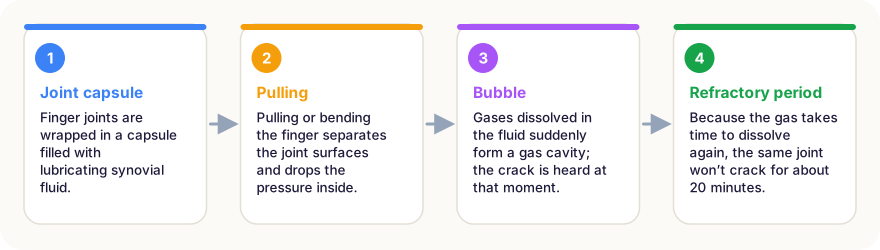
When you pull, bend or push a finger in a certain way, the joint surfaces separate slightly. The capsule stretches and the pressure inside drops. At a certain point, the fluid can no longer hold together: a gas-filled cavity suddenly forms. This process is called cavitation, and it is accompanied by the familiar pop.
After a crack, the X-ray of a joint shows a dark bubble inside. It takes time for the gas to dissolve back into the fluid, which is why there is a refractory period, usually around 20 minutes, before the same knuckle will crack again.
Bubble bursting or bubble forming?
For almost half a century, scientists disagreed about the exact source of the sound.
In 1971, engineers Anthony Unsworth, Duncan Dowson and Verna Wright studied cracking joints with pressure measurements and X-rays. They concluded that the crack came from a bubble collapsing, much like bubbles in a liquid collapsing with a pop.
In 2015, a team led by Gregory Kawchuk at the University of Alberta did something new: they filmed knuckle cracking inside an MRI scanner in real time. A volunteer’s finger was pulled gently by a cable until it cracked. The images showed a cavity appearing at the exact moment of the sound, and it remained visible afterwards. The sound, they concluded, comes from cavity formation, not collapse.
In 2018, a mathematical model by Vineeth Chandran Suja and Abdul Barakat suggested a twist: the sound could be explained by the partial collapse of the cavity just after it forms. The debate is not completely settled, but everyone agrees the noise is linked to this sudden gas cavity, not to bones cracking or ligaments snapping.
Does it cause arthritis?
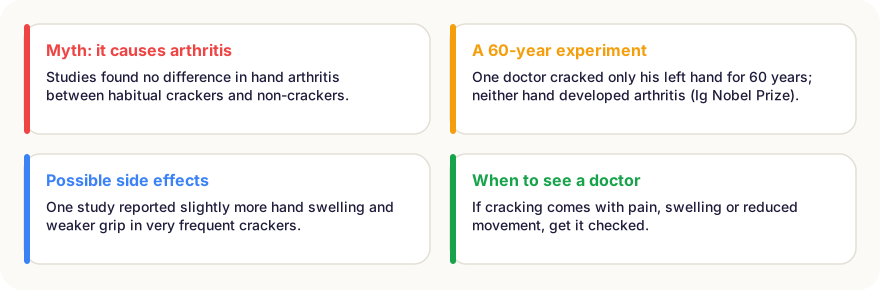
The most famous warning, that knuckle cracking leads to arthritis, has not held up.
- In 1990, Jorge Castellanos and David Axelrod examined 300 people. Habitual knuckle crackers had no more arthritis in their hands than non-crackers. They did find that frequent crackers were more likely to have hand swelling and slightly weaker grip, although the cause was not clear.
- In 2011, Kevin deWeber and colleagues compared people with and without hand osteoarthritis and found that the prevalence of osteoarthritis was similar in crackers and non-crackers, regardless of how long or how often they cracked.
- Physician Donald Unger ran a rather personal experiment: for about 60 years he cracked the knuckles of his left hand only, at least twice a day, leaving the right hand as a control. In 1998 he reported that neither hand had arthritis. In 2009 his dedication earned an Ig Nobel Prize, an award for research that first makes people laugh and then makes them think.
| Claim | What the evidence says |
|---|---|
| Cracking causes arthritis | No link found in several studies |
| It makes your knuckles bigger | No good evidence; some reports of more swelling in very frequent crackers |
| The sound is bones grinding | No: it comes from a gas cavity in the joint fluid |
| You can crack the same joint again right away | Usually not: there is a refractory period of about 20 minutes |
| Cracking can relieve stiffness | Many people report a feeling of looseness, but this is not well studied |
Other noises your joints make
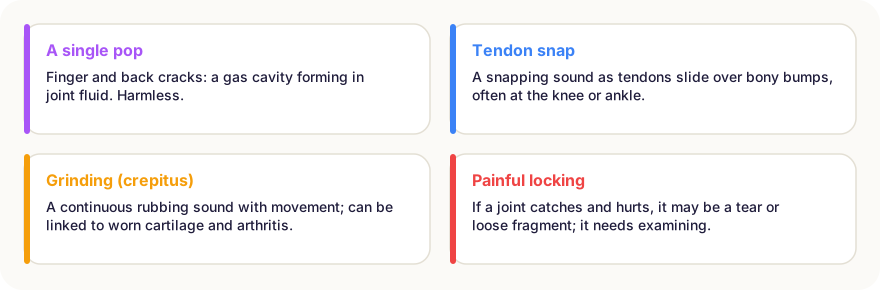
Not every noise from a joint is the same:
- A single pop, like knuckle or back cracking, usually comes from cavitation and is harmless.
- Snapping around the knee, hip or ankle can come from tendons sliding over bony bumps.
- A continuous grinding or crackling during movement, called crepitus, can sometimes be linked to worn cartilage and arthritis, especially if it is painful.
- A joint that catches or locks painfully may have a torn cartilage or a loose fragment.
If cracking or other joint noises come with pain, swelling or reduced movement, it is worth seeing a doctor.
Why do people crack their knuckles?
People crack their knuckles for many reasons: a feeling of release, habit, nervousness or boredom. Some studies suggest that cracking temporarily increases a joint’s range of motion. Whatever the reason, for most people it appears to be a harmless habit, even if it annoys those around them.
In short
- Knuckle joints are filled with synovial fluid containing dissolved gases.
- Pulling the joint apart lowers the pressure, forming a gas cavity: this is cavitation.
- A 2015 MRI study filmed the cavity forming at the moment of the crack.
- A refractory period of about 20 minutes stops the same joint cracking again.
- Studies have found no link between knuckle cracking and arthritis.
- Joint noises with pain or swelling should be checked by a doctor.
Frequently asked questions
Is knuckle cracking bad for you?
For most people it appears harmless. Large studies have found no higher rate of hand arthritis in habitual crackers. One study linked very frequent cracking to slightly more hand swelling and weaker grip.
Why can’t I crack the same knuckle twice in a row?
After a crack, the gas cavity needs time to shrink and the gas to redissolve into the joint fluid. Until then, the joint can’t produce the sudden cavity that makes the sound, typically for about 20 minutes.
Why do some people’s knuckles crack and others don’t?
Joint size, the looseness of the capsule and the amount of fluid all play a role. Some people simply cannot separate the joint surfaces enough to trigger cavitation.
What about cracking the back or neck?
The sound comes from the same kind of gas cavity forming in spinal joints. Forceful twisting of the neck, however, carries a small risk of injuring blood vessels, so it is best avoided or left to trained professionals.
Sources
- Kawchuk, G. N. et al. (2015). Real-time visualization of joint cavitation. PLOS ONE
- Unsworth, A., Dowson, D. & Wright, V. (1971). ‘Cracking joints’: a bioengineering study of cavitation in the metacarpophalangeal joint. Annals of the Rheumatic Diseases
- deWeber, K., Olszewski, M. & Ortolano, R. (2011). Knuckle cracking and hand osteoarthritis. Journal of the American Board of Family Medicine
- Castellanos, J. & Axelrod, D. (1990). Effect of habitual knuckle cracking on hand function. Annals of the Rheumatic Diseases
This article is based on peer-reviewed research and publications from trusted institutions, and it is reviewed regularly. How we work →
You might also wonder
All in Human Body →
How Does the Immune System Work? Your Body’s Defence Force, Explained Simply
Your immune system uses barriers, fast responders and cells that learn and remember. How it fights germs, how vaccines train it and what goes wrong.

Why Do We Need Sleep? What Happens in Your Brain and Body Every Night
We spend about a third of our lives asleep. What sleep does for memory, the brain and immunity, how much you need at every age and what happens without it.

Why Do We Blush? The Science of a Very Human Reaction
Blushing is the only facial expression we cannot fake or hide. What happens in the body when we turn red, why does it start, and is it actually useful?

How Does Caffeine Keep You Awake? Adenosine, Half-Life and Sleep
Caffeine doesn’t give you energy; it blocks a sleepiness signal in the brain. How it works, how long it lasts, how much is safe and why it can ruin your sleep.
Why Do Your Ears Pop on a Plane? Cabin Pressure and the Eustachian Tube
Ears block and pop on planes because cabin pressure changes faster than your middle ear can adjust. Why descent is worse, and the tricks that actually help.
What Causes Muscle Cramps? Why Muscles Suddenly Lock Up
A muscle cramp is a sudden, painful contraction you can’t control. What science says about the causes, why stretching helps and how to prevent night cramps.