How Does the Immune System Work? Your Body’s Defence Force, Explained Simply
Your immune system uses barriers, fast responders and cells that learn and remember. How it fights germs, how vaccines train it and what goes wrong.
Short answer
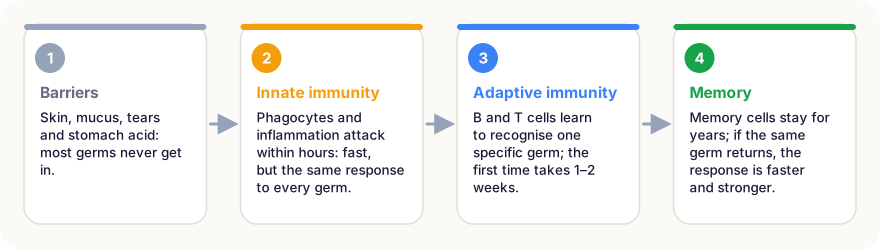
The immune system protects the body in layers. First, barriers such as skin, mucus and stomach acid keep most germs out. If microbes get in, the innate immune system responds within minutes to hours: cells called phagocytes swallow invaders, and inflammation brings more defenders to the site. If the infection continues, the adaptive immune system takes over: B cells make antibodies that target one specific germ, and T cells destroy infected cells and coordinate the attack. Afterwards, memory cells remain for years, so if the same germ returns the response is much faster. Vaccines work by safely training this memory in advance.
In this article (6)
Every day, your body meets millions of bacteria, viruses, fungi and other microbes, in the air you breathe, on the food you eat and on everything you touch. Most of the time you never notice, because a remarkable defence system is quietly at work. The immune system is not a single organ but a network of cells, tissues and chemicals spread throughout the body, able to recognise threats, destroy them and remember them for years.
The lines of defence
1. Barriers
The first defences stop germs getting in at all:
- Skin is a tough, waterproof wall.
- Mucus in the nose, throat and lungs traps microbes, and tiny hairs called cilia sweep them away.
- Tears and saliva contain enzymes that break down bacteria.
- Stomach acid destroys many microbes in food.
- Trillions of friendly bacteria in the gut and on the skin crowd out harmful ones.
2. Innate immunity: the first responders
If a germ gets through, for example via a cut, the innate immune system responds within minutes to hours. It recognises general features shared by many microbes, as immunologists Ruslan Medzhitov and Charles Janeway described, rather than specific invaders.
- Phagocytes, such as neutrophils and macrophages, swallow and digest microbes.
- Inflammation widens blood vessels and makes them leakier, so more immune cells and fluid reach the site. That is why an infected cut becomes red, warm, swollen and painful.
- Natural killer cells destroy body cells that look infected or abnormal.
- Fever may develop, as chemical signals raise the body’s thermostat.
Innate immunity is fast, but it responds in roughly the same way to every threat, and it does not get better with experience.
3. Adaptive immunity: the specialists
If the infection continues, the adaptive immune system joins in. It takes longer the first time, often 1 to 2 weeks, but it is precisely targeted. Its main players are lymphocytes, white blood cells called B cells and T cells.
Meet the cells
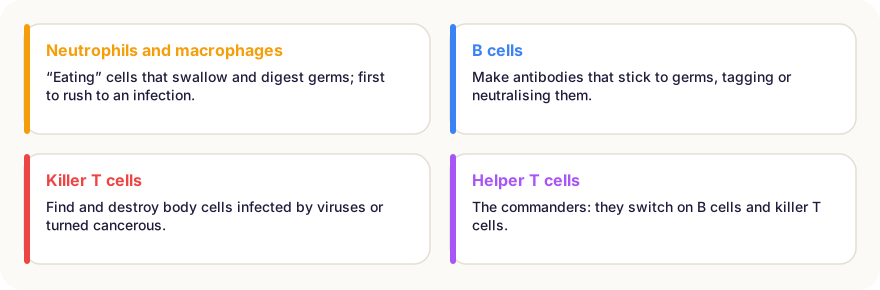
- B cells produce antibodies, Y-shaped proteins that lock onto a specific part of a germ, called an antigen. Antibodies can neutralise viruses, block toxins and tag microbes for destruction.
- Killer T cells recognise and destroy body cells that have been infected by a virus, or that have become cancerous.
- Helper T cells act like commanders: they release signals that activate B cells, killer T cells and phagocytes.
- Memory cells are B and T cells that remain after an infection, sometimes for decades.
The adaptive system is astonishingly diverse. Through a shuffling of genes as they develop, your body produces billions of different B and T cells, each recognising a different shape. When one meets its match, it multiplies rapidly into an army of identical clones.
| Innate immunity | Adaptive immunity | |
|---|---|---|
| Speed | Minutes to hours | Days to weeks the first time |
| Target | General features of many germs | One specific germ |
| Main cells | Neutrophils, macrophages, natural killer cells | B cells and T cells |
| Memory | None | Yes, often for years |
| Example | Redness and swelling around a cut | Antibodies against measles after infection or vaccination |
Immune memory and vaccines
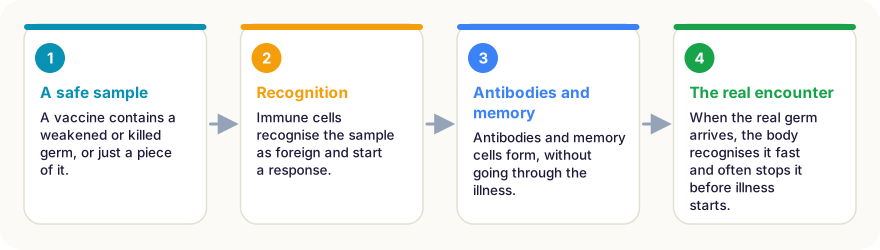
The second time the immune system meets a germ, the memory cells recognise it immediately and produce a faster, stronger response, often stopping the infection before you feel ill. That is why you usually catch chickenpox only once.
Vaccines use this memory. They expose the immune system to a harmless version or part of a germ, such as a weakened or killed microbe, a protein or the genetic instructions to make one. The body produces antibodies and memory cells without having to survive the disease. In 1796, Edward Jenner showed that a boy infected with mild cowpox was protected from smallpox. Thanks to vaccination, smallpox was declared eradicated in 1980, and diseases such as polio and measles have been dramatically reduced.
When the immune system goes wrong
The immune system must strike a balance: strong enough to fight infections, but not so aggressive that it harms the body.
- Allergies happen when it overreacts to harmless things like pollen, dust mites or peanuts.
- In autoimmune diseases, such as type 1 diabetes, rheumatoid arthritis and multiple sclerosis, it mistakenly attacks the body’s own tissues.
- Immunodeficiency, from genetic conditions, some medicines or infections such as HIV, leaves people vulnerable to infections.
Keeping your immune system healthy
There is no magic pill to “boost” immunity in healthy people. But the immune system works best when you:
- get enough sleep;
- eat a varied, balanced diet;
- stay physically active;
- avoid smoking and limit alcohol;
- keep vaccinations up to date;
- wash your hands regularly to reduce exposure to germs.
In short
- The immune system defends in layers: barriers, innate immunity and adaptive immunity.
- Innate immunity reacts within hours with phagocytes, inflammation and fever.
- Adaptive immunity uses B cells (antibodies) and T cells to target specific germs.
- Memory cells make the response faster the second time.
- Vaccines train this memory safely; smallpox was eradicated in 1980.
- Allergies and autoimmune diseases are the immune system overreacting or misfiring.
Frequently asked questions
Why do we get a fever when we are ill?
Fever is part of the immune response. Chemical signals released during infection reset the brain’s thermostat higher. A higher temperature can slow some microbes and speed up immune cells.
What is the difference between a virus and bacteria?
Bacteria are single-celled living organisms that can reproduce on their own; many are harmless or helpful. Viruses are much smaller and can only multiply inside our cells. Antibiotics work against bacteria, not viruses.
What are allergies?
An allergy is when the immune system overreacts to something harmless, such as pollen, dust mites or certain foods, treating it as a threat and causing symptoms like sneezing, itching or swelling.
Can you boost your immune system?
There is no quick trick or supplement that reliably supercharges it in healthy people. Good sleep, a balanced diet, physical activity, not smoking and staying up to date with vaccines all help it work well.
Sources
- Medzhitov, R. & Janeway, C. (2000). Innate immunity. New England Journal of Medicine
- MedlinePlus – Immune system and disorders
This article is based on peer-reviewed research and publications from trusted institutions, and it is reviewed regularly. How we work →
You might also wonder
All in Human Body →
Why Do Knuckles Crack? The Bubble Behind the Pop, and Whether It Causes Arthritis
Cracking your knuckles forms a gas cavity in the joint. What MRI scans revealed, why the same knuckle won’t crack twice in a row and whether it is harmful.

Why Do We Need Sleep? What Happens in Your Brain and Body Every Night
We spend about a third of our lives asleep. What sleep does for memory, the brain and immunity, how much you need at every age and what happens without it.

Why Do We Blush? The Science of a Very Human Reaction
Blushing is the only facial expression we cannot fake or hide. What happens in the body when we turn red, why does it start, and is it actually useful?
How Does Caffeine Keep You Awake? Adenosine, Half-Life and Sleep
Caffeine doesn’t give you energy; it blocks a sleepiness signal in the brain. How it works, how long it lasts, how much is safe and why it can ruin your sleep.
Why Do Your Ears Pop on a Plane? Cabin Pressure and the Eustachian Tube
Ears block and pop on planes because cabin pressure changes faster than your middle ear can adjust. Why descent is worse, and the tricks that actually help.

What Causes Muscle Cramps? Why Muscles Suddenly Lock Up
A muscle cramp is a sudden, painful contraction you can’t control. What science says about the causes, why stretching helps and how to prevent night cramps.