Why Do We Blush? The Science of a Very Human Reaction
Blushing is the only facial expression we cannot fake or hide. What happens in the body when we turn red, why does it start, and is it actually useful?

Short answer
We blush when we feel exposed in front of others, for example when embarrassed, praised or caught out. The sympathetic nervous system, the same system behind the “fight or flight” response, releases adrenaline, and blood vessels in the cheeks, forehead, ears and neck widen. More blood flows close to the skin, so the face turns red and feels warm. Many researchers think blushing evolved as an honest social signal: it shows others that we know we made a mistake, which tends to make them more forgiving.
In this article (6)
You trip on the stairs in front of a full room, or someone praises you out loud, and suddenly your face feels hot. You know without a mirror that you are turning red, and knowing it only makes it worse. Charles Darwin called blushing “the most peculiar and the most human of all expressions”. Science is now starting to explain why.
What happens in the body
Blushing is controlled by the sympathetic nervous system, the part of the nervous system that prepares us for action in stressful moments. When we feel suddenly exposed, it releases adrenaline.
In most of the body, adrenaline makes small blood vessels narrow. But the veins and capillaries of the face behave differently. The skin of the cheeks, forehead, ears and neck has many small blood vessels close to the surface, and they widen in response. More blood flows in, and because the skin there is thin, the extra blood shows through as red.
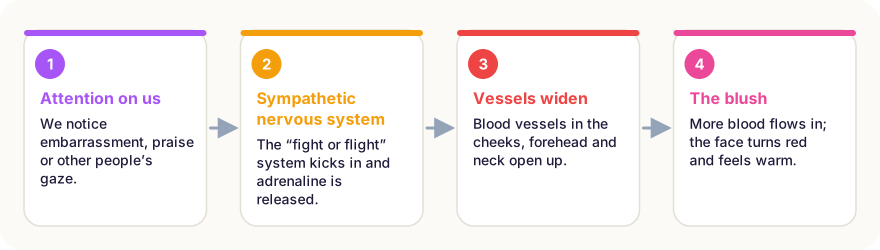
A blush usually starts within seconds, peaks quickly and fades over a few minutes. Measurements show that the cheeks also become measurably warmer.
What makes us blush?
Embarrassment is the classic trigger, but it is not the only one. Researchers have found that people blush in a wide range of situations where they suddenly become the centre of attention:
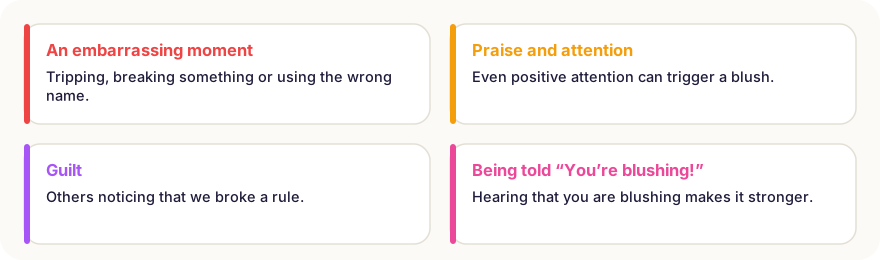
Even positive attention, such as being sung “Happy Birthday” or receiving a compliment, can make people blush. The key ingredient seems to be the feeling that others are looking at us and evaluating us.
What is going on in the brain?
For a long time psychologists assumed that blushing requires complex thinking about what other people think of us. A 2024 study by Milica Nikolić and colleagues tested this in a memorable way. Teenage girls and young women sang karaoke songs, and later watched videos of themselves singing while lying in a brain scanner. Watching themselves made their cheeks warmer.
The brain areas that became active were mainly involved in emotional arousal, attention and processing what they were seeing, including the cerebellum and visual areas. Areas typically used for thinking about other people’s thoughts were not strongly involved. The results suggest that blushing may be a fairly automatic response to self-awareness, rather than the result of careful reasoning about how others judge us.
Why would evolution give us a red face?
At first, blushing looks like a disadvantage: it reveals our feelings at the worst possible moment. But that may be exactly the point.
A blush is very hard to fake and almost impossible to hide. That makes it an honest signal. When we break a social rule or make an embarrassing mistake, blushing shows others that we know it and care about it.
In 2009 Corine Dijk and colleagues showed volunteers pictures of people who had just caused a mishap, such as knocking over a cup in a shop. When the person was shown blushing, observers judged them more favourably and found them more trustworthy than when the same person looked neutral. Blushing seems to work as a non-verbal apology that calms social tension.
When blushing becomes a problem
Some people blush very easily and worry about it constantly. Intense fear of blushing, sometimes called erythrophobia, can lead people to avoid meetings, presentations or social events, and is often linked to social anxiety.
Ironically, focusing on the blush makes it stronger. Psychological approaches that help people shift attention away from themselves and reduce anxiety can be effective. If blushing seriously affects daily life, it is worth talking to a doctor or psychologist.
In short
- Blushing is driven by the sympathetic nervous system and adrenaline, which make vessels in the face widen.
- It is triggered by sudden social attention: embarrassment, praise, guilt or being told you are blushing.
- A 2024 brain study suggests blushing is closely linked to self-awareness and arousal.
- It may have evolved as an honest signal that works like an apology and makes others more forgiving.
- Strong fear of blushing is common and treatable.
Frequently asked questions
Can you stop yourself from blushing?
Not directly; blushing is an automatic reflex. Trying hard not to blush, or being told “you are blushing”, often makes it worse. Accepting it and focusing on the conversation instead usually helps it fade.
Do people with darker skin blush?
Yes. The same changes in blood flow happen in everyone, but on darker skin the colour change is less visible. People still feel the warmth.
Is it normal to blush a lot?
Some people blush more easily than others, and that is normal. If fear of blushing seriously limits your social life, a doctor or psychologist can help; it is a recognised and treatable problem.
Is blushing the same as flushing?
Not quite. Blushing is triggered by social emotions. Flushing can have other causes, such as exercise, heat, alcohol, spicy food, menopause or some medical conditions.
Sources
- Dijk, C., de Jong, P. J. & Peters, M. L. (2009). The remedial value of blushing in the context of transgressions and mishaps. Emotion
- Nikolić, M. et al. (2024). The blushing brain: neural substrates of cheek temperature increase in response to self-observation. Proceedings of the Royal Society B
- Charles Darwin (1872). The Expression of the Emotions in Man and Animals, chapter XIII – Darwin Online
This article is based on peer-reviewed research and publications from trusted institutions, and it is reviewed regularly. How we work →
You might also wonder
All in Human Body →
How Does Caffeine Keep You Awake? Adenosine, Half-Life and Sleep
Caffeine doesn’t give you energy; it blocks a sleepiness signal in the brain. How it works, how long it lasts, how much is safe and why it can ruin your sleep.
Why Do Your Ears Pop on a Plane? Cabin Pressure and the Eustachian Tube
Ears block and pop on planes because cabin pressure changes faster than your middle ear can adjust. Why descent is worse, and the tricks that actually help.
Why Do Fingers Wrinkle in Water? Your Nervous System’s Surprising Trick
Why do fingertips prune after a long bath? It is not just skin soaking up water — it is your nervous system at work. Plus the debate over what wrinkles are for.
Why Do We Yawn? The Science of Contagious Yawning
Do we yawn because we are tired, bored or low on oxygen? The brain-cooling theory and why seeing someone yawn makes you yawn too, explained with research.
Why Does Hair Turn Grey? Stress, Genes and Stem Cells in the Follicle
Why does hair go grey, can stress really turn it white and can grey hair come back? The pigment cells in hair follicles and what new research has found.
Why Are Fingerprints Unique? A Pattern That Begins in the Womb
How do fingerprints form, why do even identical twins have different prints, and what are fingerprints for? The 2023 discovery and the science behind them.