Why Do We Yawn? The Science of Contagious Yawning
Do we yawn because we are tired, bored or low on oxygen? The brain-cooling theory and why seeing someone yawn makes you yawn too, explained with research.
Short answer
Scientists have not settled on a single cause, but the best-supported explanation is that yawning helps cool the brain: the deep breath and powerful jaw stretch increase blood flow and swap warmer blood for cooler blood. The popular idea that yawning boosts oxygen has not held up in experiments. Contagious yawning appears to be linked to social bonding and mimicry.
In this article (6)
You may yawn while reading this. Just seeing the word "yawn" can be enough. Yawning is something we all do every day, yet science still has not fully explained it. Recent research has, however, turned up some fascinating clues.
What happens in the body when we yawn?
An average yawn lasts about six seconds and has three phases:
- The mouth opens wide while you take a long, deep breath.
- The muscles of the jaw, face and neck stretch hard for a moment — even your eardrums tighten slightly.
- You breathe out more quickly and the muscles relax.
This brief routine noticeably changes blood flow inside the skull, and that is where the strongest clue about yawning’s purpose comes from.
The old theory: “not enough oxygen”
For a long time people assumed yawning raised oxygen levels in the blood or flushed out excess carbon dioxide. It sounded sensible: breathing slows when we are sleepy, so a yawn would “catch up”.
When the idea was tested, it fell apart. In psychologist Robert Provine’s experiments in the 1980s, volunteers breathed air with far more oxygen or carbon dioxide than normal, and their yawning rate did not change. People who exercise hard, and need much more oxygen, do not yawn more while doing so either.
The current favourite: cooling the brain
Today the best-supported explanation is the brain-cooling hypothesis. The idea goes like this:
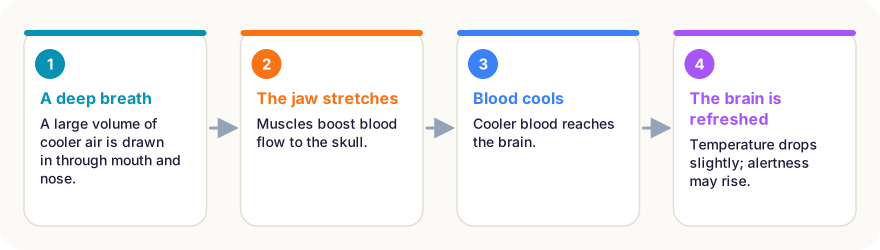
- The deep breath draws cool air over blood vessels in the mouth and nasal cavity.
- The strong jaw stretch speeds up blood flow to and from the brain.
- Slightly warmer blood is replaced with cooler blood.
The brain is very sensitive to temperature and works best within a narrow range. Tiredness, sleep deprivation and boredom can all affect brain temperature — which may be exactly why we yawn more at those moments.
Several findings support the hypothesis:
- People who held a cold pack to their forehead, or breathed only through the nose, were less likely to catch a yawn.
- Yawning becomes more frequent in mild weather and less frequent when it is very hot or very cold. If the air is warmer than the body, a yawn cannot cool; if it is very cold, there is no need to.
- Across mammals, species with bigger brains and more cortical neurons yawn longer, and humans rank near the top.
All this suggests yawning is not just about sleep. It may help the brain stay alert and perform well, which could explain why people yawn before exams or before going on stage.
Why is yawning contagious?
Perhaps the strangest thing about yawning is that it spreads. Seeing, hearing or even reading about a yawn can trigger one. Roughly half of people are susceptible to contagious yawning.
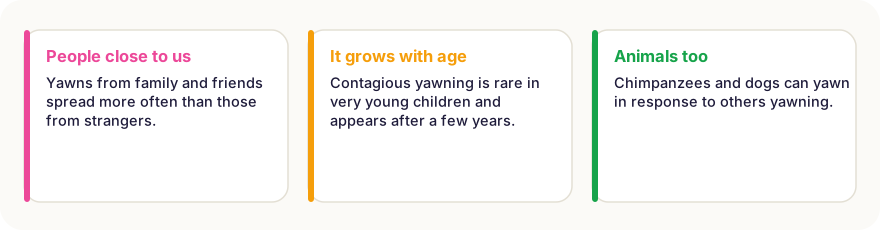
Researchers have noticed a few intriguing patterns:
- Contagious yawning happens more often between family and friends than strangers.
- In children it usually becomes noticeable after the age of four or five — around the time they get better at understanding other people’s feelings.
- It has also been observed in social animals such as chimpanzees, bonobos and dogs.
That is why contagious yawning has been linked to empathy and social synchrony. One idea is that yawning together aligns the alertness of a group. The empathy link is debated, though: some large studies found it weaker than expected, so the question remains open.
Can you stop a yawn?
Suppressing a yawn completely is hard, and a stifled yawn rarely feels satisfying. If the brain-cooling hypothesis is right, these tricks may reduce the urge:
- Breathing deeply through your nose
- Drinking something cold or splashing cold water on your face
- Moving to a cooler room
In short
Yawning is most likely an ancient mechanism that cools the brain and helps keep us alert. The oxygen theory has not survived testing, while contagious yawning may be a trace of our social nature. If you yawned a few times reading this, your brain was probably just after a little fresh air.
Frequently asked questions
Does yawning give your body more oxygen?
It is a common belief, but experiments do not support it. In the 1980s, people breathing air rich in oxygen or carbon dioxide yawned just as often as usual.
Why do I yawn when someone else yawns?
Contagious yawning affects roughly half of people and happens more often with people we are close to. Links to social bonding and empathy are being studied but are not yet settled.
Do animals yawn?
Yes. Most vertebrates, from birds to fish, yawn. Studies also suggest dogs can catch yawns from their owners.
Is yawning a lot a sign of illness?
Usually it just reflects tiredness or lack of sleep. Unexplained, excessive yawning can be a side effect of some medications or a sign of another problem, so it is worth mentioning to a doctor.
Sources
- Gallup & Gallup (2007) – Yawning as a Brain Cooling Mechanism, Evolutionary Psychology
- Gallup & Eldakar (2011) – Contagious Yawning and Seasonal Climate Variation, Frontiers in Evolutionary Neuroscience
- Gallup et al. (2016) – Yawn duration predicts brain weight and cortical neuron number in mammals, Biology Letters
This article is based on peer-reviewed research and publications from trusted institutions, and it is reviewed regularly. How we work →
You might also wonder
All in Human Body →
Why Do Fingers Wrinkle in Water? Your Nervous System’s Surprising Trick
Why do fingertips prune after a long bath? It is not just skin soaking up water — it is your nervous system at work. Plus the debate over what wrinkles are for.
Why Does Hair Turn Grey? Stress, Genes and Stem Cells in the Follicle
Why does hair go grey, can stress really turn it white and can grey hair come back? The pigment cells in hair follicles and what new research has found.
Why Are Fingerprints Unique? A Pattern That Begins in the Womb
How do fingerprints form, why do even identical twins have different prints, and what are fingerprints for? The 2023 discovery and the science behind them.
What Causes Brain Freeze? The Secret of the Ice-Cream Headache
What is that sharp pain in your forehead when you eat something cold? How brain freeze happens, why you feel it in your forehead and how to make it stop.
Why Does Your Stomach Growl? Hunger Noises and the Gut’s Cleaning Cycle
Why does your stomach rumble when you are hungry, and does it growl when you are full? Where gut sounds come from and the cleaning cycle of an empty gut.
Why Do We Sneeze? The Sneeze Reflex, Sun Sneezing and the Risk of Holding It In
How does a sneeze happen, why do some people sneeze when they look at the sun, and is holding in a sneeze dangerous? The science of the nose’s defence reflex.