What Causes Brain Freeze? The Secret of the Ice-Cream Headache
What is that sharp pain in your forehead when you eat something cold? How brain freeze happens, why you feel it in your forehead and how to make it stop.
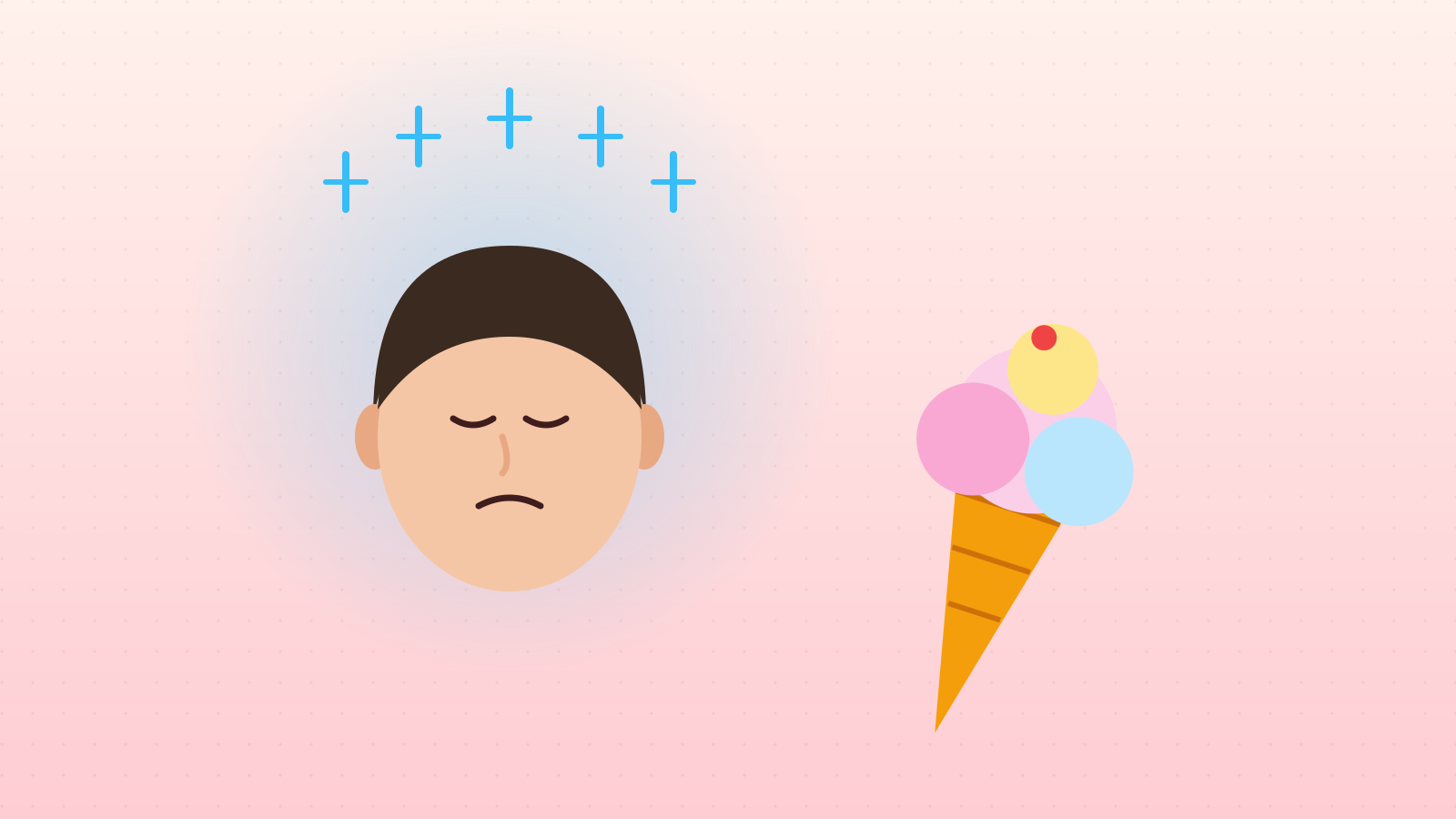
Short answer
Brain freeze is a short headache that happens when something very cold touches the roof of your mouth — the palate. The cold makes blood vessels in the palate and those supplying the brain first narrow and then rapidly widen. That sudden change makes the trigeminal nerve send pain signals, and the brain interprets them as coming not from the palate but from the forehead, which the same nerve also serves. The pain usually fades within a few seconds to a minute.
In this article (7)
Remember wolfing down a big spoonful of ice cream on a hot summer day? A few seconds later a sharp pain stabs the middle of your forehead. You squint, put down the spoon and wait for it to pass. This strange experience, familiar to almost everyone, is called brain freeze. But if the ice cream touched the inside of your mouth, why do you feel the pain in your forehead?
Does your brain actually freeze?
No. Despite the name, nothing in your brain freezes. The skull and brain are among the best-protected parts of the body, and a few spoonfuls of ice cream cannot change their temperature meaningfully.
Brain freeze is really a kind of headache. Its lengthy medical name is sphenopalatine ganglioneuralgia, after a nerve cluster just behind the roof of the mouth (the sphenopalatine ganglion). It is also called an “ice-cream headache” or “cold-stimulus headache”.
How does brain freeze happen?
Brain freeze unfolds in a few steps, within seconds:
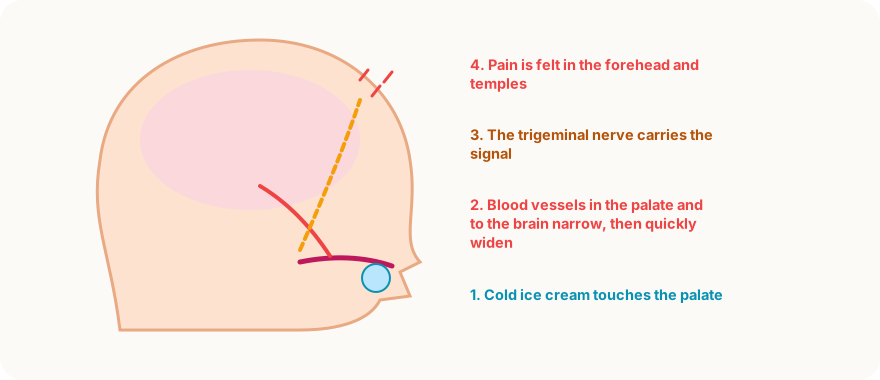
1. Cold touches the palate
The palate, the roof of your mouth, is rich in nerve endings and blood vessels. When something very cold touches it, its temperature drops quickly.
2. Blood vessels narrow, then widen
The body first responds to cold by narrowing blood vessels to reduce heat loss. Then, to keep the brain warm, it rapidly increases blood flow and the vessels widen.
In research at Harvard University, volunteers sipped ice water while blood flow to their brains was measured. At the moment brain freeze began, blood flow through the anterior cerebral artery, which supplies the front of the brain, rose sharply; the pain faded when the artery narrowed again. The researchers believe this rapid widening may be the main source of the pain.
3. The trigeminal nerve raises the alarm
These sudden changes in the vessels stimulate the trigeminal nerve, which carries sensation from most of the face and head. The nerve sends a “pain” signal to the brain.
4. The pain is felt in the forehead
Here is the strange part: the brain perceives the pain as coming not from the palate but from the forehead and temples. The trigeminal nerve carries sensation from both the palate and the forehead, and the brain cannot tell which branch the signal came from, so it projects the pain onto the area it is most used to. This is called referred pain.
Something similar happens during a heart attack, when pain from the heart can be felt in the left arm or jaw.
Do fast eaters get it more?
In a light-hearted 2002 study in Canada, middle-school students were split into two groups. One group was told to eat 100 millilitres of ice cream in 5 seconds; the other to eat it slowly.
The result was clear: students who wolfed their ice cream got brain freeze about twice as often as those who ate slowly. Published in the BMJ’s Christmas issue, the study scientifically confirmed the simplest way to prevent brain freeze: eat slowly.
Who gets it most?
Not everyone is equally sensitive:
- People with migraines are markedly more prone, suggesting migraines and brain freeze may share similar blood-vessel and nerve mechanisms.
- Children and teenagers may get it more often because they tend to eat cold food faster.
- Some people say they hardly ever experience it.
How to stop brain freeze
The good news: brain freeze usually passes on its own within 10 seconds to a minute. A few tricks may shorten it:
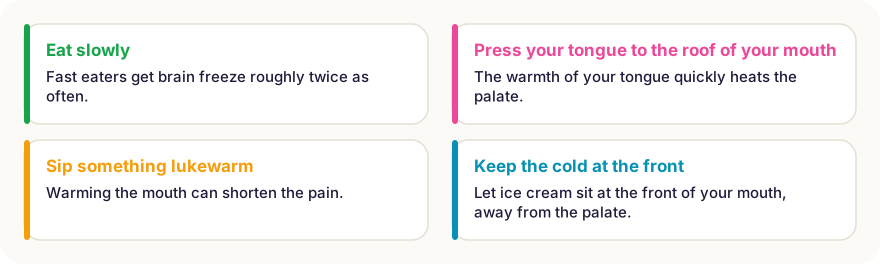
| Method | Why it works |
|---|---|
| Pressing your tongue to the roof of your mouth | The warmth of the tongue quickly heats the palate |
| Sipping lukewarm water | Returns the mouth to normal temperature |
| Closing your mouth and breathing through your nose | Warm breath may warm the palate |
| Keeping cold food at the front of your mouth | Reduces contact with the palate |
| Eating slowly | Stops the palate cooling suddenly |
Carrying on eating once the pain starts usually prolongs it. It is best to pause briefly and let your palate warm up.
Why does brain freeze matter to science?
This innocent pain is an interesting research tool. Brain freeze is a safe, fast and easily triggered headache, so researchers study it to understand the mechanisms of more serious headaches such as migraine and cluster headache. The role of sudden blood-vessel widening in headaches is one of the key questions.
In short
Brain freeze is a short, harmless headache caused when something very cold touches the palate and blood vessels rapidly narrow and then widen. The trigeminal nerve passes the change to the brain as pain, which the brain feels as if it were in the forehead. It happens about twice as often to fast eaters. Eating slowly, pressing your tongue to the roof of your mouth or sipping something lukewarm are the easiest ways to prevent it and cut it short.
Frequently asked questions
Is brain freeze dangerous?
No. Brain freeze is brief and harmless. Your brain does not actually freeze, and the pain usually lasts less than a minute.
Why do some people never get brain freeze?
Sensitivity varies. Research shows that people who suffer from migraines are more prone to brain freeze, while some people almost never experience it.
Is it only ice cream that causes brain freeze?
No. Slushies, iced coffee, ice-cold drinks and even snow can all trigger it, especially when consumed quickly.
Can cold winter air cause brain freeze?
Rapidly breathing very cold air through the mouth can cause a similar pain in some people, but the most common trigger is cold food or drink touching the palate.
Sources
This article is based on peer-reviewed research and publications from trusted institutions, and it is reviewed regularly. How we work →
You might also wonder
All in Human Body →
Why Do We Blush? The Science of a Very Human Reaction
Blushing is the only facial expression we cannot fake or hide. What happens in the body when we turn red, why does it start, and is it actually useful?
How Does Caffeine Keep You Awake? Adenosine, Half-Life and Sleep
Caffeine doesn’t give you energy; it blocks a sleepiness signal in the brain. How it works, how long it lasts, how much is safe and why it can ruin your sleep.
Why Do Your Ears Pop on a Plane? Cabin Pressure and the Eustachian Tube
Ears block and pop on planes because cabin pressure changes faster than your middle ear can adjust. Why descent is worse, and the tricks that actually help.
What Causes Muscle Cramps? Why Muscles Suddenly Lock Up
A muscle cramp is a sudden, painful contraction you can’t control. What science says about the causes, why stretching helps and how to prevent night cramps.
What Determines Eye Colour? Why Blue Eyes Have No Blue Pigment
Eye colour depends on the amount of melanin in the iris, not on blue or green pigments. The genes involved, why babies’ eyes change, and blue eyes’ origin.
Why Do We Sweat? How Your Body’s Built-In Air Conditioning Works
Sweating cools you down as it evaporates from your skin. How sweat glands work, why sweat smells, why humidity feels worse and how much water you can lose.