What Determines Eye Colour? Why Blue Eyes Have No Blue Pigment
Eye colour depends on the amount of melanin in the iris, not on blue or green pigments. The genes involved, why babies’ eyes change, and blue eyes’ origin.
Short answer
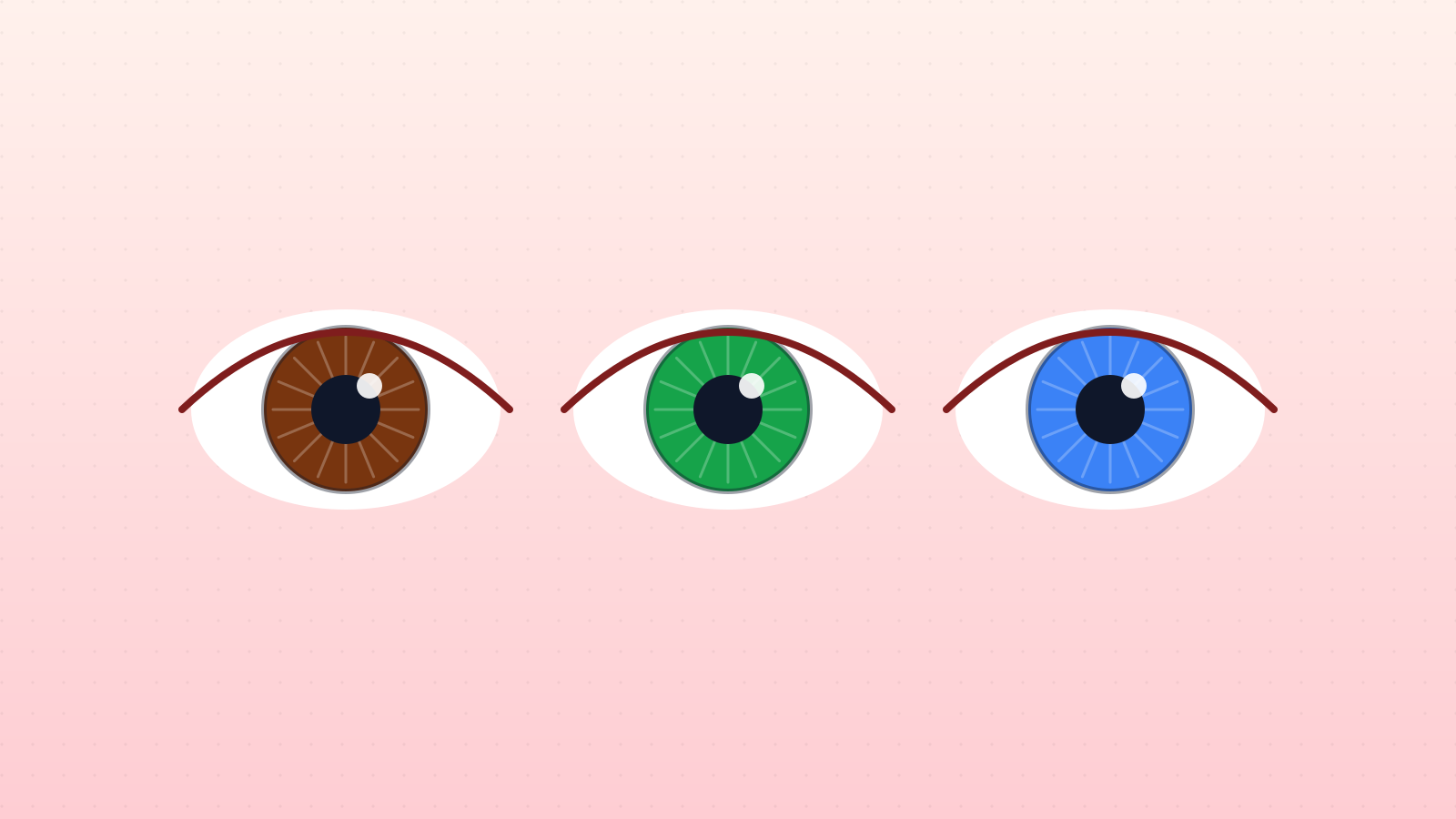
Eye colour depends mainly on how much of the brown pigment melanin is in the front layer of the iris and how that layer scatters light. Brown eyes have a lot of melanin; hazel and green eyes have less; blue eyes have very little. Blue eyes contain no blue pigment at all: the iris tissue scatters short, blue wavelengths of light, much as the sky looks blue. Eye colour is shaped by more than ten genes, with the biggest effect from OCA2 and a nearby switch in the HERC2 gene. Brown is by far the most common eye colour in the world.
In this article (7)
Brown, hazel, green, grey, blue: human eyes come in a remarkable range of colours. You might expect each colour to come from its own pigment, a blue dye for blue eyes and a green one for green eyes. In fact, almost all of the variety comes from just one pigment, and how much of it there is.
One pigment, many colours
The coloured ring of the eye, the iris, has several layers. The back layer is packed with dark pigment in almost everyone. What makes the difference is the front layer, called the stroma, and how much melanin it contains. Melanin is the same brown-black pigment that colours skin and hair.
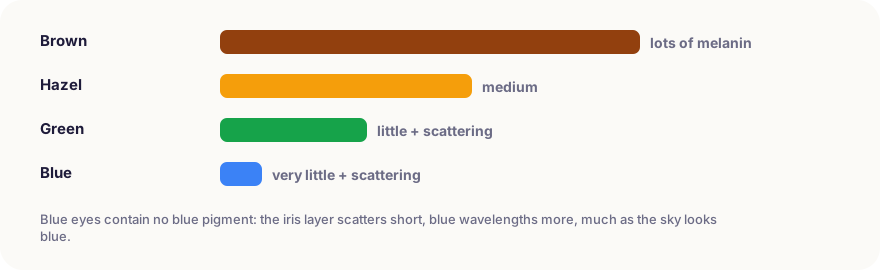
- Brown eyes have a lot of melanin in the stroma, which absorbs most light.
- Hazel and green eyes have less melanin, plus a yellowish pigment and some light scattering.
- Blue eyes have very little melanin in the stroma.
Why blue eyes are blue
If blue eyes have almost no pigment in front, why aren’t they colourless? Because the tissue of the stroma scatters light. Short, blue wavelengths are scattered more strongly than long, red ones, so blue light bounces back out of the eye while other colours pass through and are absorbed by the dark layer behind. It is a similar effect to the one that makes the sky blue. There is no blue pigment in a blue eye.
That is also why eye colour can seem to change with lighting or clothing: different light conditions change how much is scattered back.
The genes behind it
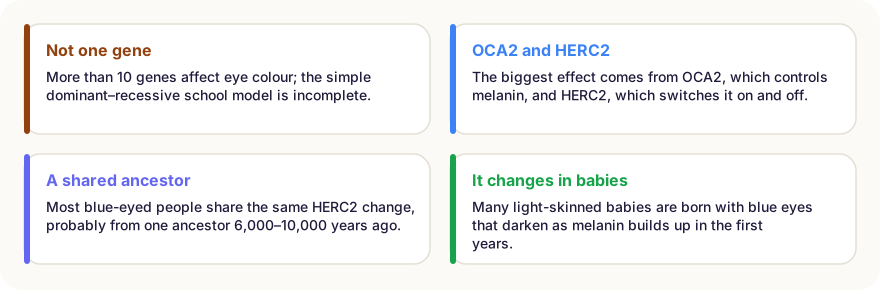
Many people learn at school that brown is “dominant” and blue is “recessive”, controlled by a single gene. The reality is more complicated. More than ten genes influence eye colour. The biggest effect comes from a gene called OCA2, which helps make melanin in the iris, and a nearby region of another gene, HERC2, which acts as a switch that turns OCA2 up or down.
In 2008 a team led by Hans Eiberg in Copenhagen found that almost all blue-eyed people they studied shared the same single-letter change in this HERC2 switch, which dials down melanin production in the iris. That suggests blue eyes trace back to a single ancestor who lived perhaps 6,000 to 10,000 years ago.
Brown is the world’s eye colour
Worldwide, brown is by far the most common eye colour, found in most people in Africa, Asia and the Americas. Blue eyes are most common in northern Europe, especially around the Baltic Sea. Green eyes are one of the rarest colours globally.
Why babies’ eyes change
Many light-skinned babies are born with blue or grey eyes because their irises contain little melanin at birth. Over the first months and years, melanin builds up, and the eyes may turn green, hazel or brown. Babies with darker skin are usually born with brown eyes that stay brown.
Two colours at once
Some people have heterochromia: two differently coloured eyes, or patches of different colours in one iris. It is usually harmless and present from birth, but a change in eye colour in adulthood should be checked by a doctor.
In short
- Eye colour depends mainly on how much melanin is in the front of the iris.
- Brown eyes have lots of melanin; blue eyes have very little.
- Blue eyes have no blue pigment; the iris scatters blue light, like the sky.
- More than ten genes are involved, especially OCA2 and HERC2.
- Most blue-eyed people may descend from one ancestor who lived 6,000–10,000 years ago.
- Brown is the most common eye colour worldwide.
Frequently asked questions
Can two blue-eyed parents have a brown-eyed child?
It is uncommon but possible. Because many genes are involved, the simple school rule that two blue-eyed parents always have blue-eyed children is not completely reliable.
Why are many babies born with blue eyes?
Many light-skinned babies have little melanin in the iris at birth. Melanin builds up over the first months and years, so their eyes may turn green, hazel or brown. Babies with darker skin are usually born with brown eyes.
What is the rarest eye colour?
Green is one of the rarest natural eye colours worldwide, found in only a small percentage of people. Truly grey and amber eyes are also uncommon.
Can eye colour change in adults?
Eye colour is usually stable in adults. A noticeable change can be a sign of certain eye diseases or medication effects and should be checked by a doctor.
Sources
- Sturm, R. A. & Frudakis, T. N. (2004). Eye colour: portals into pigmentation genes and ancestry. Trends in Genetics
- Eiberg, H. et al. (2008). Blue eye color in humans may be caused by a perfectly associated founder mutation in a regulatory element located within the HERC2 gene. Human Genetics
This article is based on peer-reviewed research and publications from trusted institutions, and it is reviewed regularly. How we work →
You might also wonder
All in Human Body →
Why Do We Blush? The Science of a Very Human Reaction
Blushing is the only facial expression we cannot fake or hide. What happens in the body when we turn red, why does it start, and is it actually useful?

How Does Caffeine Keep You Awake? Adenosine, Half-Life and Sleep
Caffeine doesn’t give you energy; it blocks a sleepiness signal in the brain. How it works, how long it lasts, how much is safe and why it can ruin your sleep.

Why Do Your Ears Pop on a Plane? Cabin Pressure and the Eustachian Tube
Ears block and pop on planes because cabin pressure changes faster than your middle ear can adjust. Why descent is worse, and the tricks that actually help.

What Causes Muscle Cramps? Why Muscles Suddenly Lock Up
A muscle cramp is a sudden, painful contraction you can’t control. What science says about the causes, why stretching helps and how to prevent night cramps.
Why Do We Sweat? How Your Body’s Built-In Air Conditioning Works
Sweating cools you down as it evaporates from your skin. How sweat glands work, why sweat smells, why humidity feels worse and how much water you can lose.
Why Do Fingers Wrinkle in Water? Your Nervous System’s Surprising Trick
Why do fingertips prune after a long bath? It is not just skin soaking up water — it is your nervous system at work. Plus the debate over what wrinkles are for.