Why Do Your Ears Pop on a Plane? Cabin Pressure and the Eustachian Tube
Ears block and pop on planes because cabin pressure changes faster than your middle ear can adjust. Why descent is worse, and the tricks that actually help.
Short answer
Your ears pop on a plane because the air pressure in the cabin changes during take-off and landing, while the air trapped in your middle ear stays at the old pressure for a while. The pressure difference pushes on the eardrum and makes the ear feel blocked. A small channel called the Eustachian tube connects the middle ear to the back of the throat; when it opens, for example when you swallow or yawn, air rushes through, the pressure equalises and you hear a pop. Descent is usually worse because the tube lets air out more easily than it lets air in.
In this article (7)
The plane starts its descent, and suddenly the world sounds muffled. Your ears feel full, maybe even painful, until you swallow and hear a sharp pop. Almost everyone who flies knows the feeling. It is a small lesson in physics happening right inside your head.
The air in the cabin changes pressure
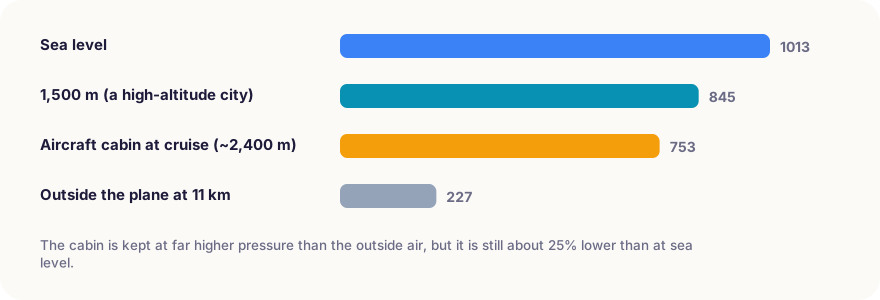
At sea level, the air around us presses with a pressure of about 1,013 hectopascals. The higher you go, the thinner the air and the lower the pressure. At an airliner’s cruising altitude of around 11 kilometres, the outside air pressure is less than a quarter of that at sea level, far too low to breathe.
Planes are therefore pressurised, but not all the way to sea-level pressure. Keeping the cabin at full sea-level pressure would strain the fuselage on every flight. Aviation rules allow a maximum “cabin altitude” of 8,000 feet (about 2,400 metres). In practice, during cruise you sit in air that feels like a mountain town.
Your middle ear is an air pocket
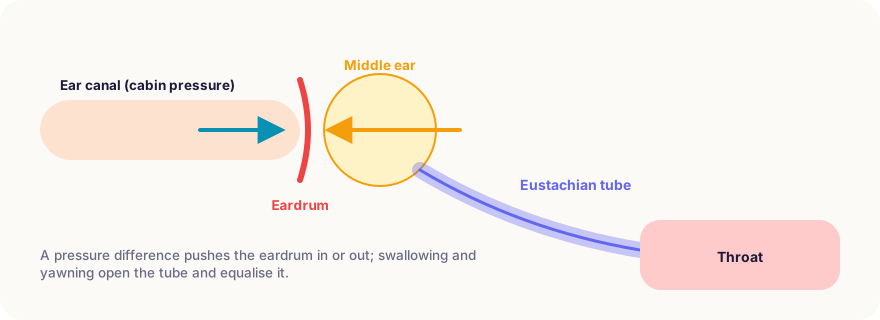
Behind the eardrum lies the middle ear, a small air-filled cavity containing three tiny bones that pass sound to the inner ear. For the eardrum to vibrate freely, the air pressure on both sides should be the same.
The middle ear is connected to the back of the nose and throat by a narrow channel about 3.5 cm long: the Eustachian tube. Most of the time it is closed. It opens briefly when you swallow, yawn or chew, letting a little air through to balance the pressure.
Why ears pop on the way up
As the plane climbs, the cabin pressure falls. The air trapped in your middle ear is now at a higher pressure than the cabin, so it pushes the eardrum outwards. Sounds become muffled.
Fortunately, excess air escapes easily. The higher pressure inside forces the tube open, air bubbles out into your throat and you feel a little pop. Many people barely notice it during take-off.
Why descent is harder
On the way down the situation reverses. Cabin pressure rises, and now the outside air pushes the eardrum inwards. To fix this, air must flow into the middle ear through the Eustachian tube.
That is harder. The throat end of the tube is soft and slit-like, and the higher outside pressure tends to squeeze it shut rather than open it. If you do not swallow often enough, the difference can grow, and the ear may start to hurt. This is often called airplane ear or, in medical terms, ear barotrauma.
Tricks that help
The goal is simple: open the Eustachian tube regularly, especially during descent.
- Swallow and yawn often. Sucking a sweet or chewing gum makes you swallow more.
- Stay awake for the landing. We swallow much less while asleep.
- Try the Valsalva manoeuvre gently. Pinch your nose, close your mouth and blow softly, as if blowing up a balloon, until you feel the ears pop. Never blow hard.
- Try the Toynbee manoeuvre. Pinch your nose and swallow at the same time.
- Help babies swallow. Breastfeeding, a bottle or a dummy during take-off and landing is often enough.
- Be careful with colds and allergies. A swollen nose and tube make equalising difficult. Ask a pharmacist or doctor before flying with a blocked nose.
Special earplugs that slow down pressure changes can help some people, especially frequent flyers.
When to see a doctor
Blocked ears normally clear within minutes to a few hours after landing. If pain is severe, if hearing stays reduced for more than a day or two, or if there is fluid, bleeding or dizziness, see a doctor. Large pressure differences can occasionally cause fluid behind the eardrum or a small tear.
The same physics explains why ears pop in a fast lift, when driving over mountain passes and, much more strongly, when diving underwater.
In short
- Cabin pressure falls during the climb and rises during descent; at cruise it feels like 1,800–2,400 m altitude.
- The middle ear is an air pocket that must match the outside pressure.
- The Eustachian tube connects it to the throat and opens when you swallow or yawn.
- Descent is harder because higher outside pressure tends to squeeze the tube shut.
- Swallowing, yawning, gentle Valsalva and staying awake during landing all help.
- Persistent pain or hearing loss after a flight should be checked by a doctor.
Frequently asked questions
Why does it hurt more when the plane lands?
During descent the cabin pressure rises, and the higher outside pressure squeezes the soft end of the Eustachian tube shut. Air has to be pushed into the middle ear, which is harder than letting it escape during the climb.
Why do babies cry on planes?
Babies have shorter, more horizontal Eustachian tubes that do not open as easily, and they cannot pop their ears on purpose. Feeding or giving a dummy during take-off and landing makes them swallow, which helps.
Is it safe to fly with a cold?
A cold or allergy can swell the Eustachian tube and make equalising difficult, sometimes painful. If you must fly, ask a pharmacist or doctor for advice, and see a doctor if ear pain or hearing loss lasts after the flight.
Can airplane ear cause damage?
Usually it is just uncomfortable and passes within minutes or hours. Rarely, a large pressure difference can cause fluid or bleeding behind the eardrum or a small tear, known as barotrauma, which needs medical attention.
Sources
- Mayo Clinic – Airplane ear: symptoms and causes
- U.S. Code of Federal Regulations, 14 CFR 25.841 – Pressurized cabins
This article is based on peer-reviewed research and publications from trusted institutions, and it is reviewed regularly. How we work →
You might also wonder
All in Human Body →
Why Do We Blush? The Science of a Very Human Reaction
Blushing is the only facial expression we cannot fake or hide. What happens in the body when we turn red, why does it start, and is it actually useful?
How Does Caffeine Keep You Awake? Adenosine, Half-Life and Sleep
Caffeine doesn’t give you energy; it blocks a sleepiness signal in the brain. How it works, how long it lasts, how much is safe and why it can ruin your sleep.
Why Do Fingers Wrinkle in Water? Your Nervous System’s Surprising Trick
Why do fingertips prune after a long bath? It is not just skin soaking up water — it is your nervous system at work. Plus the debate over what wrinkles are for.
Why Do We Yawn? The Science of Contagious Yawning
Do we yawn because we are tired, bored or low on oxygen? The brain-cooling theory and why seeing someone yawn makes you yawn too, explained with research.
Why Does Hair Turn Grey? Stress, Genes and Stem Cells in the Follicle
Why does hair go grey, can stress really turn it white and can grey hair come back? The pigment cells in hair follicles and what new research has found.
Why Are Fingerprints Unique? A Pattern That Begins in the Womb
How do fingerprints form, why do even identical twins have different prints, and what are fingerprints for? The 2023 discovery and the science behind them.