Why Are Fingerprints Unique? A Pattern That Begins in the Womb
How do fingerprints form, why do even identical twins have different prints, and what are fingerprints for? The 2023 discovery and the science behind them.
Short answer
Fingerprints form in the womb between roughly the 10th and 17th weeks of pregnancy. In the skin of the finger pads, signalling molecules that boost and suppress one another create ridges that spread in waves. These waves start from the fingertip, the centre of the pad and the joint crease. Where and when they start depends on many factors, including the shape of the finger, growth rate and tiny differences in the womb. That is why even identical twins, who share the same genes, have different fingerprints.
In this article (9)
Unlocking your phone, passing passport control or watching a detective drama, fingerprints always play the same role: a unique signature that sets one person apart from everyone else. Every one of the more than 8 billion people on Earth has different fingerprints. So how do these patterns form — and why do even twins with the same genes have different prints?
What is a fingerprint?
The skin of your fingertips, palms and soles is different from the rest of your body. Here it has a pattern of fine raised ridges separated by furrows, which scientists call dermatoglyphs.
Along each ridge runs a line of sweat pores. When you touch a surface, sweat and oils from the ridges leave an invisible copy behind — what police call a “fingerprint”.
Three basic patterns
Although fingerprints vary endlessly, they fall into three main patterns:
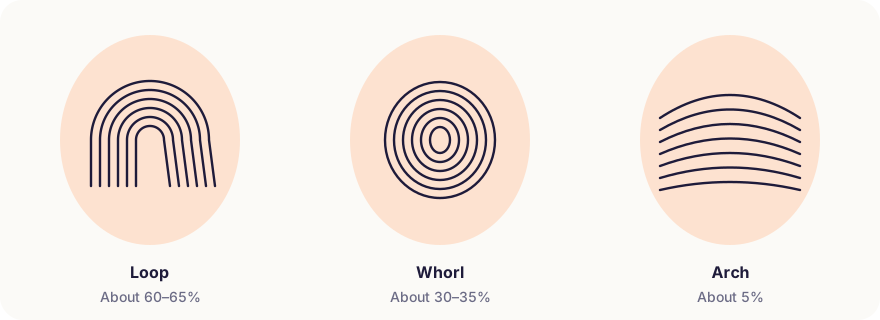
- Loop: ridges enter from one side of the finger, curve round and exit on the same side. The most common pattern, making up about 60–65% of fingerprints.
- Whorl: ridges form circles or spirals around the centre of the finger, in about 30–35% of cases.
- Arch: ridges enter on one side, rise gently in the middle and exit on the other. The rarest pattern, about 5%.
The real uniqueness lies in the details within these patterns. The points where ridges end, fork or join are called minutiae, and a single fingerprint contains hundreds of them. Fingerprint recognition systems compare their positions.
A story that begins in the womb
Fingerprints form long before birth. Around the 10th week of pregnancy, plump pads appear on the fetus’s fingertips. They gradually shrink, and by about the 17th week the ridge pattern is complete — and it barely changes for the rest of a person’s life.
The big discovery of 2023: waves
Exactly how fingerprints form remained a mystery for a long time. In 2023, Denis Headon and colleagues at the University of Edinburgh, together with a research group in China, provided an important answer.
They discovered that three families of signalling molecules work together to form ridges:
- WNT signalling promotes ridge formation;
- another pathway, EDAR, also supports ridges;
- BMP signalling suppresses ridge formation in the spaces between them.
By stimulating and suppressing each other, these molecules set up a pattern-forming system of the kind the mathematician Alan Turing proposed in 1952. Many patterns in nature, from zebra stripes to leopard spots, are thought to form through such systems.
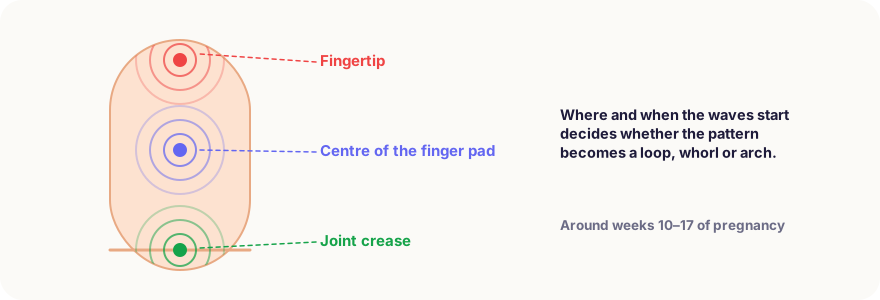
The most surprising finding was that ridges do not form everywhere on the finger at once. Instead, they spread as waves starting from three different points:
- the centre of the finger pad;
- the fingertip;
- the first joint crease of the finger.
The three waves spread towards each other, and the pattern takes shape where they meet. When the waves start and how fast they spread depend on the shape of the finger and the size of the pad:
- if the wave from the centre starts early and strong, ridges form circles — a whorl;
- if the waves are shifted to one side of the pad, a loop forms;
- if the pad is small and the waves weak, ridges run straight across — an arch.
Why do identical twins have different prints?
Identical twins share almost exactly the same DNA, yet their fingerprints differ, because fingerprints are not determined by genes alone.
Genes influence the general type of pattern, which is why twins’ patterns are often similar. But the precise starting point and timing of the waves are affected by small differences such as:
- the fetus’s position in the womb;
- blood flow to the fingers;
- the growth rate of fingers and pads;
- the pressure of amniotic fluid and the fetus’s movements.
These tiny chance events make the points where ridges end and fork unique to every individual. Even the ten fingers of one person all have different prints.
What are fingerprints for?
This is still an open question. For a long time fingerprints were thought to improve grip, increasing friction like the tread on a tyre. Experiments have revealed a more complicated picture:
- on smooth, dry surfaces, ridges can actually reduce friction slightly because they reduce the contact area;
- on wet surfaces, the furrows may help by channelling water away.
A stronger explanation concerns touch. In 2009, researchers in France built an artificial touch sensor with fingerprint-like ridges. When slid across a rough surface, the ridged sensor picked up the vibrations produced by fine textures far better than a smooth one. This suggests fingerprints help us feel the texture of fabric or tiny irregularities on a surface.
The forensic history of fingerprints
Fingerprints have been used as signatures for thousands of years; in ancient Babylon and China they were pressed into clay tablets and documents. Their modern forensic use dates back to the late 19th century:
- British scientist Francis Galton systematically studied the uniqueness and permanence of fingerprints in the 1890s.
- Argentine police officer Juan Vucetich used fingerprint evidence to solve a murder for the first time in 1892.
- Police forces around the world soon began building fingerprint archives.
Today, fingerprint recognition is part of everyday life, from phones to border crossings.
Born without fingerprints
In a very rare genetic condition called adermatoglyphia, people are born without fingerprints. It has been found in only a handful of families worldwide. In 2011 researchers linked it to a change in a gene called SMARCAD1. It is sometimes nicknamed “immigration delay disease”, because people with it can run into trouble at borders that require fingerprints.
In short
Fingerprints form between roughly the 10th and 17th weeks of pregnancy, as waves created by signalling molecules that boost and suppress one another. The waves start at the fingertip, the centre of the pad and the joint crease, and where they meet decides whether a loop, whorl or arch forms. Small chance events affecting those waves mean that even identical twins have different prints. Fingerprints are both a signature that makes us unique and a tool that sharpens our sense of touch.
Frequently asked questions
Do identical twins have the same fingerprints?
No. Identical twins have almost identical DNA but different fingerprints, because the starting points and timing of the ridge-forming waves are affected by small differences such as position in the womb, blood flow and growth rate.
Do fingerprints change?
The basic pattern stays the same for life. Deep wounds can leave permanent scars, and ageing or some kinds of work can wear ridges down, but after superficial scrapes the skin regrows with the same pattern.
Are there people without fingerprints?
Yes, though it is very rare. In a genetic condition called adermatoglyphia, people are born without fingerprints. It has been linked to a change in a gene called SMARCAD1.
What are fingerprints for?
It is still debated. Research shows fingerprint ridges enhance touch, especially helping us sense the texture of rough surfaces. Their contribution to grip depends on the conditions.
Sources
- Glover et al. (2023) – The developmental basis of fingerprint pattern formation and variation, Cell
- Scheibert et al. (2009) – The Role of Fingerprints in the Coding of Tactile Information Probed with a Biomimetic Sensor, Science
- Nousbeck et al. (2011) – A Mutation in a Skin-Specific Isoform of SMARCAD1 Causes Autosomal-Dominant Adermatoglyphia, American Journal of Human Genetics
This article is based on peer-reviewed research and publications from trusted institutions, and it is reviewed regularly. How we work →
You might also wonder
All in Human Body →
Why Do We Blush? The Science of a Very Human Reaction
Blushing is the only facial expression we cannot fake or hide. What happens in the body when we turn red, why does it start, and is it actually useful?

How Does Caffeine Keep You Awake? Adenosine, Half-Life and Sleep
Caffeine doesn’t give you energy; it blocks a sleepiness signal in the brain. How it works, how long it lasts, how much is safe and why it can ruin your sleep.
Why Do Your Ears Pop on a Plane? Cabin Pressure and the Eustachian Tube
Ears block and pop on planes because cabin pressure changes faster than your middle ear can adjust. Why descent is worse, and the tricks that actually help.
What Causes Muscle Cramps? Why Muscles Suddenly Lock Up
A muscle cramp is a sudden, painful contraction you can’t control. What science says about the causes, why stretching helps and how to prevent night cramps.
What Determines Eye Colour? Why Blue Eyes Have No Blue Pigment
Eye colour depends on the amount of melanin in the iris, not on blue or green pigments. The genes involved, why babies’ eyes change, and blue eyes’ origin.
Why Do We Sweat? How Your Body’s Built-In Air Conditioning Works
Sweating cools you down as it evaporates from your skin. How sweat glands work, why sweat smells, why humidity feels worse and how much water you can lose.