How Does Caffeine Keep You Awake? Adenosine, Half-Life and Sleep
Caffeine doesn’t give you energy; it blocks a sleepiness signal in the brain. How it works, how long it lasts, how much is safe and why it can ruin your sleep.
Short answer
Caffeine keeps you awake by blocking adenosine, a substance that builds up in the brain the longer you are awake and makes you feel sleepy. Caffeine has a similar shape, so it fits into adenosine receptors without activating them, and the tiredness signal is muffled. It starts working within about 30 to 60 minutes, and its effect fades slowly: the body removes half of it in about five hours on average. Caffeine does not remove the need for sleep; when it wears off, the built-up adenosine can make you feel tired again.
In this article (8)
For billions of people the day starts with coffee or tea. Within half an hour the fog lifts and the brain seems to switch on. It feels like a burst of energy, but caffeine does not actually give you energy at all. It works by hiding how tired you are.
The sleepiness molecule: adenosine
To understand caffeine, you first need to meet adenosine. Every cell uses a molecule called ATP as fuel. When brain cells work, ATP is used up and adenosine is left over as a by-product.
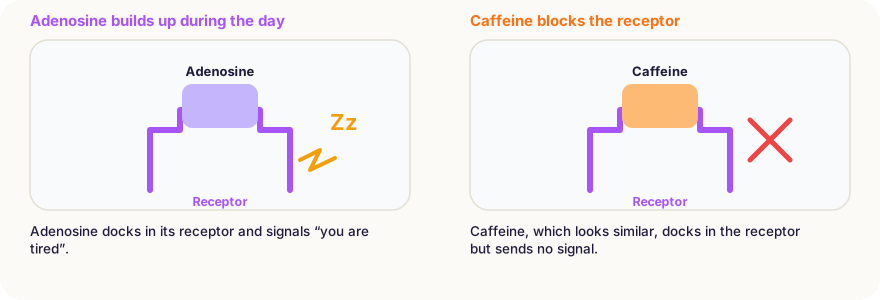
The longer you are awake and the harder your brain works, the more adenosine accumulates around the nerve cells. It docks into special adenosine receptors, which slow down nerve activity and create the growing feeling of sleep pressure. During sleep, adenosine levels fall again, which is part of why we wake up refreshed.
Caffeine is a key that jams the lock
Caffeine’s molecule is shaped very much like adenosine. It slots neatly into the same receptors, but it does not switch them on. Like a key that fits a lock but will not turn, it simply blocks them.
With adenosine’s brakes released, other brain chemicals such as dopamine and glutamate can act more freely. You feel more alert, your reaction times improve and you may feel more cheerful. Caffeine also stimulates the release of adrenaline, which can raise your heart rate slightly.
Notice what does not happen: the adenosine does not go away. Caffeine just stops you from feeling it.
How fast it works and how long it lasts
Caffeine is absorbed quickly from the stomach and small intestine. Levels in the blood usually peak 30 to 60 minutes after a drink, a little later with food.
It is then broken down slowly by the liver, mainly by an enzyme called CYP1A2. On average the body removes half of the caffeine in about five hours, but this “half-life” varies enormously, from about two to more than ten hours. Smoking speeds up the process; pregnancy, the contraceptive pill and some medicines slow it down; and genes play a big role.
That means a coffee at 4 p.m. may still leave a quarter of its caffeine in your body at bedtime.
How much caffeine is in your cup?
The caffeine in a drink varies with the type of bean or leaf, the brewing method and the serving size. These are typical values:
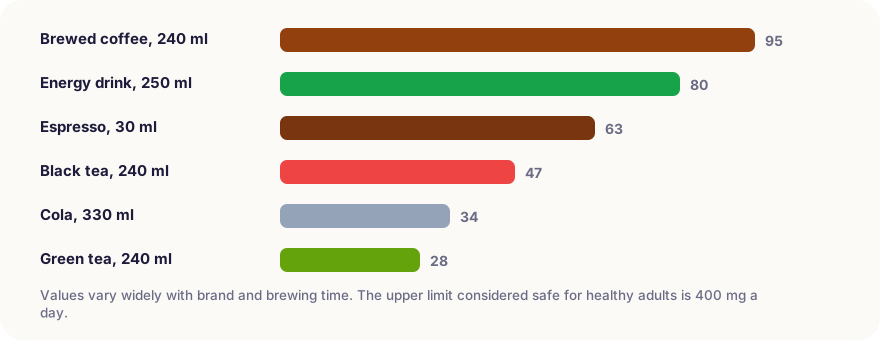
A small cup of Turkish coffee usually contains roughly as much as an espresso, while chocolate contains only small amounts.
How much is safe?
After reviewing the evidence, the European Food Safety Authority concluded in 2015 that for healthy adults up to 400 mg a day, and single doses of up to about 200 mg, do not raise safety concerns. The US Food and Drug Administration gives the same daily figure. During pregnancy the recommended limit is 200 mg a day. Children and teenagers should have much less.
Very high doses can cause a racing heart, anxiety, tremors and stomach upset. Concentrated caffeine powders and pills can be dangerous because it is easy to take far too much.
Caffeine and sleep
Even when caffeine does not stop you from falling asleep, it can make your sleep shallower. In a 2013 study led by Christopher Drake, people took 400 mg of caffeine at bedtime, three hours before or six hours before. Even the dose taken six hours earlier reduced total sleep by more than an hour, and many people did not notice the difference themselves.
Poor sleep then makes you more tired the next day, so you reach for more coffee, a cycle many people know well.
Tolerance and withdrawal
If you drink coffee every day, your brain adapts, partly by making more adenosine receptors. You then need caffeine just to feel normal. Skip it, and the extra receptors are flooded with adenosine. The result can be headaches, tiredness, low mood and difficulty concentrating, usually starting 12 to 24 hours after the last dose and lasting a few days.
In short
- Caffeine works by blocking adenosine receptors, which normally create the feeling of sleepiness.
- It does not remove tiredness; it masks it until it wears off.
- Effects start in 30–60 minutes; the average half-life is about five hours.
- Up to 400 mg a day is considered safe for healthy adults, 200 mg in pregnancy.
- Caffeine taken even six hours before bed can cut sleep by over an hour.
- Regular use causes tolerance, and stopping can trigger withdrawal headaches.
Frequently asked questions
How much caffeine is safe per day?
For healthy adults, European and US health authorities consider up to about 400 mg a day, roughly four cups of brewed coffee, unlikely to cause harm. During pregnancy the advice is up to 200 mg a day. Children and people with some health conditions should have much less.
How long before bed should I stop drinking coffee?
A study found that 400 mg of caffeine taken even six hours before bedtime reduced sleep by more than an hour. Many sleep experts suggest avoiding caffeine for at least 6 to 8 hours before bed.
Why does coffee affect some people more than others?
Genes affect how fast the liver breaks down caffeine and how sensitive the adenosine receptors are. Smoking speeds it up; pregnancy and some medicines slow it down.
Why do I get a headache when I skip coffee?
Regular caffeine use makes the brain adapt, partly by producing more adenosine receptors. When caffeine is suddenly missing, the extra adenosine signalling can cause headaches, tiredness and irritability for a few days.
Sources
- EFSA Panel on Dietetic Products, Nutrition and Allergies (2015). Scientific Opinion on the safety of caffeine. EFSA Journal
- Drake, C. et al. (2013). Caffeine effects on sleep taken 0, 3, or 6 hours before going to bed. Journal of Clinical Sleep Medicine
- U.S. Food and Drug Administration – Spilling the beans: how much caffeine is too much?
This article is based on peer-reviewed research and publications from trusted institutions, and it is reviewed regularly. How we work →
You might also wonder
All in Human Body →
Why Do We Blush? The Science of a Very Human Reaction
Blushing is the only facial expression we cannot fake or hide. What happens in the body when we turn red, why does it start, and is it actually useful?
Why Do Your Ears Pop on a Plane? Cabin Pressure and the Eustachian Tube
Ears block and pop on planes because cabin pressure changes faster than your middle ear can adjust. Why descent is worse, and the tricks that actually help.
Why Do Fingers Wrinkle in Water? Your Nervous System’s Surprising Trick
Why do fingertips prune after a long bath? It is not just skin soaking up water — it is your nervous system at work. Plus the debate over what wrinkles are for.
Why Do We Yawn? The Science of Contagious Yawning
Do we yawn because we are tired, bored or low on oxygen? The brain-cooling theory and why seeing someone yawn makes you yawn too, explained with research.
Why Does Hair Turn Grey? Stress, Genes and Stem Cells in the Follicle
Why does hair go grey, can stress really turn it white and can grey hair come back? The pigment cells in hair follicles and what new research has found.
Why Are Fingerprints Unique? A Pattern That Begins in the Womb
How do fingerprints form, why do even identical twins have different prints, and what are fingerprints for? The 2023 discovery and the science behind them.