Why Does Hair Turn Grey? Stress, Genes and Stem Cells in the Follicle
Why does hair go grey, can stress really turn it white and can grey hair come back? The pigment cells in hair follicles and what new research has found.
Short answer
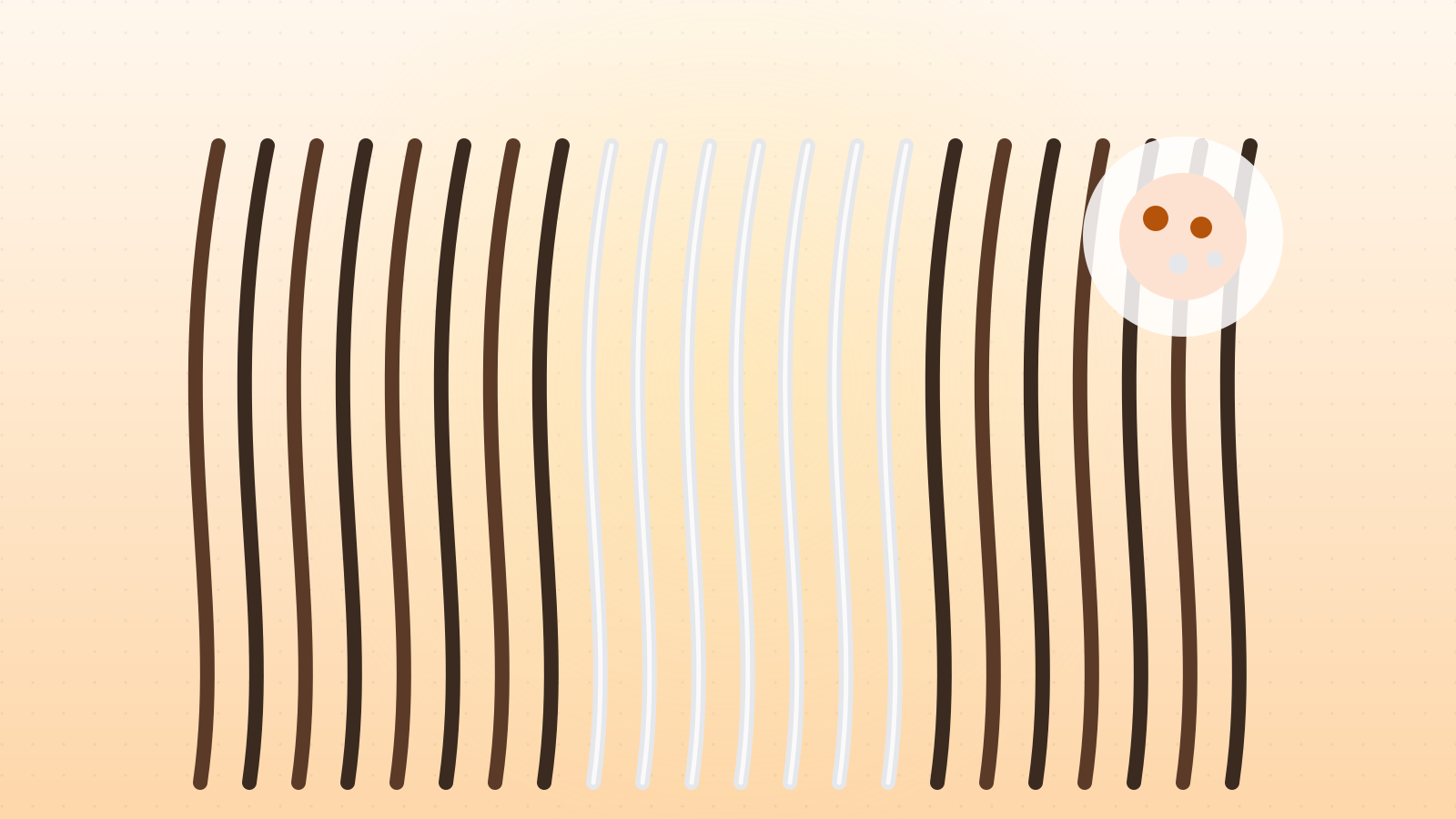
Hair gets its colour from melanin, made by cells called melanocytes at the root of each hair. These cells are replenished from pigment stem cells stored in the follicle. With age, those stem cells fail to reach the part of the follicle where they should mature — they get stuck in one compartment or run out. Without pigment, the new hair grows colourless, or white. Genes largely decide when greying starts, but stress, smoking and some illnesses can speed it up.
In this article (6)
The first grey hair you spot in the mirror comes as a small shock to most people. Grey hair is one of the most visible signs of ageing, and almost everyone meets it sooner or later. Yet why hair turns grey is a fascinating biological question that scientists have only recently begun to answer.
Where does hair colour come from?
Hair colour comes from a pigment called melanin, which comes in two main forms:
- Eumelanin, which gives brown and black tones;
- Pheomelanin, which gives red and yellow tones.
The balance between the two decides whether your hair is black, brown, blond or red.
Melanin is made by specialised cells called melanocytes at the very base of the hair follicle. They pass their pigment to the cells that build the growing hair shaft, so the hair is already coloured as it leaves the root.
One important detail: once a hair emerges from the skin, it is made of dead cells and cannot change colour. So greying always starts at the root. If a new hair grows without pigment, it is white.
Why does hair turn grey?
Hair does not grow continuously. Each follicle cycles through phases of growth, rest and shedding, repeating the cycle many times over the years. Each new growth phase needs fresh melanocytes to colour the hair.
These melanocytes are produced from melanocyte stem cells stored higher up in the follicle — and that is where the secret of greying lies.
The 2023 discovery: stuck stem cells
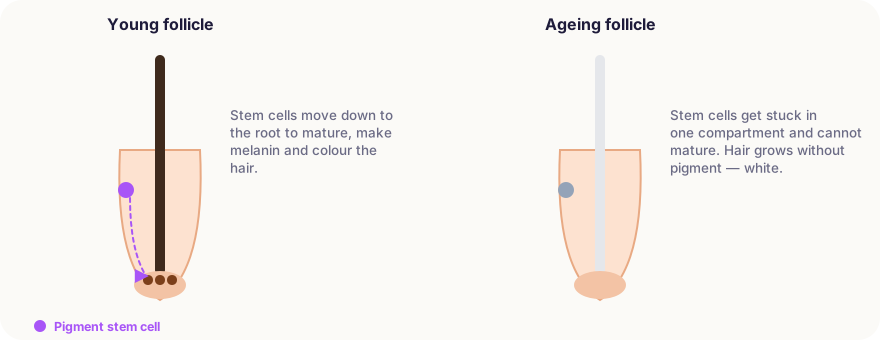
In 2023, Mayumi Ito and colleagues at New York University tracked melanocyte stem cells in mice over long periods. They discovered that these cells surprisingly move around:
- During the hair cycle, the stem cells shuttle between different compartments of the follicle.
- When they move down towards the root, they mature and start making pigment.
- When they move back up, they revert to being stem cells.
But as hair falls out and regrows again and again, a growing share of these cells get stuck in the upper compartment. They no longer receive the signals they need to mature and cannot make pigment, so the new hair grows colourless — white.
The finding suggests greying may come not just from stem cells “running out” but from them being unable to move. The researchers think getting these cells moving again could one day be a way to prevent grey hair.
Can stress really turn your hair grey?
The saying “this job is turning me grey” turns out to have some scientific truth. In 2020, Ya-Chieh Hsu and colleagues at Harvard University investigated how stress affects hair colour in mice.
Their findings were striking:
- Stress strongly activated the sympathetic nervous system, which runs the “fight or flight” response.
- Nerves reaching the hair follicles released noradrenaline.
- Noradrenaline forced the melanocyte stem cells to multiply and mature far too quickly, and the stem-cell reserve was completely used up within days.
- With the reserve gone, the mice’s hair turned permanently white.
The study was done in mice; in humans the effect of stress is probably more complex and slower. But it showed that the link between stress and hair colour has a real biological basis.
Can grey hair come back?
In 2021, researchers at Columbia University examined colour changes along human hairs millimetre by millimetre. Because hair grows about a centimetre a month, each strand is a kind of colour diary of the past months.
In some strands they saw something surprising: hairs that had turned grey during a stressful period had started to regain colour at the root once the stress eased. This suggests that, at least in its early stages, greying can sometimes reverse. Established age-related greying, however, is usually permanent.
What influences greying?
Genes
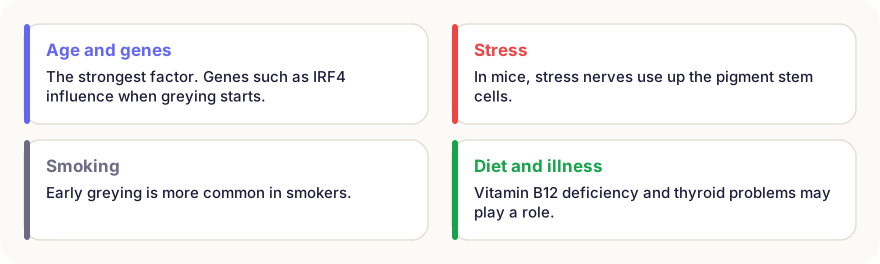
When you go grey is largely determined by your genes: people whose parents greyed early are more likely to do so too. A large genetic study in 2016 linked a gene called IRF4, which helps regulate melanin production, to greying.
The age at which greying begins also tends to vary by ancestry. On average:
| Group | Average age when greying begins |
|---|---|
| People of European ancestry | Mid-30s |
| People of Asian ancestry | Late 30s |
| People of African ancestry | Mid-40s |
These are only averages, with large differences between individuals.
Other factors
- Smoking: many studies have found premature greying is more common in smokers.
- Nutrition: deficiencies in vitamin B12 and minerals such as copper and iron have been linked to early greying.
- Illness: thyroid disease and autoimmune conditions such as vitiligo, in which the body attacks its own pigment cells, can cause hair to lose its colour.
- Oxidative stress: substances such as hydrogen peroxide that build up in the follicle over time may disrupt melanin production.
Common myths
- “Pluck one grey hair and two grow back.” False. Each follicle works independently; plucking does not affect neighbouring ones, though frequent plucking can damage the follicle.
- “Hair can turn white overnight.” False. Marie Antoinette’s hair is said to have turned white the night before her execution, but a hair that has left the skin cannot change colour. Such stories most likely come from coloured hairs suddenly falling out, revealing white hairs that were already there.
- “Grey hair exists.” Not really. The grey look is an illusion created by white strands mixed in among dark ones.
In short
Hair colour comes from melanin produced by melanocytes in the follicle, which are replenished from pigment stem cells. With age those stem cells get stuck or run out, and new hairs grow without pigment — white. Genes largely decide when it happens, while stress, smoking and some illnesses can speed it up. New research shows greying can sometimes reverse in its early stages, opening the door to future treatments that might prevent it.
Frequently asked questions
If you pluck a grey hair, do more grow back?
No. Each follicle works independently, so plucking one white hair does not affect its neighbours. Frequent plucking can damage the follicle, though, and stop hair growing there.
Can hair turn white overnight?
No. A hair that has emerged from the skin is made of dead cells and cannot change colour. Stories of hair turning white overnight probably come from coloured hairs suddenly falling out, revealing white hairs that were already there.
Can grey hair regain its colour?
Sometimes, temporarily. A 2021 study showed that after a stressful period, the root ends of some grey hairs regained their colour. Permanent age-related greying, however, usually does not reverse.
What causes premature greying?
Heredity is the most important factor. Smoking, vitamin B12 deficiency, thyroid disease and some autoimmune conditions such as vitiligo have also been linked to early greying.
Sources
- Sun et al. (2023) – Dedifferentiation maintains melanocyte stem cells in a dynamic niche, Nature
- Zhang et al. (2020) – Hyperactivation of sympathetic nerves drives depletion of melanocyte stem cells, Nature
- Rosenberg et al. (2021) – Quantitative mapping of human hair greying and reversal in relation to life stress, eLife
- Adhikari et al. (2016) – A genome-wide association scan in admixed Latin Americans identifies loci influencing facial and scalp hair features, Nature Communications
This article is based on peer-reviewed research and publications from trusted institutions, and it is reviewed regularly. How we work →
You might also wonder
All in Human Body →
Why Do We Blush? The Science of a Very Human Reaction
Blushing is the only facial expression we cannot fake or hide. What happens in the body when we turn red, why does it start, and is it actually useful?

How Does Caffeine Keep You Awake? Adenosine, Half-Life and Sleep
Caffeine doesn’t give you energy; it blocks a sleepiness signal in the brain. How it works, how long it lasts, how much is safe and why it can ruin your sleep.

Why Do Your Ears Pop on a Plane? Cabin Pressure and the Eustachian Tube
Ears block and pop on planes because cabin pressure changes faster than your middle ear can adjust. Why descent is worse, and the tricks that actually help.
What Causes Muscle Cramps? Why Muscles Suddenly Lock Up
A muscle cramp is a sudden, painful contraction you can’t control. What science says about the causes, why stretching helps and how to prevent night cramps.
What Determines Eye Colour? Why Blue Eyes Have No Blue Pigment
Eye colour depends on the amount of melanin in the iris, not on blue or green pigments. The genes involved, why babies’ eyes change, and blue eyes’ origin.
Why Do We Sweat? How Your Body’s Built-In Air Conditioning Works
Sweating cools you down as it evaporates from your skin. How sweat glands work, why sweat smells, why humidity feels worse and how much water you can lose.