Why Do We Sneeze? The Sneeze Reflex, Sun Sneezing and the Risk of Holding It In
How does a sneeze happen, why do some people sneeze when they look at the sun, and is holding in a sneeze dangerous? The science of the nose’s defence reflex.
Short answer
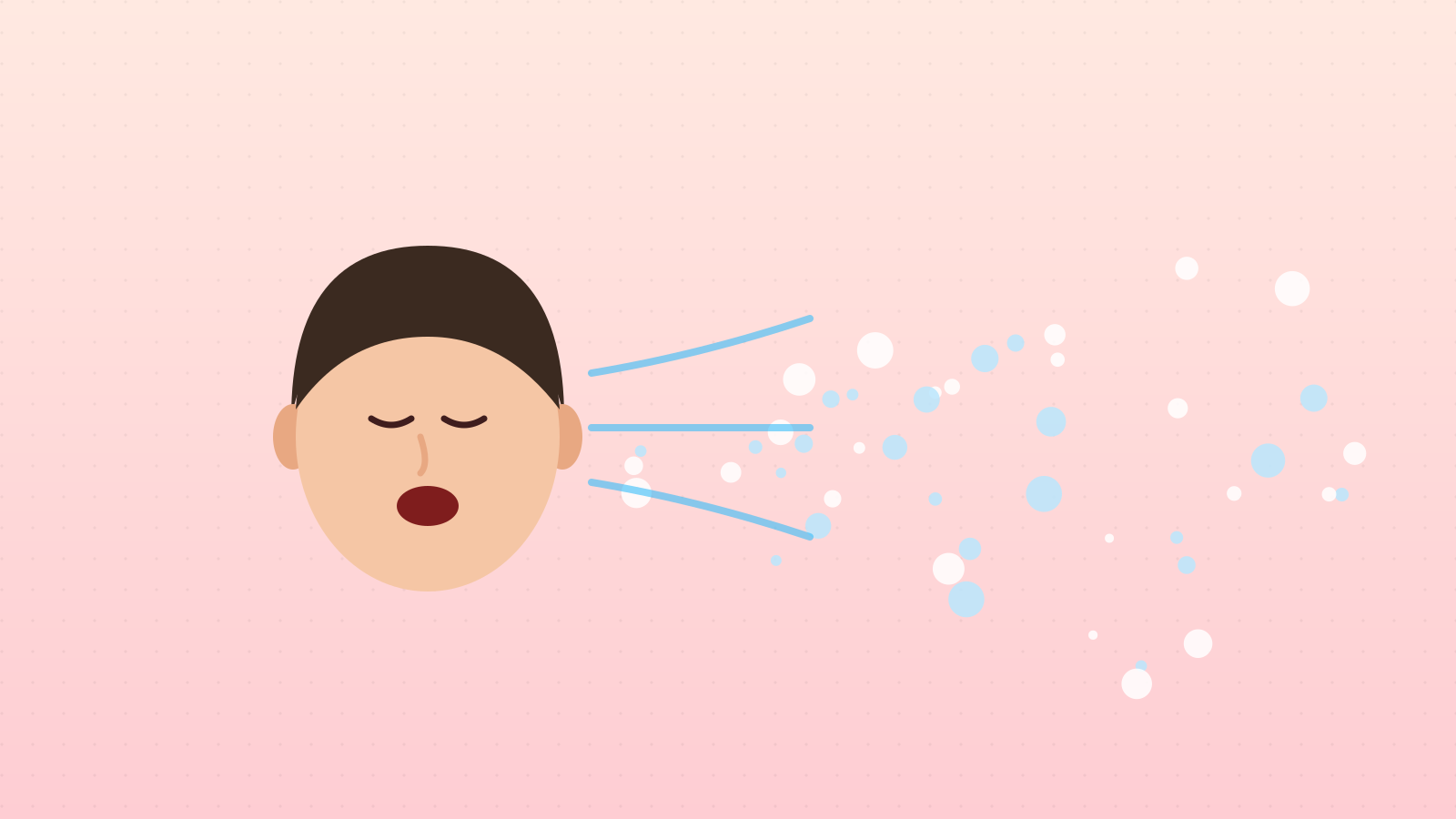
A sneeze is a defence reflex that starts when nerve endings inside the nose are irritated by something like dust, pollen or germs. The trigeminal nerve carries the signal to the brainstem, which triggers a deep breath, a brief closure of the throat and then an explosive exhalation through the mouth and nose. The goal is to expel foreign material from the nasal passages.
In this article (8)
First a tickle in the nose, then your eyes close by themselves and — “achoo!” A sneeze is an ordinary moment in all our lives, yet it contains one of the body’s most powerful and ancient defence reflexes. And some people sneeze not because anything irritates their nose, but simply because they look at the sun.
The guardians of the nose
The nose is not just for smelling; it is the lungs’ first line of defence. Its inner lining is covered with a sticky layer of mucus and tiny hair-like cilia that trap most of the dust, pollen and germs in the air we breathe.
The lining is also packed with nerve endings linked to the trigeminal nerve, which handles touch and pain in the face. When something irritates these endings enough, the alarm goes off.
A sneeze, step by step
The sneeze reflex is an involuntary sequence of movements lasting a few seconds:
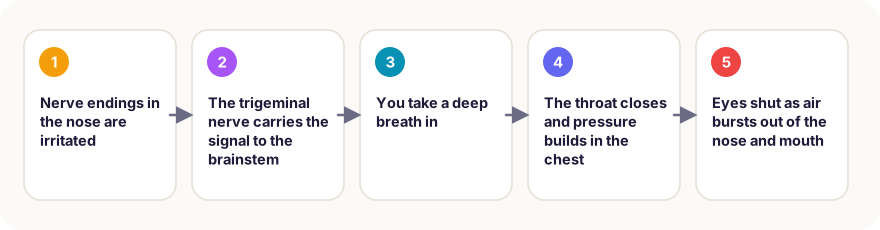
- Irritation: a trigger such as dust, pollen or inflammation from a virus stimulates nerve endings in the nose.
- Signal: the trigeminal nerve carries the message to the sneeze centre in the brainstem.
- Preparation: the brainstem makes you take a deep breath — that familiar “ah… ah…” moment.
- Pressure: the throat closes briefly while the muscles of the chest, abdomen and diaphragm contract, building high pressure in the lungs.
- Explosion: the throat suddenly opens and air bursts out through the nose and mouth. The tongue rises slightly to direct part of the air through the nose, and the eyelids close reflexively.
All of this fires many tightly linked muscles at once — which is why a big sneeze can leave a slight strain in your neck, back or stomach muscles.
How powerful is a sneeze?
You often read online that sneezes reach 160 kilometres (100 miles) per hour. Measurements with high-speed cameras suggest that figure is exaggerated: real speeds vary a lot from person to person but generally fall well below it.
What is really surprising is how far a sneeze spreads. When Lydia Bourouiba and colleagues at MIT studied coughs and sneezes with high-speed cameras, they found that:
- large droplets fall to the ground within a few metres;
- but small droplets are carried inside a warm, moist cloud of air released with the sneeze;
- this cloud lets droplets travel much further than expected and stay suspended for a while.
The findings matter for understanding how illnesses spread — and explain why covering your mouth and nose with a tissue or the inside of your elbow is so strongly recommended.
What triggers a sneeze?
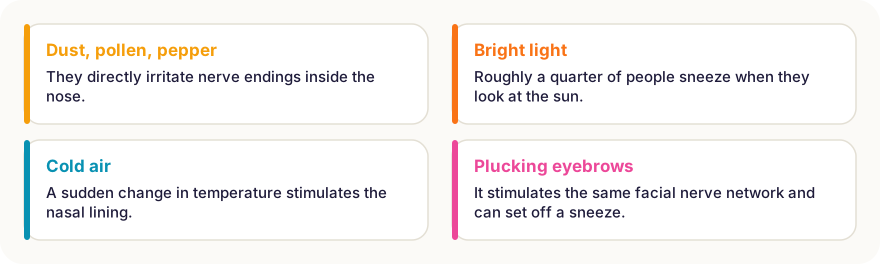
- Allergens and dust: pollen, house dust mites and pet dander are the most common triggers. In people with allergies, the immune system overreacts and releases histamine, which stimulates nerve endings and causes repeated sneezing.
- Infections: cold and flu viruses inflame the inside of the nose. Sneezing is the body’s attempt to expel the virus — and, unfortunately, the virus’s way of reaching new people.
- Irritants: black pepper, smoke, strong smells and perfume.
- Cold air: stepping suddenly into the cold can stimulate the nasal lining.
- Plucking eyebrows: this stimulates branches of the trigeminal nerve in the face, which in some people turns into a sneeze.
Sneezing at the sun
If you sneeze when you step from a dark room into a sunny street, you are not alone. This is the photic sneeze reflex, also nicknamed “ACHOO syndrome”. Studies suggest roughly a quarter of people experience it.
The reflex is known to be inherited, running in families, though its cause is not fully understood. The leading explanation is that the optic nerve, which signals the pupils to constrict, and the trigeminal nerve, which carries sensation from the nose, work very close together in the brain. The strong signal from bright light may partly be misread as “the nose is irritated”.
The reflex is usually harmless, though some experts point out it could pose a risk for pilots and drivers at high speed when emerging from a tunnel.
Is holding in a sneeze dangerous?
In a crowded room it can be tempting to stifle a sneeze by pinching your nose and closing your mouth. But that traps the sneeze’s explosive energy inside the airways with nowhere to go.
Rare cases show this can have serious consequences. In 2023, doctors in Scotland reported a man who developed a tear in his windpipe after trying to sneeze with his nose and mouth closed. Injuries to the throat and eardrum have also been recorded in the past.
| Method | Is it safe? |
|---|---|
| Sneezing into a tissue | Yes, the best option |
| Sneezing into the inside of your elbow | Yes, if there is no tissue |
| Sneezing into your hands | Spreads germs onto your hands |
| Holding it in with nose and mouth closed | Not recommended; rarely causes injury |
Pressing a finger under your nose or pushing your tongue against the roof of your mouth before a sneeze starts can sometimes prevent it. Once it has begun, though, it is best to let it out safely.
Why do we say “bless you”?
Wishing someone well after a sneeze is a tradition in many cultures. In English people say “Bless you!”, in German “Gesundheit!” (health), and in Turkish “Çok yaşa!” (live long), to which the sneezer replies “Sen de gör!” (may you see it too).
The origins of the custom are uncertain. Some historians link it to times when epidemics were common and a sneeze could be seen as a sign of illness. Whatever its roots, a blessing makes no scientific difference — but it lives on as a kind habit.
In short
A sneeze is a powerful defence reflex triggered by irritated nerve endings in the nose and run by the trigeminal nerve and the brainstem. A deep breath, a closed throat and an explosive exhalation expel foreign material from the nose. About a quarter of people also sneeze when they look at the sun. Because forcibly holding in a sneeze can, rarely, cause injury, it is best to sneeze into a tissue or your elbow.
Frequently asked questions
Does your heart stop when you sneeze?
No — that is a popular myth. Pressure in the chest changes briefly during a sneeze and the heart rhythm may shift for a moment, but the heart does not stop.
Can you keep your eyes open while sneezing?
It is very hard, because closing the eyelids is part of the reflex. Even if they stay open, your eyes will not pop out — another myth.
Is it harmful to hold in a sneeze?
Forcibly stifling a sneeze by pinching the nose and closing the mouth sharply raises pressure in the airways. Rarely, injuries to the eardrum, throat or windpipe have been reported. Sneezing into a tissue or your elbow is the safest option.
How far does a sneeze spread?
Large droplets from a sneeze fall to the ground within a few metres. Smaller droplets, however, can be carried much further inside the warm, moist cloud of air the sneeze creates, and can stay suspended for a while.
Sources
- Bourouiba et al. (2014) – Violent expiratory events: on coughing and sneezing, Journal of Fluid Mechanics
- Keeton (1995) – Photic sneeze reflex, Neurology
- Misirovs et al. (2023) – Spontaneous tracheal perforation following a sneeze, BMJ Case Reports
This article is based on peer-reviewed research and publications from trusted institutions, and it is reviewed regularly. How we work →
You might also wonder
All in Human Body →
Why Do Fingers Wrinkle in Water? Your Nervous System’s Surprising Trick
Why do fingertips prune after a long bath? It is not just skin soaking up water — it is your nervous system at work. Plus the debate over what wrinkles are for.
Why Do We Yawn? The Science of Contagious Yawning
Do we yawn because we are tired, bored or low on oxygen? The brain-cooling theory and why seeing someone yawn makes you yawn too, explained with research.
Why Does Hair Turn Grey? Stress, Genes and Stem Cells in the Follicle
Why does hair go grey, can stress really turn it white and can grey hair come back? The pigment cells in hair follicles and what new research has found.
Why Are Fingerprints Unique? A Pattern That Begins in the Womb
How do fingerprints form, why do even identical twins have different prints, and what are fingerprints for? The 2023 discovery and the science behind them.
What Causes Brain Freeze? The Secret of the Ice-Cream Headache
What is that sharp pain in your forehead when you eat something cold? How brain freeze happens, why you feel it in your forehead and how to make it stop.
Why Does Your Stomach Growl? Hunger Noises and the Gut’s Cleaning Cycle
Why does your stomach rumble when you are hungry, and does it growl when you are full? Where gut sounds come from and the cleaning cycle of an empty gut.