Why Does Your Stomach Growl? Hunger Noises and the Gut’s Cleaning Cycle
Why does your stomach rumble when you are hungry, and does it growl when you are full? Where gut sounds come from and the cleaning cycle of an empty gut.
Short answer
The muscles in the walls of your stomach and intestines contract in waves to move their contents along. Those contractions push gas and fluid around, producing the rumbling sound doctors call borborygmi. The noise is louder when your stomach is empty because there is no food to muffle it. On an empty stomach, a powerful “cleaning wave” also sweeps through the gut every 90–120 minutes — often when the growling is loudest.
In this article (8)
A long rumble rising from your stomach in a silent meeting room, during an exam or in the middle of an important conversation — that small moment of embarrassment happens to almost everyone. Yet it is actually a sign your digestive system is working properly. So why is the stomach so noisy, and why does it get louder when you are hungry?
The digestive system is a conveyor belt that never stops
The digestive tract, from mouth to bowel, is about 8–9 metres long in an adult. Most of it is a tube with layers of smooth muscle in its walls. These muscles work involuntarily — we do not control them.
They contract and relax in waves to push the contents forward, a movement called peristalsis. It is rather like squeezing a tube of toothpaste from the bottom up.
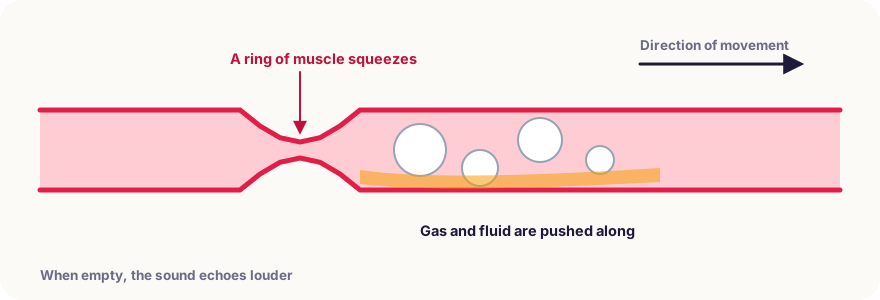
These waves also move the gas and fluid in the stomach and intestines. As gas bubbles squeeze through narrow sections and fluids slosh about, a range of sounds is produced — the gurgles, rumbles and growls we hear.
These sounds have a name: borborygmi
Doctors call stomach and intestinal sounds borborygmi, from an ancient Greek word that imitates the sound itself. Most of the noise actually comes not from the stomach but from the small intestine — though we call it all “stomach growling”.
Three ingredients make the sound:
- Muscle contractions: the motor that drives the movement.
- Gas: swallowed air, fizzy drinks and gases produced by gut bacteria.
- Fluid: stomach acid, digestive juices and the drinks we consume.
Why does it growl more when you are hungry?
There are two reasons.
1. The soundproofing disappears
When there is food in your stomach and intestines, the sounds come through as if from inside a pillow — food dampens and muffles them. When your stomach is empty, there is little inside but gas and a small amount of fluid. Just as sound echoes in an empty room, rumbling in an empty stomach is far more noticeable.
2. The cleaning cycle starts
Even on an empty stomach, the digestive system does not rest. A few hours after your last meal, a special cycle called the migrating motor complex begins in the gut. It acts like a “housekeeping” routine, sweeping leftover food, bacteria and indigestible particles out of the intestines.
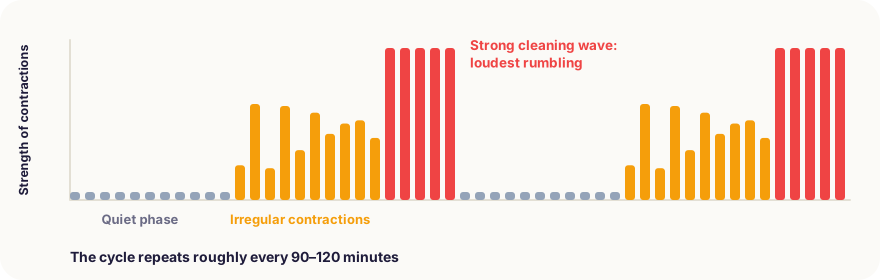
The cycle has three phases and repeats roughly every 90–120 minutes:
- Quiet phase: contractions almost stop.
- Irregular contractions: contractions become more frequent and stronger.
- Strong cleaning wave: a few minutes of very powerful, regular contractions start in the stomach and travel along the small intestine, sweeping everything ahead of them.
The loudest rumbles are often heard during this last phase. The cycle is regulated by a hormone called motilin, and the moment you eat something it stops and the digestive system switches to normal digestion mode.
The hunger hormone plays a part
One of the key hormones that makes us feel hungry is ghrelin. It is released by the stomach wall when the stomach is empty and sends the brain a “time to eat” message. Ghrelin levels usually rise before mealtimes and fall after eating.
Ghrelin affects not just the brain but also the gut, and can increase stomach and intestinal movement. That is why hunger and growling so often arrive together. In people who eat at regular times, the body even “learns” the schedule, and the stomach may start rumbling as mealtime approaches.
Does it growl when you are full?
Yes. The digestive system keeps working after a meal, contracting to mix and move food along — and those contractions make noise too. Because food muffles the sound, though, these rumbles are usually less noticeable.
Some things can make your gut noisier even when you are full:
- Fizzy drinks add extra gas to the stomach.
- Eating quickly, chewing gum and talking while eating make you swallow air.
- High-fibre foods such as beans, lentils, cabbage and broccoli feed bacteria in the large intestine that produce more gas.
- In people with lactose intolerance, undigested dairy leads to extra gas and rumbling.
How to quieten a growling stomach
Stomach growling is completely normal, but you might want to keep it in check before an important meeting. These may help:
| Method | How it works |
|---|---|
| Drinking a glass of water | Partly fills the stomach and dampens the sounds |
| A small snack | Stops the cleaning cycle |
| Regular mealtimes | Avoids long stretches of hunger |
| Eating slowly | Less air is swallowed |
| Cutting back on fizzy drinks | Reduces the amount of gas in the stomach |
When to worry
On its own, stomach growling is almost always harmless. You should see a doctor if it comes with:
- severe or persistent abdominal pain;
- marked bloating and gas;
- prolonged diarrhoea or constipation;
- vomiting, blood in the stool or unexplained weight loss.
Interestingly, doctors listen carefully to abdominal sounds too. A completely silent abdomen can mean the gut has stopped working and sometimes points to a blockage or another serious problem. In other words, regular rumbling is a sign that everything is working as it should.
In short
Stomach growling is the sound of the muscles in the walls of your stomach and intestines moving gas and fluid along — medically known as borborygmi. It gets louder when you are hungry because there is no food to muffle it, and because a strong cleaning wave sweeps through the gut every 90–120 minutes on an empty stomach. The hunger hormone ghrelin boosts these movements too. A growling stomach is simply the natural sound of your digestive system doing its job.
Frequently asked questions
Does stomach growling always mean you are hungry?
No. The digestive system works and makes noise even when you are full, but food muffles the sounds. When you are hungry, the sounds can be more frequent and louder.
How can I stop my stomach growling?
Drinking a glass of water, eating a small snack or having regular small meals can reduce growling. Fizzy drinks and eating quickly, which makes you swallow air, can make it worse.
When is stomach growling a sign of a problem?
See a doctor if the noises come with abdominal pain, bloating, diarrhoea, vomiting or weight loss. On its own, growling is almost always normal.
Does the noise really come from the stomach?
Partly. Much of it actually comes from the small intestine — but popularly all these noises are called stomach growling.
Sources
- Deloose et al. (2012) – The migrating motor complex: control mechanisms and its role in health and disease, Nature Reviews Gastroenterology & Hepatology
- MedlinePlus – Abdominal sounds
This article is based on peer-reviewed research and publications from trusted institutions, and it is reviewed regularly. How we work →
You might also wonder
All in Human Body →
Why Do We Blush? The Science of a Very Human Reaction
Blushing is the only facial expression we cannot fake or hide. What happens in the body when we turn red, why does it start, and is it actually useful?
How Does Caffeine Keep You Awake? Adenosine, Half-Life and Sleep
Caffeine doesn’t give you energy; it blocks a sleepiness signal in the brain. How it works, how long it lasts, how much is safe and why it can ruin your sleep.
Why Do Your Ears Pop on a Plane? Cabin Pressure and the Eustachian Tube
Ears block and pop on planes because cabin pressure changes faster than your middle ear can adjust. Why descent is worse, and the tricks that actually help.
What Causes Muscle Cramps? Why Muscles Suddenly Lock Up
A muscle cramp is a sudden, painful contraction you can’t control. What science says about the causes, why stretching helps and how to prevent night cramps.
What Determines Eye Colour? Why Blue Eyes Have No Blue Pigment
Eye colour depends on the amount of melanin in the iris, not on blue or green pigments. The genes involved, why babies’ eyes change, and blue eyes’ origin.
Why Do We Sweat? How Your Body’s Built-In Air Conditioning Works
Sweating cools you down as it evaporates from your skin. How sweat glands work, why sweat smells, why humidity feels worse and how much water you can lose.