Why Do We Need Sleep? What Happens in Your Brain and Body Every Night
We spend about a third of our lives asleep. What sleep does for memory, the brain and immunity, how much you need at every age and what happens without it.
Short answer
We need sleep because the brain and body carry out essential maintenance that cannot happen properly while we are awake. During sleep the brain strengthens and sorts memories, clears out waste products that build up during the day, and resets the chemical signals that control attention and mood. The body repairs tissues, releases growth hormone and fine-tunes the immune system. Sleep is driven by two systems: a pressure to sleep that builds the longer we are awake, and a 24-hour internal clock. Most adults need 7 to 9 hours a night; regularly getting less is linked to poorer concentration, mood problems and higher risks of illness.
In this article (7)
By the time you are 75, you will have spent about 25 years asleep. From an evolutionary point of view that seems strange: while asleep, an animal cannot eat, find a partner or watch for predators. Yet every animal studied so far sleeps or shows a similar resting state, from fruit flies to whales. Sleep must be doing something too important to skip.
Two forces that put you to sleep
Your need for sleep is controlled by two systems working together.
Sleep pressure. From the moment you wake up, a chemical called adenosine slowly builds up in the brain. The longer you stay awake, the more accumulates and the sleepier you feel. During sleep it is cleared away. Caffeine keeps you alert by blocking adenosine’s effects, not by giving you energy.
The body clock. A tiny region of the brain called the suprachiasmatic nucleus acts as a 24-hour clock, set mainly by light hitting the eyes. In the evening, as light fades, it triggers the release of the hormone melatonin, which signals that it is night. This circadian rhythm is why you can feel a second wind late in the evening, or feel terrible on a night shift even after sleeping during the day.
What happens during a night’s sleep
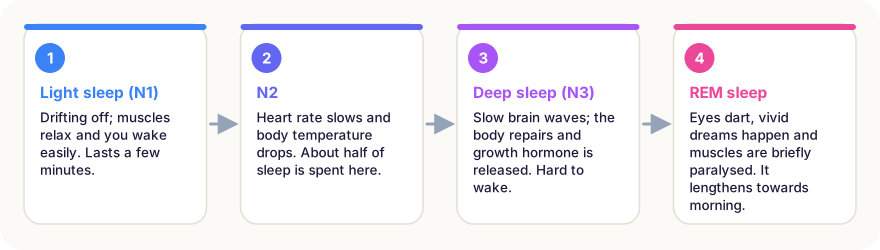
Sleep is not a single state. Through the night you pass through cycles of about 90 minutes, each containing several stages:
- Light sleep (N1 and N2): your heart rate and breathing slow, body temperature drops, and the brain produces bursts of activity called sleep spindles, which are linked to memory.
- Deep sleep (N3): large, slow brain waves dominate. This is the most restorative stage for the body, and the hardest from which to wake. It is concentrated in the first half of the night.
- REM sleep: the eyes dart under the lids, the brain becomes very active, and most vivid dreams occur. The body’s muscles are temporarily paralysed, which stops us acting out our dreams. REM periods get longer towards morning.
Why sleep matters
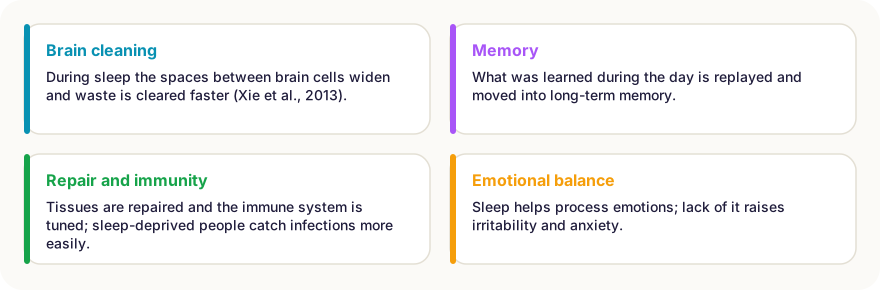
Memory. Sleep helps turn the day’s experiences into lasting memories. During deep sleep the brain appears to replay recent events, strengthening important connections and moving information from short-term storage in the hippocampus to longer-term storage in the cortex. People who sleep after learning remember more than those who stay awake.
Cleaning the brain. In 2013, a team led by Maiken Nedergaard studied the brains of mice and found that during sleep the spaces between brain cells expanded by about 60%. This allowed cerebrospinal fluid to flow through more freely and wash away waste products, including proteins linked to Alzheimer’s disease, much faster than during wakefulness. Researchers are still working out how this applies to humans.
Repair and immunity. During deep sleep the body releases growth hormone, which helps repair tissues and build muscle. Sleep also tunes the immune system. In experiments, people who slept poorly were more likely to catch a cold when exposed to the virus, and vaccines tend to produce weaker responses after sleep deprivation.
Emotions and decisions. Sleep, especially REM sleep, helps the brain process emotional experiences. After a bad night, the brain’s fear centre, the amygdala, reacts more strongly, which is why we feel irritable and anxious when tired.
How much sleep do you need?
| Age group | Recommended sleep per day |
|---|---|
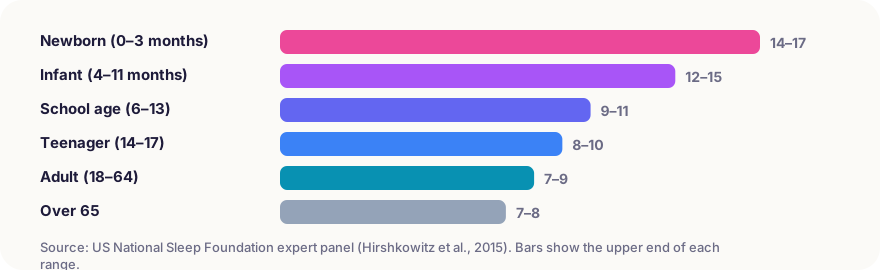
| Newborns (0–3 months) | 14–17 hours |
| Infants (4–11 months) | 12–15 hours |
| Toddlers (1–2 years) | 11–14 hours |
| Pre-school (3–5 years) | 10–13 hours |
| School age (6–13 years) | 9–11 hours |
| Teenagers (14–17 years) | 8–10 hours |
| Adults (18–64 years) | 7–9 hours |
| Older adults (65+) | 7–8 hours |
Individual needs vary a little, but very few people truly function well on less than 6 hours.
What happens without enough sleep
In a well-known 2003 study, Hans Van Dongen and colleagues limited volunteers to 4, 6 or 8 hours in bed a night for two weeks. Those on 6 hours steadily got worse at attention tests until, by the end, they performed as badly as people kept awake for one to two nights without any sleep. Crucially, they did not realise how impaired they were: they reported feeling only slightly sleepy.
Long-term short sleep is linked to:
- poorer concentration, memory and reaction times, and more accidents;
- weight gain, because sleep loss increases hunger hormones;
- higher risks of type 2 diabetes, high blood pressure and heart disease;
- low mood, anxiety and depression.
Extreme sleep deprivation leads to microsleeps, brief lapses of a few seconds that people often don’t notice, which are especially dangerous while driving.
How to sleep better
- Keep a regular schedule, even at weekends.
- Get daylight in the morning and keep evenings dim.
- Avoid caffeine in the afternoon; it can stay in the body for many hours.
- Keep the bedroom cool, dark and quiet.
- Put screens away before bed and avoid heavy meals and alcohol late at night.
- If you regularly snore loudly, stop breathing at night or feel exhausted despite enough sleep, talk to a doctor.
In short
- Sleep is controlled by sleep pressure (adenosine) and a 24-hour body clock.
- A night has cycles of about 90 minutes, with light, deep and REM sleep.
- Sleep strengthens memories, helps clear waste from the brain and supports immunity.
- Most adults need 7–9 hours a night; children and teenagers need more.
- Two weeks of 6-hour nights can impair attention as much as 1–2 sleepless nights.
- A regular schedule, morning light and a dark, cool bedroom help sleep.
Frequently asked questions
How long can a person go without sleep?
The best-documented record is about 11 days, set by student Randy Gardner in 1964. Long sleep deprivation is dangerous, and record attempts are no longer accepted by record organisations.
Can you catch up on lost sleep at the weekend?
Partly. Extra sleep helps reduce sleepiness, but studies suggest it does not fully reverse the effects of a week of short nights on concentration and metabolism. Regular sleep is better.
Why do teenagers stay up late?
During puberty the internal clock shifts later, so teenagers naturally feel sleepy later at night and struggle to wake early. This is biological, not just a habit.
Is napping good for you?
A short nap of 10 to 30 minutes can boost alertness without leaving you groggy. Long or late naps can make it harder to fall asleep at night.
Sources
- Xie, L. et al. (2013). Sleep drives metabolite clearance from the adult brain. Science
- Van Dongen, H. P. A. et al. (2003). The cumulative cost of additional wakefulness: dose-response effects on neurobehavioral functions and sleep physiology from chronic sleep restriction and total sleep deprivation. Sleep
- Hirshkowitz, M. et al. (2015). National Sleep Foundation’s sleep time duration recommendations: methodology and results summary. Sleep Health
This article is based on peer-reviewed research and publications from trusted institutions, and it is reviewed regularly. How we work →
You might also wonder
All in Human Body →
How Does the Immune System Work? Your Body’s Defence Force, Explained Simply
Your immune system uses barriers, fast responders and cells that learn and remember. How it fights germs, how vaccines train it and what goes wrong.
Why Do Knuckles Crack? The Bubble Behind the Pop, and Whether It Causes Arthritis
Cracking your knuckles forms a gas cavity in the joint. What MRI scans revealed, why the same knuckle won’t crack twice in a row and whether it is harmful.

Why Do We Blush? The Science of a Very Human Reaction
Blushing is the only facial expression we cannot fake or hide. What happens in the body when we turn red, why does it start, and is it actually useful?
How Does Caffeine Keep You Awake? Adenosine, Half-Life and Sleep
Caffeine doesn’t give you energy; it blocks a sleepiness signal in the brain. How it works, how long it lasts, how much is safe and why it can ruin your sleep.
Why Do Your Ears Pop on a Plane? Cabin Pressure and the Eustachian Tube
Ears block and pop on planes because cabin pressure changes faster than your middle ear can adjust. Why descent is worse, and the tricks that actually help.
What Causes Muscle Cramps? Why Muscles Suddenly Lock Up
A muscle cramp is a sudden, painful contraction you can’t control. What science says about the causes, why stretching helps and how to prevent night cramps.