Was Spinosaurus a Swimmer? The Sail-Backed Giant and Palaeontology’s Biggest Debate
Spinosaurus was longer than T. rex and hunted fish. Did it swim like a crocodile or wade like a giant heron? The fossils, the lost skeleton and the debate.
Short answer
Spinosaurus was a giant meat-eating dinosaur that lived about 100 to 95 million years ago in North Africa, and it is the longest predatory dinosaur known, at around 14 metres. It clearly spent much of its life around water: it had a long, narrow, crocodile-like snout with conical teeth for catching fish, nostrils set far back on the snout and unusually dense bones. In 2014 and 2020, a team led by Nizar Ibrahim argued that it was semi-aquatic and swam using a deep, paddle-like tail. In 2022, another team led by Paul Sereno argued that its sail made it unstable and buoyant in deep water, so it more likely hunted while wading in the shallows, like a heron. The debate is not settled.
In this article (9)
With a sail on its back taller than a person, a snout like a crocodile and a body longer than a city bus, Spinosaurus is one of the strangest dinosaurs ever discovered. It starred as the villain in Jurassic Park III, beating T. rex in a famous fight scene. But in real science, Spinosaurus is famous for a different battle: an ongoing debate about whether this giant predator was a swimmer, the first dinosaur adapted to life in water, or a wading hunter that stalked fish in the shallows.
A lost dinosaur
The story begins in Egypt. In 1912, fossil hunters working for the German palaeontologist Ernst Stromer found bones of a large predator with extraordinarily long spines on its back. In 1915, Stromer described it as Spinosaurus aegyptiacus, the “Egyptian spine lizard”.
Then disaster struck. In 1944, during the Second World War, an Allied bombing raid destroyed the museum in Munich where the fossils were stored. Spinosaurus vanished. For the rest of the 20th century, scientists had to rely on Stromer’s drawings, notes and a few photographs, together with scraps of related animals.
The giant from the river
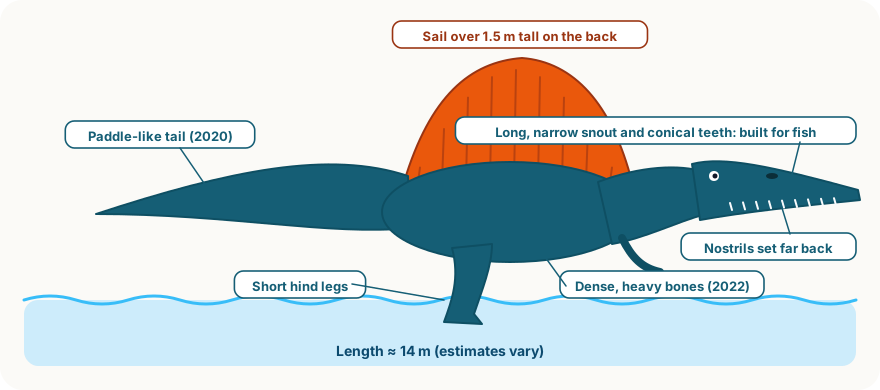
Newer finds, especially from the Kem Kem beds of Morocco, have filled in much of the picture. Spinosaurus lived around 100 to 95 million years ago in the Cretaceous period, when North Africa was crossed by enormous river systems teeming with fish, some of them several metres long.
| Feature | Description | What it suggests |
|---|---|---|
| Length | About 14 m, the longest known predatory dinosaur | A giant predator |
| Snout | Long, narrow, with conical teeth | Catching slippery fish |
| Nostrils | Set far back on the snout | Could breathe with the snout tip in water |
| Sail | Spines on the back over 1.5 m tall | Probably display |
| Hind legs | Surprisingly short | Unusual body proportions |
| Bones | Very dense, with little hollow space | Possibly reduced buoyancy |
| Tail | Tall, flexible and paddle-shaped | Possibly swimming |
2014: the first semi-aquatic dinosaur?
In 2014, a team led by palaeontologist Nizar Ibrahim published a study in Science based on a new partial skeleton from Morocco. They reconstructed Spinosaurus with short hind legs, a long body and dense limb bones, and they argued that it was semi-aquatic, spending much of its time in water, rather like a crocodile.
This was a radical claim. Dinosaurs were long thought to be strictly land animals; the marine reptiles and pterosaurs that are often mistaken for dinosaurs belong to separate groups.
2020: a tail built for swimming
In 2020, the same team reported in Nature that they had found much of the tail. It was surprising: tall spines and bony rods along the top and bottom made it deep and flat from side to side, like a paddle or the tail of a newt or crocodile. Using a robotic model in a water tank, they found that this tail produced much more forward thrust than the tails of other meat-eating dinosaurs. They concluded that Spinosaurus used its tail to swim in pursuit of prey.
2022: dense bones and divers
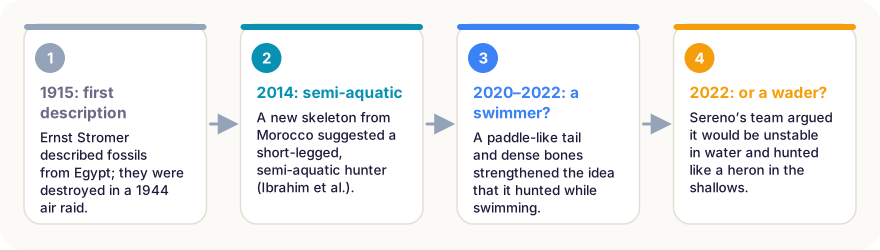
In 2022, a study led by Matteo Fabbri in Nature looked at bone density in more than 250 living and extinct animals. Animals that dive underwater for food, such as penguins and hippos, tend to have very dense bones, which act like ballast. Spinosaurus and its relative Baryonyx had such dense bones, suggesting to the authors that they hunted while submerged.
The counter-argument: a giant heron?
The same year, a team led by Paul Sereno published a study in eLife with a blunt title: “Spinosaurus is not an aquatic dinosaur”. Using a detailed digital model of the whole animal, they calculated how it would behave in water. Their findings:
- Spinosaurus would have floated easily and struggled to dive, despite its dense bones.
- Its tall sail would have made it unstable, tipping it onto its side in deep water.
- As a swimmer, it would have been slow, compared with the fish it was chasing.
- Its tail was not stiff or powerful enough to be an efficient swimming organ.
Instead, they suggested Spinosaurus was a “semiaquatic bipedal ambush piscivore”: a two-legged hunter that waded in shallow water and along riverbanks, snapping up fish, much like a giant heron or stork.
Why the debate is so hard to settle
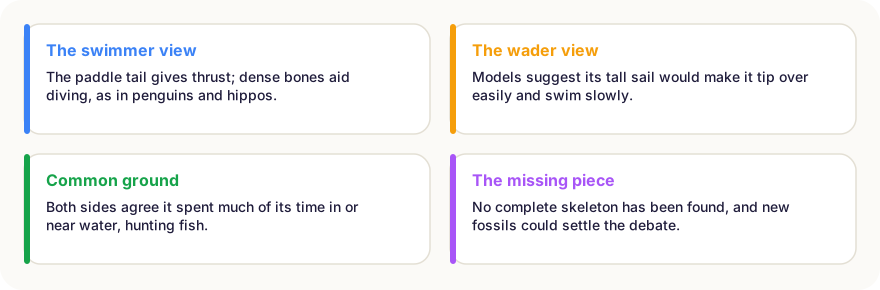
Spinosaurus is known only from incomplete skeletons, often of different individuals, and the original type specimen was destroyed. Small differences in reconstructions, such as how long the legs were, how big the sail was or how dense the bones were, make big differences to calculations about buoyancy and balance. Interpreting bone density is also tricky, since some land animals have dense bones too.
What the two sides largely agree on is important: Spinosaurus was a giant predator specialised for catching fish and lived around water. The disagreement is about how much of its life it spent in the water and whether it actually swam after prey.
What was the sail for?
The great sail remains a mystery in its own right. Its spines could exceed 1.5 metres. The most widely supported idea is display: a big, possibly colourful sail would have signalled size and health to rivals and potential mates. Earlier ideas, such as regulating body temperature or storing fat like a camel’s hump, have less support today.
In short
- Spinosaurus lived 100–95 million years ago in North Africa and was about 14 m long.
- Its original fossils were destroyed in 1944; new finds in Morocco revived research.
- A narrow crocodile-like snout, retracted nostrils and dense bones link it to water.
- Ibrahim’s team (2014, 2020) argued it was semi-aquatic and swam with a paddle tail.
- Sereno’s team (2022) argued it was too buoyant and unstable and hunted while wading.
- Both sides agree it was a fish-eating giant that lived by rivers; the details are still debated.
Frequently asked questions
Was Spinosaurus bigger than T. rex?
It was longer: about 14 metres compared with roughly 12 to 13 metres for the largest T. rex. But T. rex was more heavily built, so it was probably heavier. Weight estimates for Spinosaurus vary a lot.
What did Spinosaurus eat?
Mainly fish, including large ones such as giant coelacanths and sawfish relatives that lived in its river systems. Like other predators, it may also have eaten other animals when it could.
What was the sail on its back for?
No one knows for sure. The leading idea is display: a large sail would have been an eye-catching signal to rivals and mates. Older ideas, such as temperature control, have less support.
Where did Spinosaurus live?
In North Africa, in what are now Egypt and Morocco, about 100 to 95 million years ago. The area was then a vast system of rivers and wetlands full of fish, crocodile relatives and other large predators.
Sources
- Ibrahim et al. (2014) – Semiaquatic adaptations in a giant predatory dinosaur, Science
- Ibrahim et al. (2020) – Tail-propelled aquatic locomotion in a theropod dinosaur, Nature
- Fabbri et al. (2022) – Subaqueous foraging among carnivorous dinosaurs, Nature
- Sereno et al. (2022) – Spinosaurus is not an aquatic dinosaur, eLife
This article is based on peer-reviewed research and publications from trusted institutions, and it is reviewed regularly. How we work →
You might also wonder
All in Dinosaurs →
How Did Dinosaurs Lay Eggs? Nests, Incubation and Surprising Soft Shells
All dinosaurs hatched from eggs. How they built nests, how long eggs took to hatch, which dinosaurs sat on them and why some shells were soft.
What Were Triceratops Horns For? Fighting, Display and Defence Against T. rex
Triceratops had three horns and a huge bony frill. Were they weapons against T. rex, for fighting rivals or for attracting mates? What fossils reveal.
Are Birds Dinosaurs? Why Your Pigeon Is a Living Theropod
Birds did not just evolve from dinosaurs – they are dinosaurs. Feathers, wishbones and nesting fossils show how a T. rex relative became today’s birds.
How Are Fossils Formed? From Bone to Stone in Millions of Years
Fossils form when remains are buried fast and minerals slowly replace them. Why fossilisation is so rare, the main types of fossil and how they are dated.
What Killed the Dinosaurs? The Asteroid, the Evidence and the Volcanoes
66 million years ago an asteroid hit Mexico and ended the age of dinosaurs. How scientists found the clues: iridium, shocked quartz and a buried crater.
What Colour Were Dinosaurs? How Scientists Read Colour From Fossils
For a long time dinosaur colours were guesswork. Now microscopic pigment capsules in fossil feathers reveal ginger stripes, black wings and countershading.