How Smart Are Crows? Toolmakers, Face Readers and Planners of the Bird World
Crows make tools, remember human faces for years and plan for the future. What experiments reveal about crow intelligence and how a small bird brain manages it.
Short answer
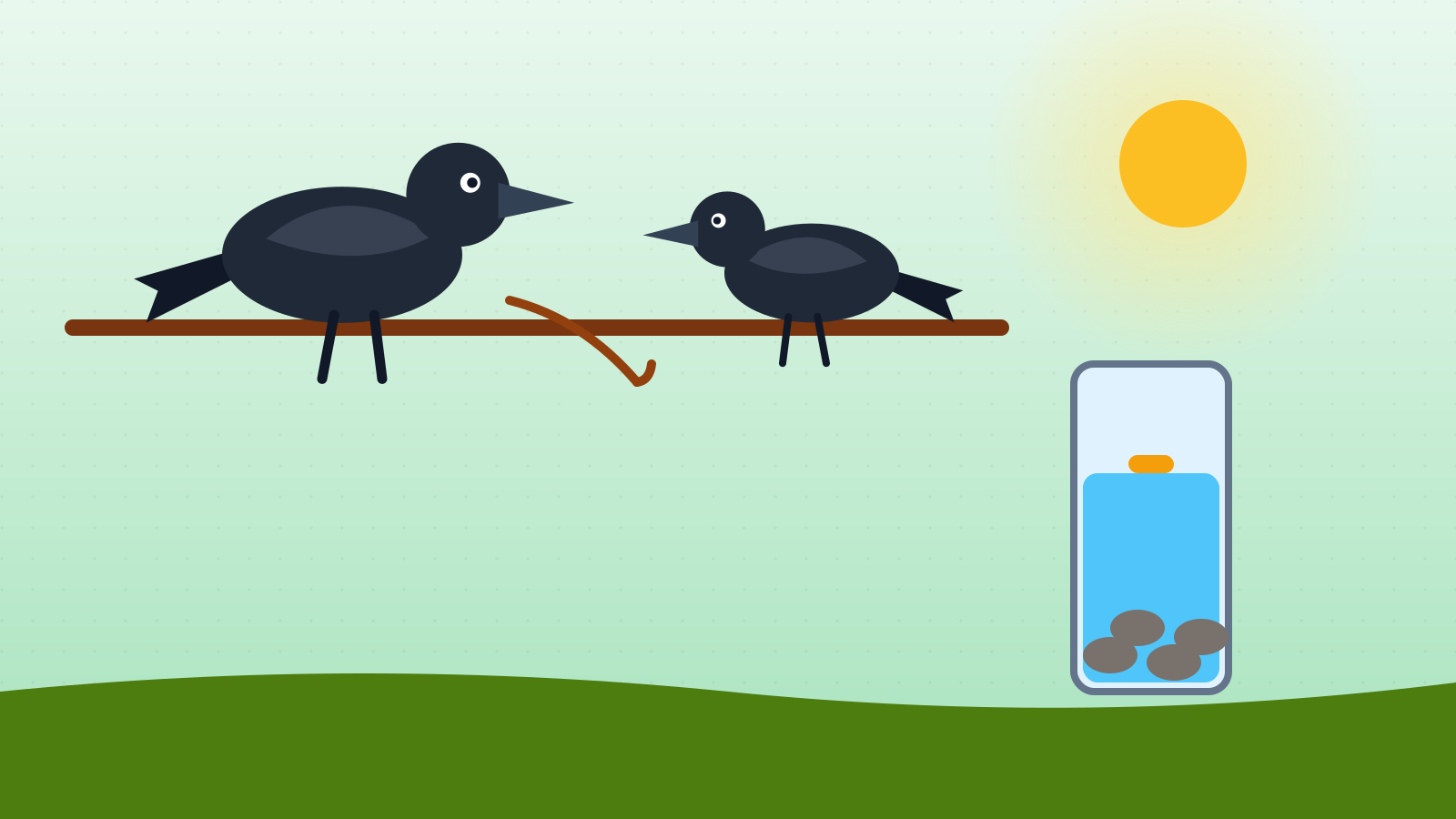
Crows are among the most intelligent animals on Earth, rivalling great apes in some tests. New Caledonian crows make and use hooked tools from twigs, and in experiments they have solved puzzles such as raising the water level in a tube with stones to reach floating food. American crows remember the faces of people who threatened them for years and even warn other crows. Ravens, close relatives, have chosen and saved tools they could only use the next day, a sign of planning ahead. Their brains are small, but they are packed with neurons: a 2016 study found that crow and parrot forebrains contain as many neurons as the brains of some monkeys.
In this article (9)
“Bird brain” is meant as an insult. Yet the crow on the streetlight outside your window may be one of the cleverest animals you will ever meet. Crows and their relatives, a family called corvids that also includes ravens, jays, magpies and rooks, can make tools, solve multi-step puzzles, recognise individual humans and even plan for the future. Some scientists call them “feathered apes”.
A family of clever birds
Corvids are found on every continent except Antarctica and South America’s far south. They thrive in cities as easily as in forests, which itself says something about their flexibility. They live long, often in family groups, and spend a long time learning from their parents, all traits associated with intelligence in other animals.
Toolmakers of New Caledonia
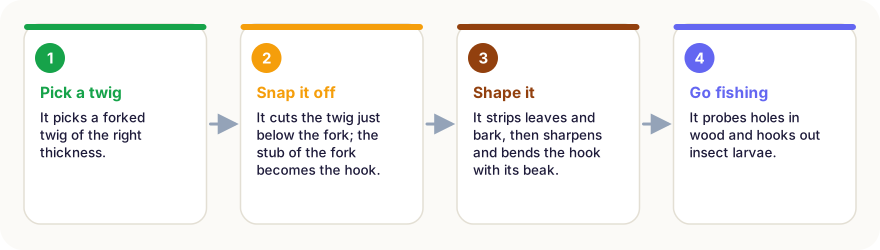
On the Pacific island of New Caledonia lives a crow that has become a celebrity in animal research. In 1996, biologist Gavin Hunt reported in Nature that wild New Caledonian crows make two kinds of tools: hooked twigs and stepped tools cut from the stiff, barbed leaves of the pandanus plant. They use them to pull insect larvae out of holes in dead wood.
Making a hooked tool is not simple. The crow must choose a suitable forked twig, snap it off just below the fork, strip off leaves and bark and then shape the stub of the fork into a hook with its beak. Young crows take months to master the technique, learning partly by watching adults.
In 2002, scientists at Oxford described a crow called Betty. Offered a straight piece of wire and a little bucket of food at the bottom of a tube, she bent the wire into a hook and used it to lift the bucket out. Later research showed that New Caledonian crows bend materials into hooks more often than first thought, but Betty’s flexible problem-solving remains a classic example.
The Aesop’s fable test
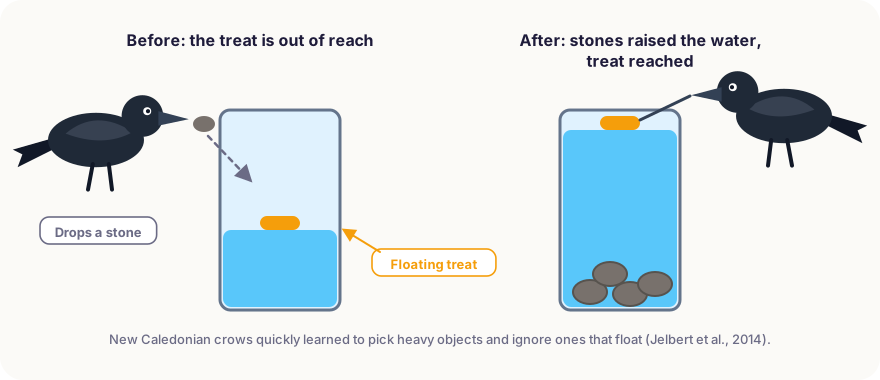
In one of Aesop’s ancient fables, a thirsty crow drops pebbles into a pitcher until the water rises high enough to drink. Scientists turned this story into an experiment. A treat floats on water in a narrow tube, too low for the crow to reach. Stones and other objects are placed nearby.
In a 2014 study, Sarah Jelbert and colleagues found that New Caledonian crows quickly learned to drop stones into the tube. They preferred heavy objects that sink over ones that float, and solid objects over hollow ones, and they chose tubes with water over tubes filled with sand. Their understanding had limits, though: in some trickier versions they performed no better than young children, showing that they learn the task step by step rather than fully understanding the physics.
They never forget a face
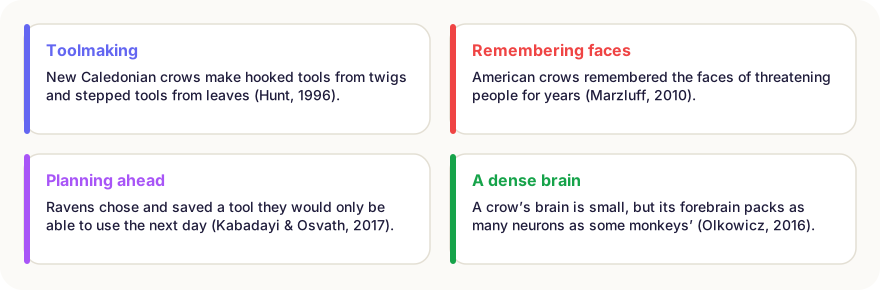
In Seattle, researchers led by John Marzluff trapped and released a few wild American crows while wearing a particular rubber mask. Afterwards, people wearing that “dangerous” mask were scolded and mobbed by crows on the campus, while a different, neutral mask was ignored. According to the 2010 study in Animal Behaviour, this recognition lasted for years, and the number of crows scolding the mask actually grew. Many of those crows had never been caught themselves. They seem to have learned who was dangerous by watching other crows.
Planning for tomorrow
For a long time, planning for future needs was thought to be uniquely human, perhaps shared with great apes. In 2017, Can Kabadayi and Mathias Osvath tested ravens. The birds learned to use a tool to open a box containing food. Later, they were offered a choice of objects, including the right tool, but the box was not available until the next day. The ravens chose and kept the tool, and used it successfully later. They also learned to save a token that could be traded with a human for food later. The researchers concluded that ravens’ planning skills were comparable to those of great apes.
A small brain packed with neurons
How can a brain the size of a walnut do all this? Part of the answer came in 2016, when Seweryna Olkowicz and colleagues counted neurons in the brains of 28 bird species. They found that the forebrains of corvids and parrots contain primate-like numbers of neurons, because their neurons are much smaller and more densely packed. Some corvids have as many forebrain neurons as some monkeys with much larger brains.
| Ability | Example | Study |
|---|---|---|
| Toolmaking | Hooked twigs and leaf tools | Hunt, 1996 |
| Innovation | Bending wire into a hook | Weir et al., 2002 |
| Causal reasoning | Dropping stones to raise water | Jelbert et al., 2014 |
| Face recognition | Remembering threatening people for years | Marzluff et al., 2010 |
| Planning | Saving a tool for the next day | Kabadayi & Osvath, 2017 |
| Brain structure | Primate-like forebrain neuron counts | Olkowicz et al., 2016 |
Why did crows become so smart?
Crows and great apes are only very distantly related; their last common ancestor lived over 300 million years ago. Their intelligence evolved independently, an example of convergent evolution. Scientists suggest that similar pressures shaped both: a varied diet that requires flexibility, long lives, complex social groups and a long period of learning when young.
Living with clever neighbours
Crows’ intelligence explains much of what we see in cities: birds that learn rubbish collection schedules, drop nuts onto roads for cars to crack, or remember which neighbour feeds them and which one chases them away. If you treat crows well, they may well remember you.
In short
- Crows and ravens belong to the corvids, some of the cleverest animals known.
- New Caledonian crows make hooked tools from twigs and leaves.
- Crows drop stones to raise water levels, much like the crow in Aesop’s fable.
- American crows remember threatening faces for years and teach others.
- Ravens can plan ahead, saving tools for the next day.
- Corvid brains are small but packed with primate-like numbers of neurons.
Frequently asked questions
Are crows smarter than dogs?
It depends on the task. Crows outperform dogs in many problem-solving and tool-use tests, while dogs excel at reading human gestures. Intelligence comes in different forms, so a single ranking is misleading.
Do crows really remember human faces?
Yes. In a study in Seattle, crows scolded people wearing a mask linked to being captured for years afterwards, and crows that had never been caught joined in, apparently learning from others.
What is the difference between a crow and a raven?
Both belong to the genus Corvus. Ravens are larger, have thicker beaks, wedge-shaped tails and deeper, croaking calls, while crows are smaller with fan-shaped tails and a ‘caw’.
Do crows use tools in the wild?
New Caledonian crows routinely make and use tools in the wild, including hooked twigs and tools cut from leaves. Most other crow species rarely use tools in nature, though they can solve tool problems in experiments.
Sources
- Hunt (1996) – Manufacture and use of hook-tools by New Caledonian crows, Nature
- Weir, Chappell & Kacelnik (2002) – Shaping of hooks in New Caledonian crows, Science
- Marzluff et al. (2010) – Lasting recognition of threatening people by wild American crows, Animal Behaviour
- Kabadayi & Osvath (2017) – Ravens parallel great apes in flexible planning for tool-use and bartering, Science
- Olkowicz et al. (2016) – Birds have primate-like numbers of neurons in the forebrain, PNAS
- Jelbert et al. (2014) – Using the Aesop’s fable paradigm to investigate causal understanding of water displacement by New Caledonian crows, PLoS ONE
This article is based on peer-reviewed research and publications from trusted institutions, and it is reviewed regularly. How we work →
You might also wonder
All in Animals →
How Do Fish Breathe Underwater? Inside the Remarkable Gill
Fish take oxygen from water with gills packed with blood vessels. How gills work, why water is harder to breathe than air and why fish suffocate on land.
What Are Tardigrades? The Tiny ‘Water Bears’ That Can Survive Space
Tardigrades are tiny animals that survive freezing, drying out, radiation and even space. How they do it, where they live and why they are not indestructible.
How Do Bats See in the Dark? Echolocation Explained
Bats are not blind, but many hunt in total darkness by listening to echoes. How echolocation works, how fast bats call, and how moths fight back.
How Do Chameleons Change Colour? Nanocrystals, Not Pigments
Chameleons don’t change colour mainly to hide. They tune tiny crystals in their skin to signal mood, warn rivals and control temperature. How the trick works.
How Do Fireflies Glow? The Chemistry of Living Light
Fireflies make light without heat using a chemical reaction in their tails. How does bioluminescence work, how is it switched on and off, and why do they flash?
Why Are Flamingos Pink? Food, Pigments and Feather Make-Up
Flamingos are born grey, not pink. Their colour comes from pigments in algae and shrimp, and some even apply “make-up”. The science behind the pink bird.