How Do Fish Breathe Underwater? Inside the Remarkable Gill
Fish take oxygen from water with gills packed with blood vessels. How gills work, why water is harder to breathe than air and why fish suffocate on land.

Short answer
Fish breathe by passing water over their gills, organs made of thousands of thin, feathery filaments full of tiny blood vessels. A fish takes water in through its mouth and pumps it out over the gills and through slits behind its head. As the water flows past, oxygen dissolved in it passes into the blood, and carbon dioxide passes out. Gills are extremely efficient because blood flows in the opposite direction to the water, a countercurrent system that lets fish extract up to about 80% of the oxygen from the water. This matters because water holds about 30 times less oxygen than the same volume of air.
In this article (7)
We take breathing for granted: open your mouth, fill your lungs with air, and oxygen floods into your blood. Fish live surrounded by water, yet they too need oxygen, and they get it without ever taking a breath of air. Their secret is one of nature’s most efficient organs: the gill.
The oxygen problem
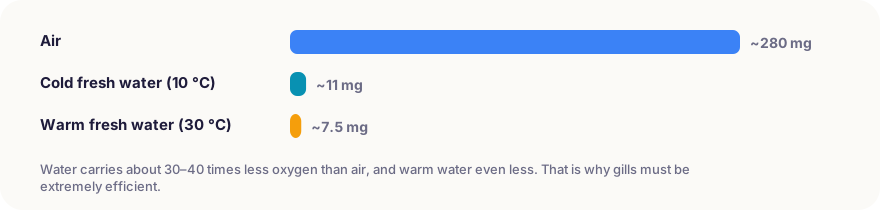
Water does contain oxygen, but not as part of the water molecule itself. The oxygen fish use is dissolved oxygen, oxygen gas from the air that has mixed into the water. There is not much of it. A litre of air contains about 280 milligrams of oxygen, while a litre of cool fresh water holds only around 10 milligrams, roughly 30 times less.
Water is also about 800 times denser than air, so moving it over a breathing surface takes much more effort. To survive, fish need an organ that squeezes as much oxygen as possible out of every mouthful of water.
How gills work
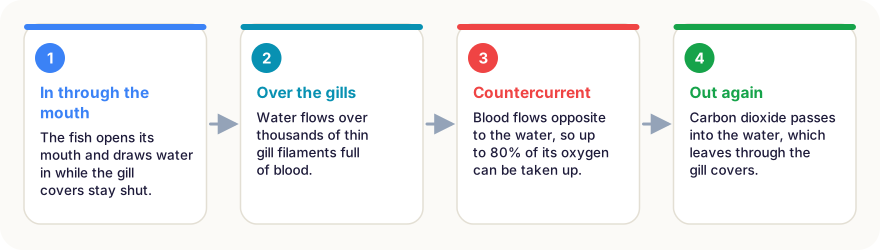
Most bony fish have four pairs of gill arches on each side of the head, protected by a hard flap called the operculum. Each arch carries two rows of thin filaments, and each filament is covered with tiny folds called lamellae. The lamellae have walls only a few cells thick, packed with capillaries, the smallest blood vessels.
Breathing happens like this:
- The fish opens its mouth and lowers the floor of its mouth, drawing water in while the opercula stay closed.
- It closes its mouth and raises the floor, pushing water back over the gills.
- Oxygen diffuses from the water, through the thin lamellae, into the blood. Carbon dioxide moves the other way, into the water.
- The water leaves through the gill openings behind the head.
Unlike our lungs, where air goes in and comes out the same way, water flows through the gills in one direction only. Together, all the lamellae give a fish a huge surface area for gas exchange, in some fast-swimming species more than ten times the area of their body surface.
The countercurrent trick
The real genius of gills is the direction of flow. In the lamellae, blood flows in the opposite direction to the water. This is called countercurrent exchange.
Why does it matter? As blood flows through a lamella, it keeps meeting water that has slightly more oxygen than itself, so oxygen keeps diffusing into the blood along the whole length. If blood and water flowed the same way, they would soon reach the same oxygen level and exchange would stop halfway. Thanks to countercurrent flow, fish can extract up to about 80% of the oxygen in the water passing over their gills. Human lungs, by comparison, take only about a quarter of the oxygen from each breath of air.
| Fish gills | Human lungs | |
|---|---|---|
| Medium | Water | Air |
| Oxygen available per litre | about 10 mg (cool water) | about 280 mg |
| Flow pattern | One-way, countercurrent | In and out (tidal) |
| Oxygen extracted | up to about 80% | about 25% |
| Other jobs | Salt balance, removing ammonia | Mainly gas exchange |
More than breathing
Gills are multi-purpose organs. As physiologist David Evans and colleagues described in a major review, they also:
- balance salt and water: saltwater fish pump out excess salt through special gill cells, while freshwater fish absorb salt;
- remove waste: most of a fish’s nitrogen waste leaves as ammonia through the gills, not in urine;
- control acidity in the blood.
Unusual breathers
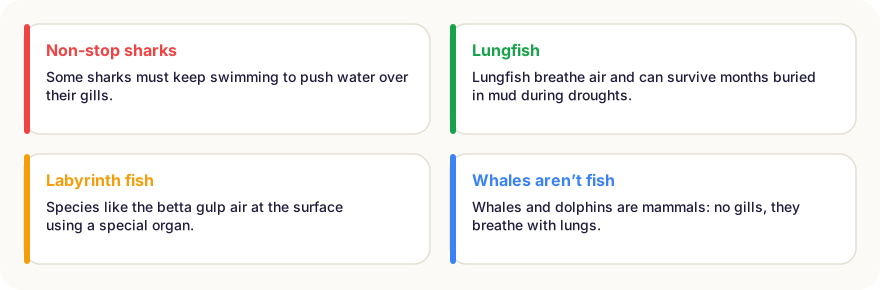
- Ram ventilators. Some sharks, tuna and mackerel swim with their mouths open, letting their forward motion drive water over the gills. Some must keep moving to breathe properly.
- Air-breathing fish. Lungfish have lungs as well as gills; African lungfish can survive dry seasons buried in mud, breathing air for months. Bettas and gouramis have a labyrinth organ that lets them gulp air at the surface, useful in warm, oxygen-poor water.
- Not fish at all. Whales and dolphins live in water but are mammals with lungs, and must surface to breathe.
Why fish suffocate out of water
Air has far more oxygen than water, so why does a fish die on land? Out of water, the delicate filaments and lamellae collapse and stick together, like wet hair clumping when lifted out of a bath. The surface area for absorbing oxygen shrinks dramatically, and the gills dry out. The fish suffocates surrounded by oxygen.
Fish can also suffocate in water. Warm water holds less oxygen, and pollution or algal blooms can use it up, which is why fish kills sometimes happen in lakes and ponds during hot summers.
In short
- Fish breathe with gills, thin filaments packed with blood vessels.
- Water holds about 30 times less oxygen than air, so gills must be very efficient.
- Water flows one way in through the mouth and out through the gill openings.
- Countercurrent flow lets fish extract up to about 80% of the oxygen.
- Gills also control salt balance and remove ammonia.
- Out of water, gills collapse, so fish suffocate despite the oxygen in the air.
Frequently asked questions
Why do fish die out of water?
Out of water, the delicate gill filaments collapse and stick together, so the surface area for absorbing oxygen shrinks dramatically. They also dry out. The fish suffocates even though air contains far more oxygen than water.
Do fish drink water?
Saltwater fish lose water to the sea and drink seawater, getting rid of the extra salt through their gills. Freshwater fish absorb water through their skin and gills and rarely drink, producing lots of dilute urine instead.
Can fish drown?
In a sense, yes. If water contains too little dissolved oxygen, for example in warm, polluted or overcrowded water, fish can suffocate. This causes mass fish deaths in some lakes in hot summers.
Do whales and dolphins have gills?
No. Whales and dolphins are mammals and breathe air with lungs. They must come to the surface to breathe through blowholes.
Sources
- Evans, D. H., Piermarini, P. M. & Choe, K. P. (2005). The multifunctional fish gill: dominant site of gas exchange, osmoregulation, acid-base regulation, and excretion of nitrogenous waste. Physiological Reviews
- Encyclopaedia Britannica – Gill
This article is based on peer-reviewed research and publications from trusted institutions, and it is reviewed regularly. How we work →
You might also wonder
All in Animals →
What Are Tardigrades? The Tiny ‘Water Bears’ That Can Survive Space
Tardigrades are tiny animals that survive freezing, drying out, radiation and even space. How they do it, where they live and why they are not indestructible.

How Do Bats See in the Dark? Echolocation Explained
Bats are not blind, but many hunt in total darkness by listening to echoes. How echolocation works, how fast bats call, and how moths fight back.

How Do Chameleons Change Colour? Nanocrystals, Not Pigments
Chameleons don’t change colour mainly to hide. They tune tiny crystals in their skin to signal mood, warn rivals and control temperature. How the trick works.

How Do Fireflies Glow? The Chemistry of Living Light
Fireflies make light without heat using a chemical reaction in their tails. How does bioluminescence work, how is it switched on and off, and why do they flash?

Why Are Flamingos Pink? Food, Pigments and Feather Make-Up
Flamingos are born grey, not pink. Their colour comes from pigments in algae and shrimp, and some even apply “make-up”. The science behind the pink bird.

How Can Owls Turn Their Heads So Far? The Secrets of a 270° Neck
Owls turn their heads about 270 degrees without cutting off blood to the brain. Why they need to, and the neck bones and vessels that make it possible.