What Are Tardigrades? The Tiny ‘Water Bears’ That Can Survive Space
Tardigrades are tiny animals that survive freezing, drying out, radiation and even space. How they do it, where they live and why they are not indestructible.
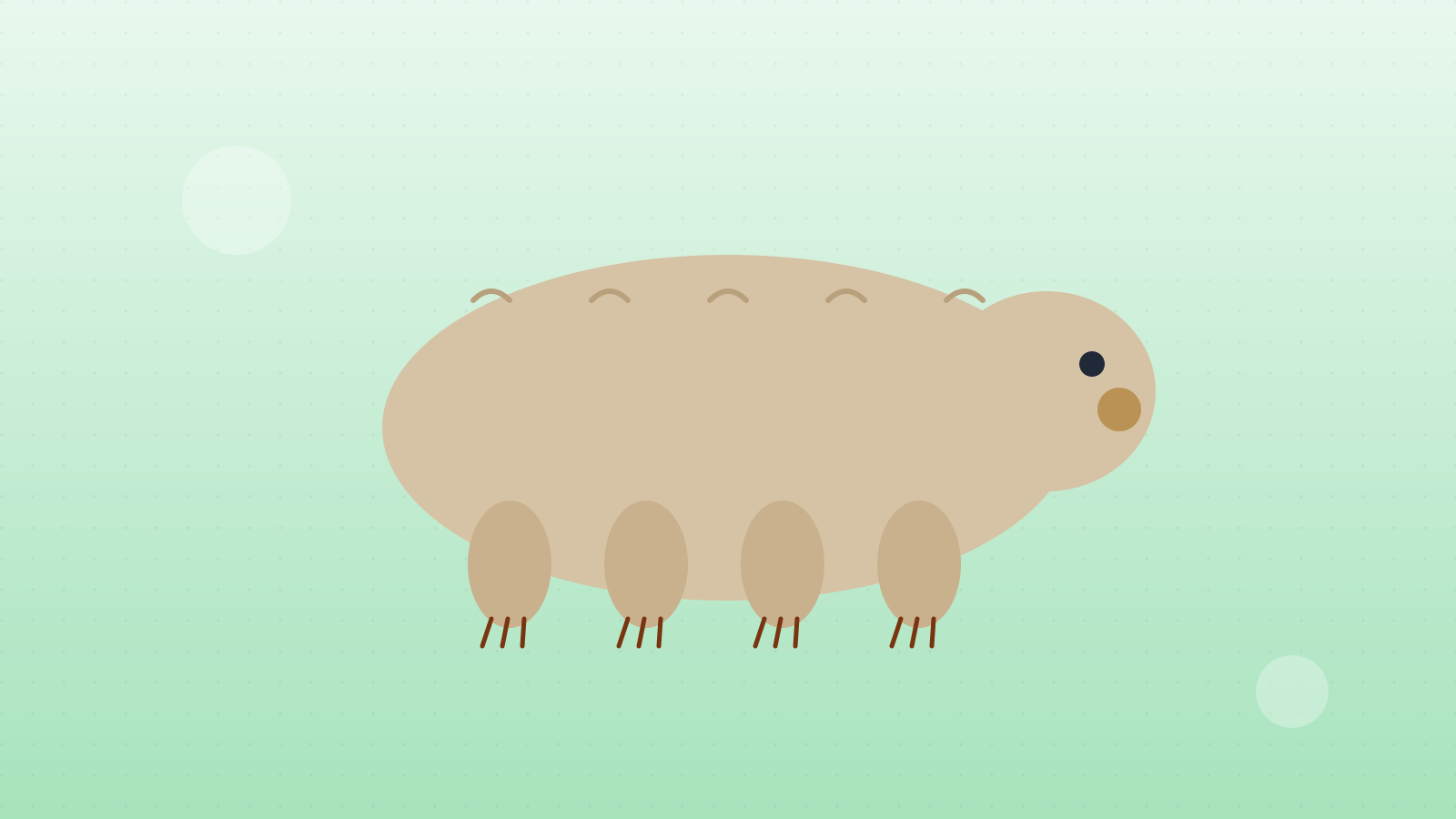
Short answer
Tardigrades, also called water bears or moss piglets, are microscopic eight-legged animals, usually less than a millimetre long, found almost everywhere on Earth, from garden moss to deep-sea mud. They are famous for surviving extreme conditions. When their surroundings dry out, they curl into a dried, barrel-shaped state called a tun, losing almost all their body water and slowing their metabolism to almost nothing. In this state they can withstand freezing, intense radiation and even the vacuum of space. Special proteins turn their cells into a protective glass-like solid and shield their DNA. When water returns, they revive and carry on with life.
In this article (6)
Under a microscope, a tardigrade looks almost cute: a plump, transparent body, a round head and eight stubby legs tipped with tiny claws, lumbering through a drop of water like a miniature bear. Yet this little creature has a reputation as the toughest animal on Earth. It has survived boiling, freezing, crushing pressures and even a trip into space. How?
Meet the water bear
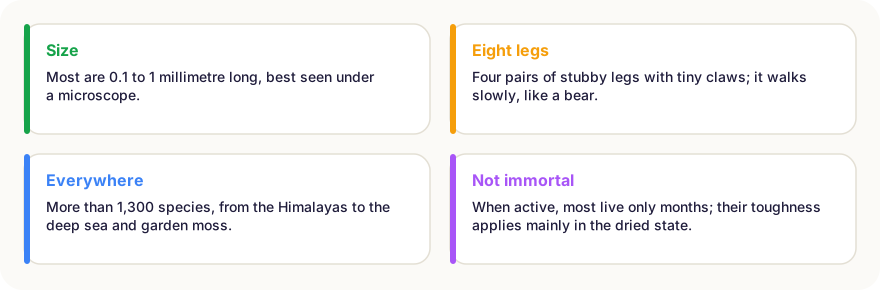
Tardigrades were first described in 1773 by German pastor Johann August Ephraim Goeze, who called them kleiner Wasserbär, “little water bear”. The scientific name, from Latin, means “slow stepper”.
They are true animals, with a brain, muscles, a gut and eggs, packed into a body usually 0.1 to 1 millimetre long. More than 1,300 species are known, and they live almost everywhere: in moss and lichen on walls and trees, in soil, in lakes, in the deep sea, on Himalayan mountains and in Antarctica. Most feed by piercing plant cells, algae or tiny animals with sharp mouthparts and sucking out the contents.
The tun: surviving by drying out
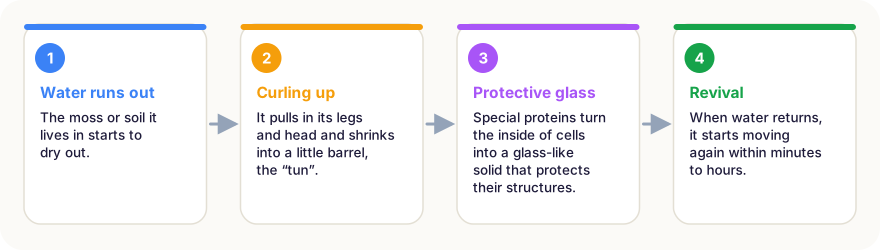
Many tardigrades live in places that regularly dry out, such as a cushion of moss on a sunny wall. Their secret is a state called cryptobiosis, “hidden life”.
When water starts to disappear, a tardigrade pulls in its legs and head and shrivels into a tiny dried barrel called a tun. It loses up to 97% of its body water, and its metabolism slows to less than 0.01% of normal, so low that it is barely detectable. In this state it can wait for years. When water returns, it rehydrates and starts walking again within minutes to hours.
How do its cells survive drying out, when ours would be destroyed? In 2017, a team led by Thomas Boothby found that tardigrades produce special proteins, called tardigrade-specific intrinsically disordered proteins. As the animal dries, these floppy proteins form a glass-like solid inside the cells, which locks other molecules in place and prevents them from unfolding or clumping together. Some tardigrades also use a sugar called trehalose for similar protection.
Survival records
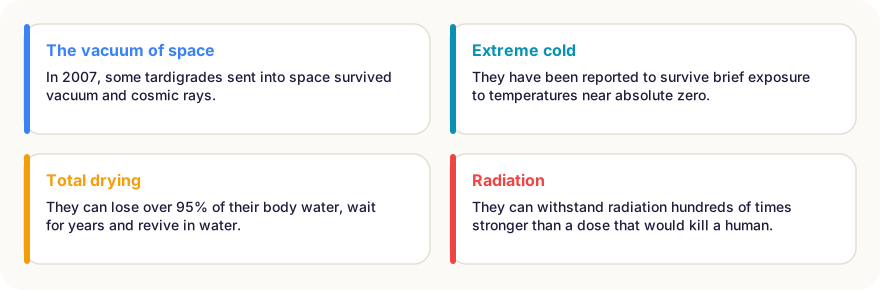
| Challenge | What tardigrades have survived (mostly as tuns) |
|---|---|
| Vacuum of space | Exposure in low Earth orbit in 2007 |
| Extreme cold | Brief exposure close to absolute zero (−273 °C) in laboratory tests |
| Long freezing | Revived after about 30 years frozen in Antarctic moss |
| Drying out | Losing almost all body water and waiting for years |
| Radiation | Doses hundreds of times higher than would kill a human |
| High pressure | Pressures several times greater than at the deepest ocean floor |
Space. In 2007, a team led by K. Ingemar Jönsson sent dried tardigrades into orbit on the European FOTON-M3 satellite and exposed them directly to space. Many survived the vacuum and cosmic radiation. Those also exposed to the full ultraviolet light of the Sun fared much worse, but a few still survived, and some later laid eggs that hatched.
Radiation. In 2016, Takuma Hashimoto and colleagues sequenced the genome of a tough tardigrade species and found a unique protein they named Dsup, short for “damage suppressor”. It binds to DNA and helps shield it. When the researchers put the gene into human cells grown in the laboratory, those cells suffered much less DNA damage from X-rays.
Freezing for decades. In 2016, Japanese researchers revived tardigrades from a sample of Antarctic moss that had been frozen for about 30 years. One later laid eggs that hatched.
Not quite indestructible
Tardigrades are often called “indestructible”, but that is an exaggeration. Their extraordinary toughness applies mostly to the dried tun state. When active, they are far more fragile. Studies have shown that many active tardigrades die after long exposure to temperatures not far above human body temperature, which raises concerns about how they will cope with a warming climate. And they cannot survive being dried out over and over indefinitely.
Why scientists care
Understanding tardigrades could have practical benefits:
- Their protective proteins might help preserve medicines and vaccines without refrigeration, a big advantage in hot regions.
- Proteins like Dsup inspire research into protecting human cells from radiation, for example during cancer treatment or long space missions.
- They help scientists think about whether life could survive on other planets or travel between them.
In 2019, an Israeli lunar lander carrying dried tardigrades crashed on the Moon. Scientists think they could not survive the impact, but the story shows how much these tiny animals capture our imagination.
In short
- Tardigrades are microscopic eight-legged animals, usually under 1 mm long.
- They live almost everywhere, from moss to the deep sea; over 1,300 species are known.
- When dried, they become a tun, a state of almost suspended life called cryptobiosis.
- Special proteins form a protective glass in their cells, and Dsup shields their DNA.
- As tuns, they have survived space, extreme cold and intense radiation.
- They are not indestructible: active tardigrades are much more fragile.
Frequently asked questions
Are tardigrades really indestructible?
No. They are extremely tough in their dried state, but active tardigrades are much more vulnerable. Studies show that, when active, many die after long exposure to temperatures not much above human body temperature.
Where can I find tardigrades?
Collect a little moss or lichen from a wall or tree, soak it in water for a few hours, and look at the water under a basic microscope. Tardigrades are often found this way.
How long do tardigrades live?
Active tardigrades typically live a few months to a couple of years. Time spent in the dried tun state may not count towards this, so their total lifespan can be much longer.
Are tardigrades insects?
No. Tardigrades form their own group of animals, the phylum Tardigrada. Their closest relatives are thought to be arthropods, such as insects and spiders, and velvet worms.
Sources
- Jönsson, K. I. et al. (2008). Tardigrades survive exposure to space in low Earth orbit. Current Biology
- Boothby, T. C. et al. (2017). Tardigrades use intrinsically disordered proteins to survive desiccation. Molecular Cell
- Hashimoto, T. et al. (2016). Extremotolerant tardigrade genome and improved radiotolerance of human cultured cells by tardigrade-unique protein. Nature Communications
This article is based on peer-reviewed research and publications from trusted institutions, and it is reviewed regularly. How we work →
You might also wonder
All in Animals →
How Do Fish Breathe Underwater? Inside the Remarkable Gill
Fish take oxygen from water with gills packed with blood vessels. How gills work, why water is harder to breathe than air and why fish suffocate on land.
How Do Bats See in the Dark? Echolocation Explained
Bats are not blind, but many hunt in total darkness by listening to echoes. How echolocation works, how fast bats call, and how moths fight back.
How Do Chameleons Change Colour? Nanocrystals, Not Pigments
Chameleons don’t change colour mainly to hide. They tune tiny crystals in their skin to signal mood, warn rivals and control temperature. How the trick works.

How Do Fireflies Glow? The Chemistry of Living Light
Fireflies make light without heat using a chemical reaction in their tails. How does bioluminescence work, how is it switched on and off, and why do they flash?

Why Are Flamingos Pink? Food, Pigments and Feather Make-Up
Flamingos are born grey, not pink. Their colour comes from pigments in algae and shrimp, and some even apply “make-up”. The science behind the pink bird.

How Can Owls Turn Their Heads So Far? The Secrets of a 270° Neck
Owls turn their heads about 270 degrees without cutting off blood to the brain. Why they need to, and the neck bones and vessels that make it possible.