Why Does Static Electricity Shock You? The Science of the Door-Handle Spark
Why do door handles shock you, why is it worse in winter and how does a balloon stick to a wall? The science of static electricity and how to avoid it.
Short answer
When two different materials touch and separate, electrons move from one to the other. The material that gains electrons becomes negatively charged; the one that loses them becomes positive. Walking on carpet or pulling off a jumper makes your body build up charge this way. When you reach for a metal door handle, the charge suddenly jumps to the metal in a tiny spark and you feel a shock. Charge builds up more easily in dry air, which is why shocks are more common in winter.
In this article (8)
The crackle as you pull off a jumper on a winter morning, the spark that leaps to your finger as you touch the car door, hair that stands on end — static electricity is the oldest electrical phenomenon we encounter in daily life. Long before electricity was understood, people noticed that amber attracted feathers. Yet the details of this seemingly simple effect still puzzle scientists today.
It all starts with atoms
All matter is made of atoms. At the centre of each atom are positively charged protons, surrounded by negatively charged electrons. Normally an atom has equal numbers of protons and electrons, so materials are electrically neutral.
Because electrons sit in the outer parts of atoms, they are far more mobile than protons, and in some situations they can move from one material to another. That is where static electricity begins.
Charge transfer by contact
When two different materials touch and then separate, some electrons move from one to the other. This is called the triboelectric effect — “tribo” comes from the Greek for rubbing. Rubbing is not strictly necessary — contact and separation are enough — but rubbing increases the area in contact and so boosts the effect.
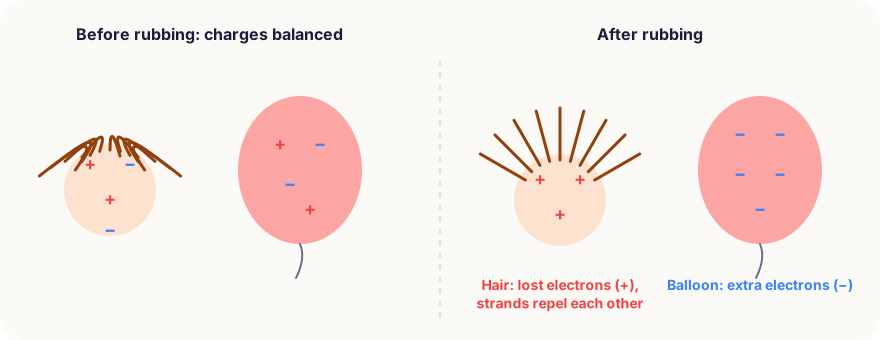
When you rub a balloon on your hair, for example:
- some electrons move from your hair to the balloon, so the balloon becomes negative;
- having lost electrons, your hair becomes positive;
- strands of hair with the same charge repel each other — which is why your hair stands on end;
- the oppositely charged balloon and hair attract each other, so your hair follows the balloon as you pull it away.
Scientists rank materials by their tendency to give or take electrons in a triboelectric series:
| Tends to give electrons (becomes positive) | Tends to take electrons (becomes negative) |
|---|---|
| Human skin, hair | Rubber, balloons |
| Wool, nylon | Polyester |
| Glass | PVC, plastics |
The further apart two materials are in the series, the more charge builds up when they are rubbed together.
A mystery science still hasn’t solved
Remarkably, for an effect known for thousands of years, exactly how it works is still debated. A 2019 review highlighted many unanswered questions about triboelectric charging. For instance, it is not fully clear whether the charge is always carried by electrons or sometimes by ions or tiny fragments of material. Even two pieces of the same material can become charged when rubbed together.
Why do door handles shock you?
As you walk across a carpet, charge keeps transferring between your soles and the carpet. Pulling off a jumper, getting up from a car seat or climbing out from under a blanket also charge your body. As long as that charge has nowhere to go, you can build up thousands of volts.
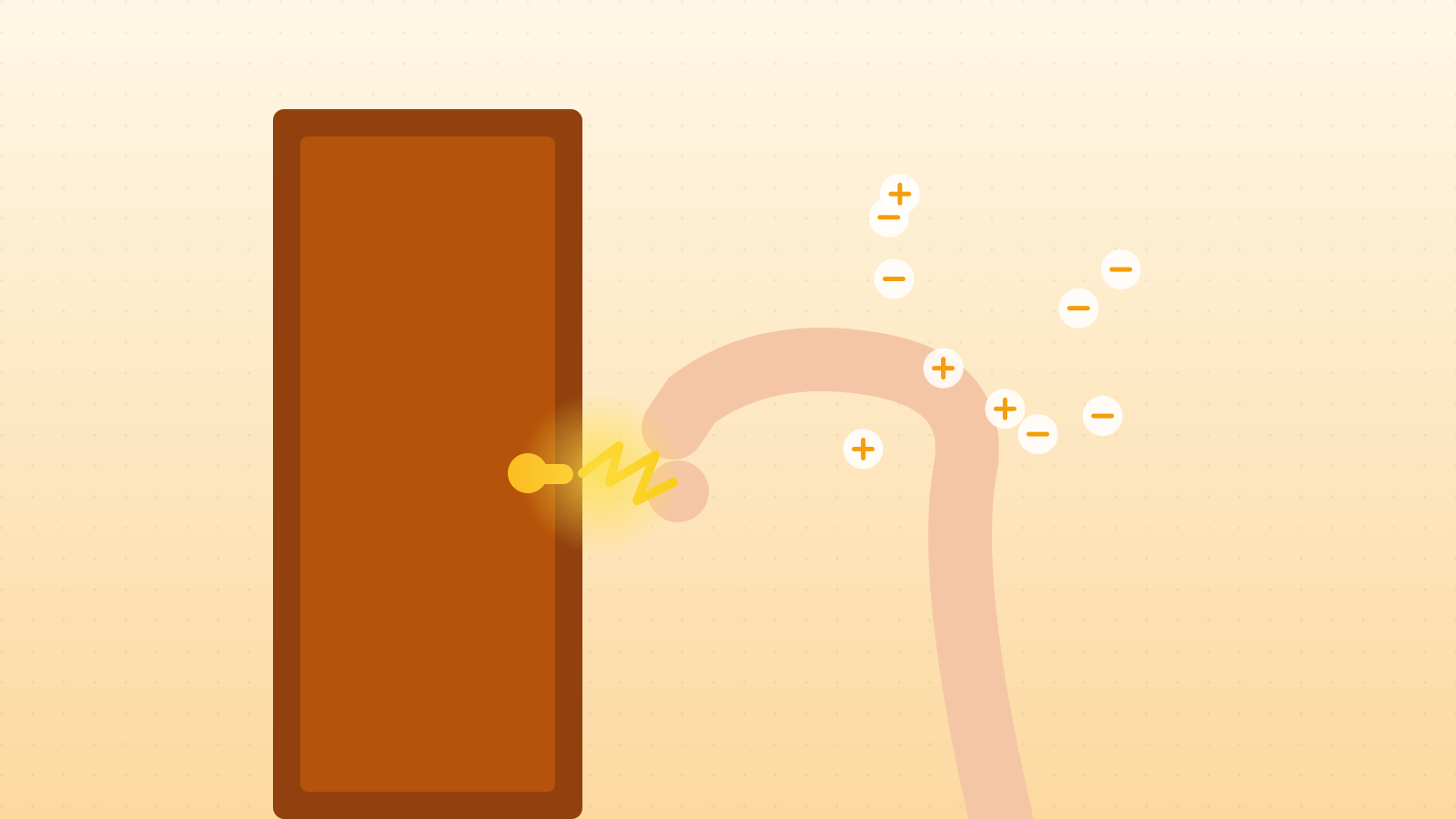
The moment you reach for a metal door handle, fridge or car door, the charge finds a way out. Metal conducts electricity very well, so the charge jumps all at once. The sudden current crossing the few millimetres of air between your finger and the metal produces a tiny spark, a faint crackle and a pin-prick sensation.
People typically feel discharges above about 2,000–3,000 volts, and someone walking on carpet in dry air can build up far more than that. Despite the high voltage, the current is tiny and lasts only millionths of a second, which is why shocks are usually harmless.
Why are shocks worse in winter?
Humidity is the silent enemy of static electricity. In humid air, a thin film of water forms on surfaces and lets accumulated charge slowly leak away into the air and surroundings, so large charges cannot build up.
In winter, two things happen at once:
- cold air naturally holds little moisture;
- central heating dries indoor air even further.
In dry air, charge cannot leak away and builds up through the day — so we get shocked far more often by door handles and by each other.
How does a balloon stick to a wall?
Hold a balloon you have rubbed on your hair against a wall and it sticks — even though the wall is uncharged. Where does the attraction come from?
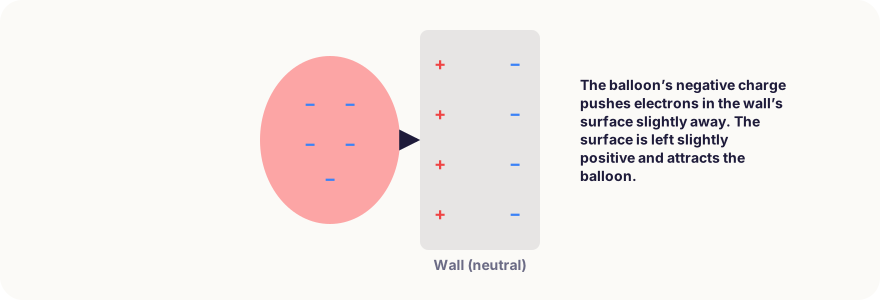
The answer is polarisation. As the negative balloon approaches, it pushes the electrons in the wall’s atoms and molecules slightly away. The surface facing the balloon becomes slightly positive, the far side slightly negative. The balloon’s negative charge attracts the nearby positive surface more strongly than it repels the more distant negative part, and that net pull is enough to hold a light balloon in place.
The same principle explains why a rubbed comb picks up scraps of paper and why screens attract dust.
When is static electricity dangerous?
Everyday shocks are harmless, but static electricity can be a serious risk in some settings:
- Flammable gases and vapours: at petrol stations, paint shops or flour mills, even a tiny spark can start a fire, which is why such places use earthing precautions.
- Electronics: computer components and chips can be damaged by discharges too small for a person to feel, so technicians wear grounding wrist straps.
- Lightning: nature’s biggest static discharge. Huge charges built up in storm clouds discharge to the ground on the same principle — see How does lightning form?.
How to avoid static shocks
If constant winter shocks are getting on your nerves, try these:
- Humidify the air: keeping indoor humidity around 40–50% markedly reduces charge build-up.
- Wear natural fabrics: cotton and linen build up less charge than wool and synthetics.
- Moisturise your skin: dry skin holds more charge; hand cream can help.
- Touch with a key: touch a metal handle with a key in your hand instead of your fingertip. The spark jumps from the key, and your nerve-rich fingertip feels nothing.
- Getting out of a car: hold the metal door frame before your feet touch the ground, so the charge drains away gently as you stand up.
In short
Static electricity forms when two different materials touch and separate and electrons move from one to the other. Our bodies build up charge as we walk on carpet or pull off a jumper, and it discharges in a spark when we approach metal. Dry winter air stops the charge leaking away, so shocks are more common then. A balloon sticks to a wall because it polarises the charges in the wall’s surface. Known for thousands of years, the effect still holds scientific secrets in its details.
Frequently asked questions
Is a static shock dangerous?
Everyday shocks are usually harmless. Although the voltage can reach thousands of volts, the current is tiny and lasts only a fraction of a second. Sparks can be dangerous where flammable gases are present, however.
Why do some people get shocked more often?
Dry skin, synthetic clothes, rubber-soled shoes and carpeted rooms all increase charge build-up. Keeping your skin moisturised and wearing cotton can help.
How can I avoid static shocks?
Touch metal with a key or coin held in your hand rather than your fingertip; the spark jumps from the key and you feel nothing. Humidifying the air at home also works well.
Is static electricity a risk at petrol stations?
Rarely, but yes. Getting in and out of the car while refuelling can build up charge on your body. Touching a metal part of the car before handling the nozzle discharges it safely.
Sources
This article is based on peer-reviewed research and publications from trusted institutions, and it is reviewed regularly. How we work →
You might also wonder
All in Everyday Science →
Why Does Ice Float? Water’s Life-Saving Weirdness
Solids are usually denser than their liquids, so why does ice float? How hydrogen bonds make water an exception and keep lakes alive in winter.
Why Do Onions Make You Cry? The Chemistry of Tears and How to Stop Them
Why do your eyes water when you cut onions? The tear gas onions make to protect themselves — and the science-backed ways to chop onions without crying.
Why Does Salt Melt Ice? The Chemistry of Gritting Roads in Winter
Why do we salt roads in winter, how does salt melt ice and why doesn’t it work when it is very cold? Freezing-point depression and its side effects, explained.

How Does a Microwave Heat Food? The Physics of Spinning Water Molecules
How does a microwave oven heat food, why does metal spark inside it and is it safe? The science of microwave heating, explained with diagrams.

Why Does Popcorn Pop? The Physics of a Tiny Pressure Cooker
Why do corn kernels pop, where does the “pop” sound come from and why do some kernels never pop? The physics of popcorn, step by step with diagrams.

Why Is the Night Sky Dark? Olbers’ Paradox and the Age of the Universe
With billions of stars out there, why isn’t the night sky ablaze with light? Olbers’ paradox, the finite age of the universe and cosmic expansion, explained.