Why Does Salt Melt Ice? The Chemistry of Gritting Roads in Winter
Why do we salt roads in winter, how does salt melt ice and why doesn’t it work when it is very cold? Freezing-point depression and its side effects, explained.
Short answer
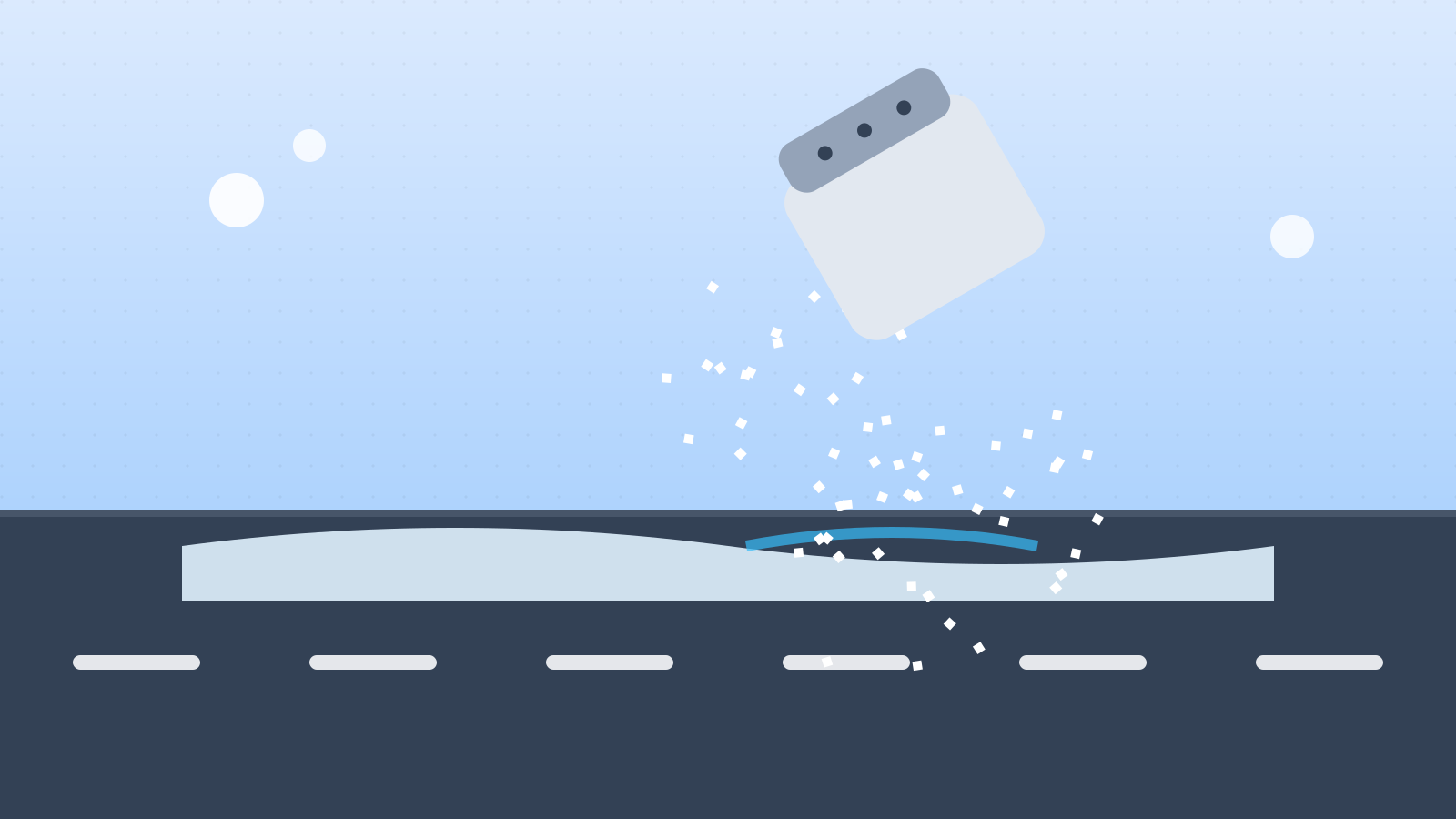
At 0 °C, ice and water are in constant balance: some water molecules freeze while some ice molecules melt. When salt dissolves in the thin film of water on the surface of ice, its ions make it harder for water molecules to join the ice crystal. Melting carries on but freezing slows, so the ice melts. That is why salty water can stay liquid below 0 °C. Road salt works down to about −9 °C in practice; below that it stops being effective.
In this article (8)
The white grains spread by gritters on snowy mornings are close relatives of the salt in your kitchen. This simple substance can quickly turn icy roads into wet but safe surfaces. But how does salt melt ice — and why does it sometimes do nothing at all on very cold days?
The hidden dance between ice and water
Imagine dropping an ice cube into water at 0 °C. From the outside nothing seems to change, but at the molecular level there is constant movement:
- some molecules in the water attach to the ice crystal and freeze;
- some molecules in the ice break away and join the water — they melt.
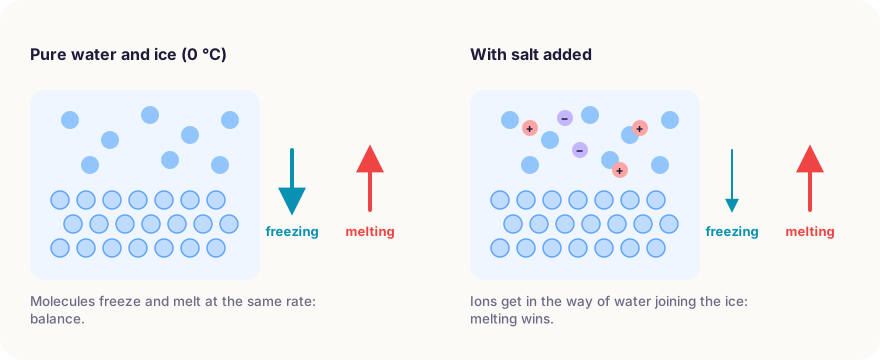
At exactly 0 °C, both processes happen at the same rate. As many molecules freeze as melt, so the ice neither grows nor shrinks. Scientists call this dynamic equilibrium, and the freezing point of water is precisely the temperature at which this balance is struck.
Salt upsets the balance
Ice is never completely dry. Its surface has a thin film of water, especially where sunlight or traffic has warmed it. When salt dissolves in that water, it splits into sodium and chloride ions.
These ions:
- get in between water molecules and make it harder for them to reach and attach to the ice crystal;
- are not accepted into the ice crystal’s orderly structure;
- so freezing slows down, while molecules keep breaking away from the ice at the same rate.
The balance tips and melting wins. For a new balance to form, the temperature must fall further. In short, salt lowers the freezing point of water — an effect chemists call freezing-point depression.
What matters is not the type of salt but how many particles it splits into in water: the more ions, the lower the freezing point. The same principle explains why seawater freezes at around −1.9 °C.
How cold can salt work?
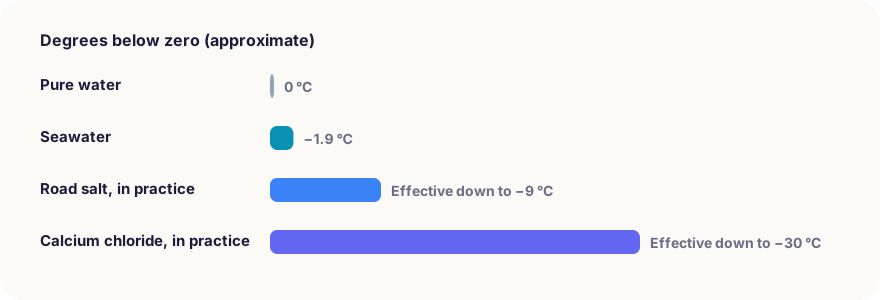
Salt’s effect has limits. The more salt dissolves, the lower the freezing point — but beyond a certain point, water cannot dissolve any more.
| Substance | Effect on freezing point |
|---|---|
| Pure water | 0 °C |
| Seawater (3.5% salt) | About −1.9 °C |
| Table salt (sodium chloride), theoretical minimum | About −21 °C |
| Road salt, practical limit | About −9 °C |
| Calcium chloride, in practice | Down to about −30 °C |
In theory, sodium chloride can lower the freezing point to about −21 °C — but that requires a very concentrated salt solution, which is hard to achieve on a road. In extreme cold, the thin water film salt needs to dissolve in does not form either. So in practice road salt slows down markedly below about −9 °C.
In very cold climates, salts such as calcium chloride or magnesium chloride are used instead. They split into three ions each, producing more particles than sodium chloride, and calcium chloride also releases heat as it dissolves, helping to melt the ice.
Why is salted ice colder?
An intriguing side effect: as salt melts ice, the surroundings cool down. Melting ice requires heat, and that heat is drawn from the surroundings — the ice and salty water themselves. The temperature of a salt-and-ice mixture therefore drops well below 0 °C.
This effect has been used for centuries to make ice cream. The ice-cream mixture goes in a container placed inside a larger one filled with ice and salt. The salty ice drops below −10 °C or even −20 °C and freezes the ice cream quickly — a classic kitchen experiment you can try at home.
Why spray brine?
In recent years many road authorities have started spraying brine (salty water) instead of dry salt. It has several advantages:
- the salt is already dissolved, so it starts working immediately;
- it is not blown away by the wind or flung off the road by tyres;
- sprayed before snow falls, it stops ice bonding to the road — so-called anti-icing;
- the same effect can be achieved with less salt.
Grit instead of salt
Sand or fine grit does not melt ice. Instead, it roughens the surface so tyres and shoes can grip. It is especially useful on very cold days when salt is ineffective, and the two are sometimes used together: salt melts the ice while grit gives instant traction.
The price of salt
Salt is vital for winter safety, but it comes at a cost:
- Corrosion: salty water speeds up rusting of cars, bridges and the steel reinforcement inside concrete.
- Plants: salt splashed onto verges raises soil salinity and can kill trees and grass.
- Water: salt washes into streams, lakes and groundwater, harming freshwater life.
- Pets: salt can irritate dogs’ and cats’ paws — wiping them with lukewarm water after winter walks is a good idea.
That is why experts recommend using salt where it is needed, in the amount needed, with gentler alternatives such as grit on pavements.
In short
Salt melts ice by upsetting the balance between freezing and melting. Ions dissolved in the thin film of water on the ice make it harder for water molecules to refreeze, lowering the freezing point below 0 °C. Road salt works down to about −9 °C; in colder conditions, stronger salts such as calcium chloride or grip-giving grit are used. Salt keeps winter roads safe, but because it also damages cars, plants and water, it should be used with care.
Frequently asked questions
Why doesn’t salt melt ice when it is very cold?
Table salt can theoretically lower the freezing point to about −21 °C, but creating such a concentrated salt solution on a road is difficult. In practice, road salt works very slowly below about −9 °C and becomes almost useless.
Does grit or sand melt ice?
No. Sand or fine gravel does not melt ice; it only roughens the surface so tyres and shoes can grip. Unlike salt, it works even in very cold weather.
Does road salt damage cars?
Yes. Salty water speeds up rusting. Regularly washing the underside and body of a car in winter reduces corrosion.
Is salt harmful to the environment?
When overused, yes. Salt washes into soil and groundwater, harming plants, trees and freshwater life. It can also irritate pets’ paws.
Sources
- PBS NewsHour – Why does salt melt road ice?
- American Association of Chemistry Teachers – Salting Roads in Winter
This article is based on peer-reviewed research and publications from trusted institutions, and it is reviewed regularly. How we work →
You might also wonder
All in Everyday Science →
How Does Soap Work? The Two-Faced Molecule That Cleans
Water alone can’t wash away grease, but soap can. How soap molecules trap oil in micelles, why they destroy some viruses and why 20 seconds matter.
Why Do Apples Turn Brown? Enzymatic Browning and How to Stop It
A cut apple turns brown within minutes because an enzyme reacts with oxygen. What happens, why lemon juice helps, and whether brown apple is safe to eat.

Why Does Bread Go Stale? It Isn’t Just Drying Out
Stale bread isn’t simply dry: its starch slowly recrystallises. Why bread stales faster in the fridge, why toasting revives it and the best way to store it.
Why Is Glass Transparent When Sand Is Not? The Physics of Clear Glass
Glass is made from sand, yet light passes straight through it. Why glass is clear, why it blocks some ultraviolet, and whether old windows really flow.

Does Hot Water Freeze Faster Than Cold? The Mpemba Effect Explained
A Tanzanian schoolboy claimed hot water freezes faster than cold. Is the Mpemba effect real? The proposed explanations and what careful experiments found.

Why Do Mentos and Coke Explode? The Science of the Soda Fountain
Drop Mentos into cola and foam shoots metres high. It is physics, not a chemical reaction: rough candy surfaces let dissolved carbon dioxide escape all at once.