How Does Soap Work? The Two-Faced Molecule That Cleans
Water alone can’t wash away grease, but soap can. How soap molecules trap oil in micelles, why they destroy some viruses and why 20 seconds matter.
Short answer
Soap works because each soap molecule has two very different ends: a head that loves water and a long tail that loves oil and avoids water. When you wash, the tails bury themselves in grease and dirt while the heads stay in the water. The molecules surround the oil in tiny balls called micelles, which water can then rinse away. Soap also breaks apart the fatty outer envelope of some viruses and bacteria, which is why washing hands with soap for at least 20 seconds works so well.
In this article (7)
Try washing a greasy pan with plain water and the oil just beads up and slides around. Add a drop of soap and the grease lets go. It seems ordinary, but it is a beautiful piece of chemistry. The secret lies in a molecule with a split personality.
Water and oil don’t mix
Water molecules are polar: they have a slightly positive end and a slightly negative end, so they cling to each other strongly. Oils and fats are non-polar. They cannot form those attractions with water, so water molecules push them out of the way, and oil gathers in droplets or films.
Most of the dirt on our hands and clothes is held in place by oils: the natural oils of our skin, cooking fat, grease. That is why water alone washes away salt or sugar but not a greasy fingerprint.
A molecule with two faces
A soap molecule solves this by being both things at once.
- One end, the head, carries an electric charge. It loves water and dissolves easily in it. Chemists call it hydrophilic.
- The other end, the tail, is a long chain of carbon and hydrogen atoms, much like the molecules in oil. It avoids water and dissolves in fat. It is hydrophobic.
Molecules like this are called surfactants. They also lower the surface tension of water, which helps it spread out and soak into fabrics and the tiny folds of the skin.
Micelles: tiny cages for grease
When soapy water meets an oily spot, the soap molecules arrange themselves automatically. Their tails push into the oil to escape the water, while their heads stay pointing outwards into the water.
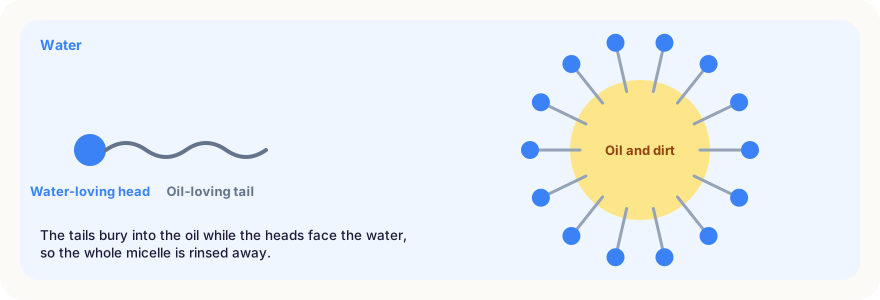
Scrubbing breaks the oil into smaller droplets, and each one becomes surrounded by soap molecules, forming a tiny ball called a micelle. On the outside, a micelle looks like it is made of water-loving heads, so it stays suspended in the water instead of sticking back to your skin. When you rinse, the micelles and the dirt inside them are carried away.
How soap destroys some germs
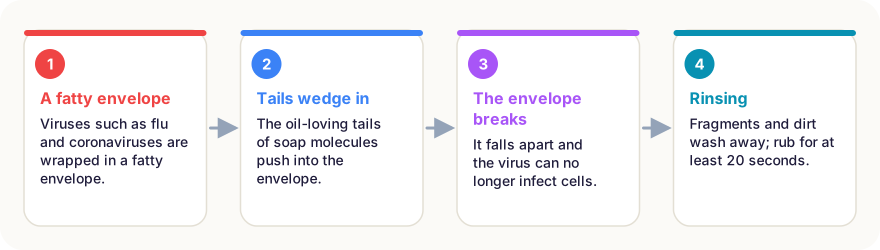
Soap does more than wash dirt off. Many viruses, including influenza viruses and coronaviruses, are wrapped in a thin envelope made of fatty molecules. Bacteria also have membranes built from fats.
The oil-loving tails of soap molecules can wedge themselves into these fatty envelopes. As more soap molecules push in, the envelope is pulled apart, a bit like a soap bubble bursting. Without its envelope, the virus can no longer infect cells. The fragments are then trapped in micelles and rinsed away.
Why the 20 seconds matter
Public health agencies such as the US Centers for Disease Control and Prevention recommend washing your hands with soap and water for at least 20 seconds. That gives the soap time to spread over every surface, loosen oils, break apart germs and lift them away. The friction of rubbing your hands together is a key part of the process.
Don’t forget the parts people often miss: the backs of the hands, between the fingers, the thumbs and under the nails. Rinsing well and drying with a clean towel completes the job, because wet hands pick up and spread germs more easily.
Soap, detergent and hard water
Traditional soap is made by heating fats or oils with a strong alkali, such as sodium hydroxide, in a reaction called saponification. It is gentle and effective, but it has a weakness. In hard water, which contains a lot of calcium and magnesium, soap molecules bind to these minerals and form an insoluble grey residue: soap scum, the ring around the bathtub.
Synthetic detergents, developed in the 20th century, work in the same way as soap but with heads that do not bind to calcium and magnesium. That is why most washing powders, dish soaps and shampoos today are detergents.
In short
- Water cannot remove oily dirt because oil and water don’t mix.
- A soap molecule has a water-loving head and an oil-loving tail.
- Soap molecules surround oil in tiny balls called micelles, which water rinses away.
- Soap also breaks the fatty envelope of viruses such as flu and coronaviruses.
- Washing for at least 20 seconds and scrubbing all surfaces gives soap time to work.
- Detergents are synthetic surfactants that work even in hard water.
Frequently asked questions
Is hand sanitiser better than soap?
Not usually. Washing with soap and water removes dirt and many germs that sanitiser does not work well against. Alcohol-based sanitiser with at least 60% alcohol is a good alternative when soap and water are not available.
Does hot water clean better than cold?
For hand washing, cold and warm water work about equally well when used with soap. Water hot enough to kill germs would scald your skin; the scrubbing and the soap do most of the work.
What is the difference between soap and detergent?
Soap is made from fats or oils and an alkali. Detergents are synthetic molecules that work the same way but do not form soap scum in hard water, which is why they are used in most washing powders and shampoos.
Why do I need to scrub for 20 seconds?
The soap needs time to reach all parts of the hands, loosen oils and break apart germs. Studies of hand washing show that washing for about 15 to 30 seconds removes far more germs than a quick rinse.
Sources
- Centers for Disease Control and Prevention – About handwashing
- Encyclopaedia Britannica – Soap and detergent
This article is based on peer-reviewed research and publications from trusted institutions, and it is reviewed regularly. How we work →
You might also wonder
All in Everyday Science →
Why Do Apples Turn Brown? Enzymatic Browning and How to Stop It
A cut apple turns brown within minutes because an enzyme reacts with oxygen. What happens, why lemon juice helps, and whether brown apple is safe to eat.
Why Does Bread Go Stale? It Isn’t Just Drying Out
Stale bread isn’t simply dry: its starch slowly recrystallises. Why bread stales faster in the fridge, why toasting revives it and the best way to store it.
Why Is Glass Transparent When Sand Is Not? The Physics of Clear Glass
Glass is made from sand, yet light passes straight through it. Why glass is clear, why it blocks some ultraviolet, and whether old windows really flow.
Why Does Ice Float? Water’s Life-Saving Weirdness
Solids are usually denser than their liquids, so why does ice float? How hydrogen bonds make water an exception and keep lakes alive in winter.
Why Do Onions Make You Cry? The Chemistry of Tears and How to Stop Them
Why do your eyes water when you cut onions? The tear gas onions make to protect themselves — and the science-backed ways to chop onions without crying.
Why Does Salt Melt Ice? The Chemistry of Gritting Roads in Winter
Why do we salt roads in winter, how does salt melt ice and why doesn’t it work when it is very cold? Freezing-point depression and its side effects, explained.