Why Is Glass Transparent When Sand Is Not? The Physics of Clear Glass
Glass is made from sand, yet light passes straight through it. Why glass is clear, why it blocks some ultraviolet, and whether old windows really flow.
Short answer
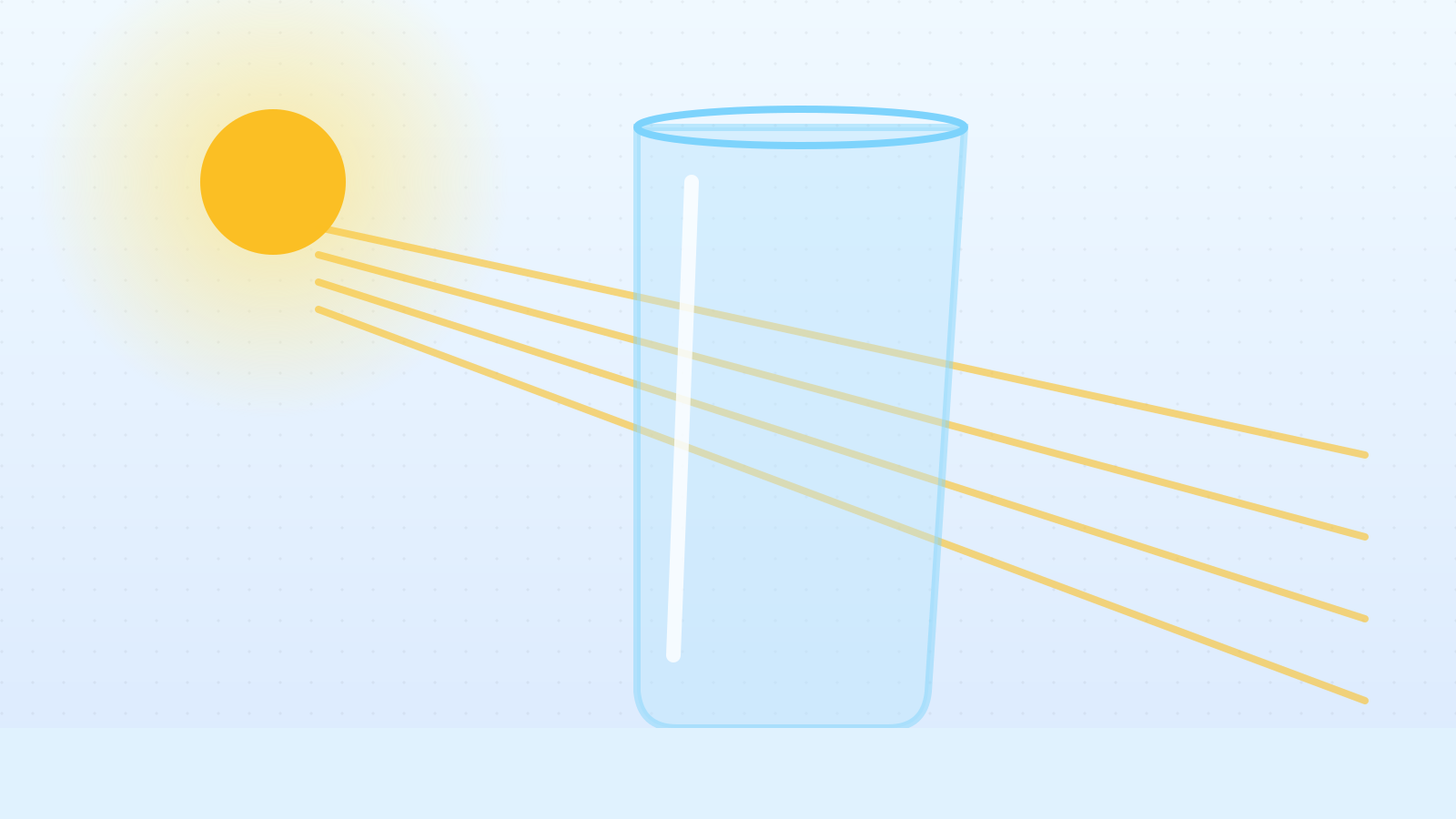
Glass is transparent because visible light does not have enough energy to be absorbed by the electrons in it, and because glass has no internal boundaries to scatter light. In silica glass, electrons can only absorb light with about 9 electronvolts of energy, while visible light carries only 1.6 to 3.3, so it passes straight through. Sand is made of the same material, but its countless tiny grains have surfaces that scatter light in every direction, so a pile of sand looks white or tan rather than clear.
In this article (6)
Glass begins as sand, soda and limestone heated in a furnace. Sand is grainy and opaque; a window is so clear that birds sometimes fly into it. How can the same material be both? The answer comes from two different ideas: what light needs to be absorbed, and what makes light scatter.
What glass is made of
Most everyday glass, the kind in windows and bottles, is soda-lime glass. It is about 70 to 74% silica (silicon dioxide, the main component of sand), with soda (sodium oxide) to lower the melting temperature and lime (calcium oxide) to make it more durable.
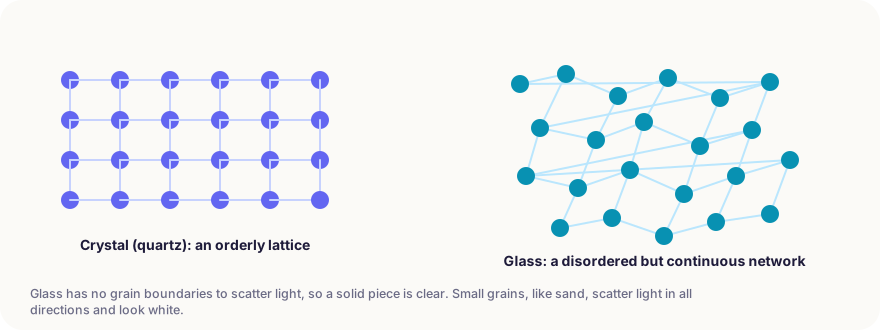
When this mixture is melted and cooled quickly, the atoms do not have time to arrange themselves into an orderly crystal. They freeze in place in a random network. A material like this is called an amorphous solid.
Reason one: visible light is too weak to be absorbed
Light travels as packets of energy called photons. A material absorbs light when a photon has just the right amount of energy to lift one of its electrons to a higher energy level.
In metals, electrons can absorb almost any amount of energy, so metals absorb and reflect visible light and are opaque and shiny. In silica glass, the electrons are held tightly in chemical bonds. To excite them, a photon would need about 9 electronvolts of energy. Photons of visible light carry only 1.6 to 3.3 electronvolts.
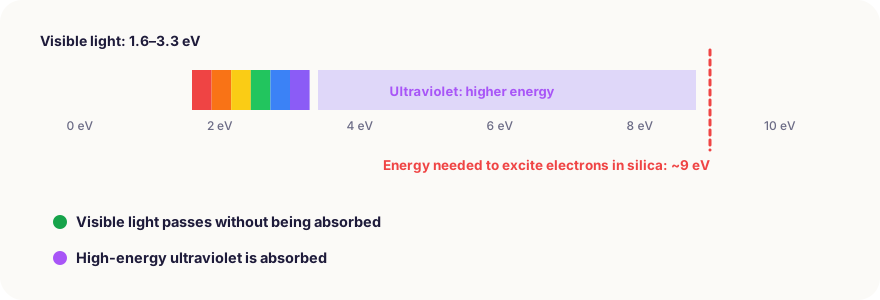
Visible photons therefore cannot be absorbed by the electrons; they simply pass through. Light does slow down slightly inside glass, which is why glass bends light, the effect that makes lenses work.
Reason two: no boundaries to scatter light
If silica is transparent, why is sand not? Sand is made of countless tiny grains, many of them crystalline quartz. Every time light crosses from air into a grain and out again, it bends and partly reflects. After thousands of such encounters in random directions, the light is scattered everywhere. This is why sand, sugar, salt, snow and crushed glass all look white or pale, even though each grain is clear.
A solid piece of glass has no grains and no internal boundaries. Light enters at one surface and leaves at the other, with very little scattering in between.
Frosted glass uses this effect on purpose: roughening the surface creates many tiny facets that scatter light, so the glass lets light through but hides what is behind it.
Glass is not clear to every kind of light
Glass is transparent to visible light, but not to everything.
- Ultraviolet: ordinary window glass absorbs most UVB, the main cause of sunburn, but lets much of the longer-wave UVA through. You are unlikely to get sunburnt through a car window, but UVA can still contribute to skin ageing.
- Infrared: glass lets in short-wave infrared from the sun but absorbs much of the long-wave infrared, the heat radiation given off by warm objects inside a room. This is part of how a greenhouse traps warmth.
The slight green tint you see when looking through the edge of a pane comes from traces of iron oxide, which absorb a little red light. Very pure glass, such as the glass used in optical fibres, is so transparent that light can travel through kilometres of it.
The myth of flowing windows
A popular story says that glass is really a very slow liquid, and that is why old cathedral windows are thicker at the bottom. It is not true.
In 1998 the Brazilian materials scientist Edgar Zanotto calculated how long medieval glass would take to flow noticeably at room temperature. The answer was far longer than the age of the universe. The uneven thickness of old windows comes from the way the glass was made: methods such as spinning molten glass into a disc produced panes that were thicker in places, and glaziers often installed the heavy edge at the bottom.
In short
- Glass is mostly silica whose atoms are frozen in a random network.
- It is transparent because visible light has too little energy (1.6–3.3 eV) to excite its electrons (about 9 eV needed).
- A solid piece of glass has no grain boundaries to scatter light, unlike sand or crushed glass.
- Window glass blocks most UVB but lets through much UVA.
- Old windows are thicker at the bottom because of how they were made, not because glass flows.
Frequently asked questions
Is glass a liquid or a solid?
Glass is an amorphous solid. Its atoms are arranged randomly like a liquid’s, but they are locked in place. At room temperature it does not flow in any measurable way.
Can you get sunburnt through a window?
Ordinary window glass blocks most UVB, the main cause of sunburn, but lets through much of the UVA, which can still age and damage the skin over long periods.
Why does the edge of a glass pane look green?
Common window glass contains small amounts of iron oxide, which absorbs a little red light. Looking through the long edge of a pane magnifies this, so it appears green.
Why do frosted glass and crushed glass look white?
Their many rough surfaces scatter light in all directions instead of letting it pass straight through, just like sand, snow or sugar.
Sources
- Zanotto, E. D. (1998). Do cathedral glasses flow? American Journal of Physics
- Encyclopaedia Britannica – Glass
This article is based on peer-reviewed research and publications from trusted institutions, and it is reviewed regularly. How we work →
You might also wonder
All in Everyday Science →
How Does Soap Work? The Two-Faced Molecule That Cleans
Water alone can’t wash away grease, but soap can. How soap molecules trap oil in micelles, why they destroy some viruses and why 20 seconds matter.
Why Do Apples Turn Brown? Enzymatic Browning and How to Stop It
A cut apple turns brown within minutes because an enzyme reacts with oxygen. What happens, why lemon juice helps, and whether brown apple is safe to eat.
Why Does Bread Go Stale? It Isn’t Just Drying Out
Stale bread isn’t simply dry: its starch slowly recrystallises. Why bread stales faster in the fridge, why toasting revives it and the best way to store it.
Why Does Ice Float? Water’s Life-Saving Weirdness
Solids are usually denser than their liquids, so why does ice float? How hydrogen bonds make water an exception and keep lakes alive in winter.
Why Do Onions Make You Cry? The Chemistry of Tears and How to Stop Them
Why do your eyes water when you cut onions? The tear gas onions make to protect themselves — and the science-backed ways to chop onions without crying.
Why Does Salt Melt Ice? The Chemistry of Gritting Roads in Winter
Why do we salt roads in winter, how does salt melt ice and why doesn’t it work when it is very cold? Freezing-point depression and its side effects, explained.