Why Does Ice Float? Water’s Life-Saving Weirdness
Solids are usually denser than their liquids, so why does ice float? How hydrogen bonds make water an exception and keep lakes alive in winter.
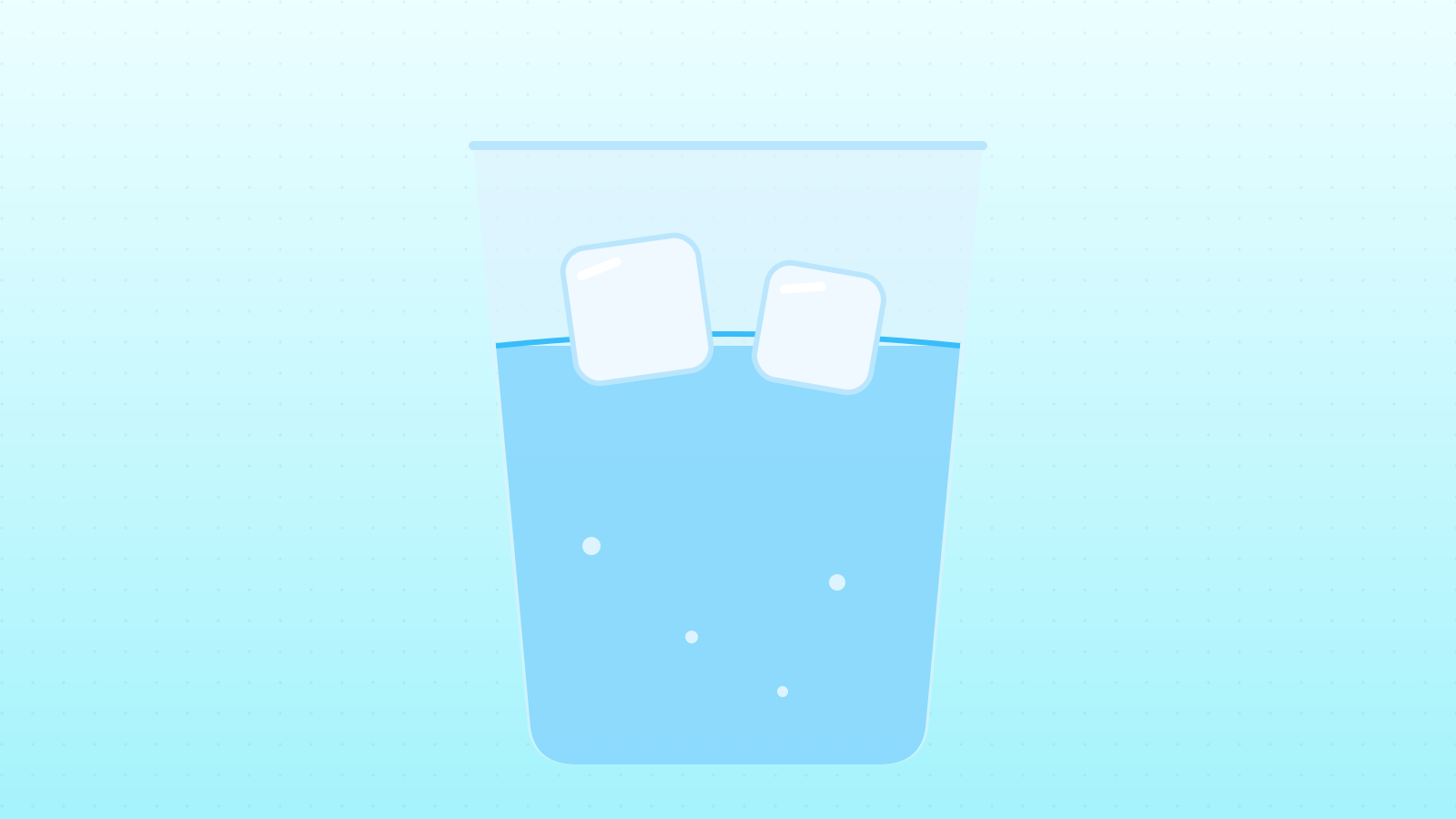
Short answer
When water freezes, hydrogen bonds lock its molecules into a regular hexagonal lattice with gaps between them. This open structure takes up more space than the jumbled but tightly packed molecules of liquid water. Ice is therefore about 9% less dense than water, so it floats.
In this article (7)
Drop an ice cube into a glass of water and you take it for granted that it will not sink. Yet this is one of nature’s strangest exceptions. For most substances, the solid is denser than the liquid and sinks. Water breaks the rule — and that small quirk shapes life on Earth.
Normally, solids sink
When you cool a substance, its molecules slow down and move closer together. As it freezes they settle into a tight arrangement that takes up less space than the liquid. So the solid is usually denser:
- Frozen alcohol (ethanol) sinks in liquid ethanol.
- Solid wax sinks to the bottom of molten wax.
- Frozen olive oil sinks in liquid olive oil.
Water does the exact opposite.
The secret: hydrogen bonds
A water molecule (H₂O) consists of one oxygen atom and two hydrogen atoms arranged in a V shape. Oxygen pulls electrons towards itself, so it carries a slight negative charge, while the hydrogen ends are slightly positive.
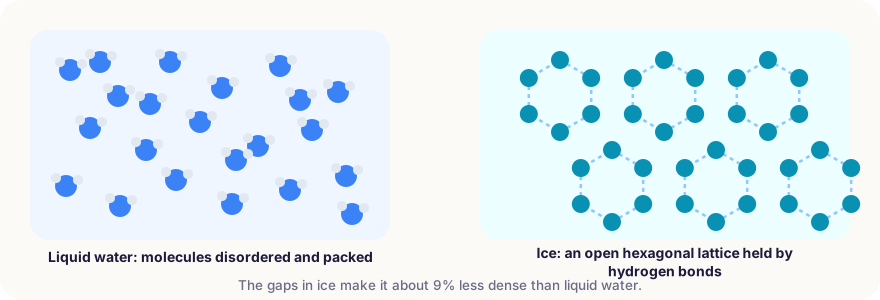
Because of this difference, the hydrogen end of one molecule is attracted to the oxygen end of its neighbour. This weak but important attraction is called a hydrogen bond.
- In liquid water, hydrogen bonds constantly form and break. Molecules jostle together in a disorderly way, leaving very little empty space.
- In ice, each molecule forms stable hydrogen bonds with four neighbours. These bonds hold the molecules at fixed angles, creating a hexagonal lattice with open spaces inside.
As a result, ice takes up more space than the same number of molecules in liquid water. Ice has a density of about 0.92 g/cm³, compared with about 1.00 g/cm³ for liquid water. That roughly 9% difference is enough to make ice float.
The same hexagonal lattice is the reason snowflakes have six points.
Why 4 degrees matters
Water’s oddness is not limited to the moment of freezing. As water cools, its density increases until it reaches a maximum at about 4 °C. Below 4 °C, molecules start forming ice-like arrangements and the water expands again.
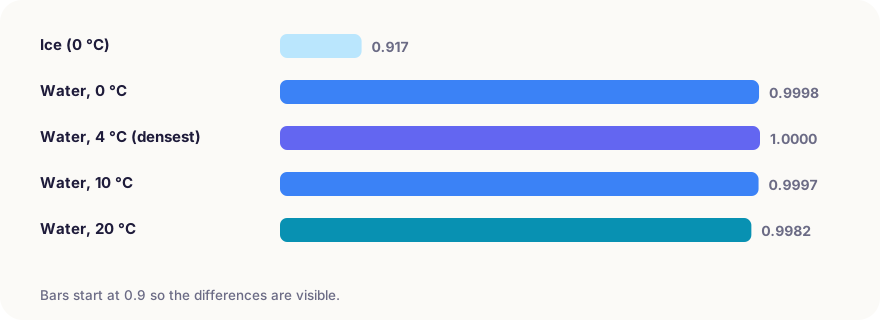
In lakes, this has a remarkable consequence:
- In autumn, surface water cools, becomes heavier and sinks.
- This mixing continues until the whole lake reaches about 4 °C.
- When the surface cools below 4 °C, it becomes lighter and stays on top.
- Ice forms at the surface and covers the water below like an insulating lid.
The water at the bottom of the lake stays around 4 °C all winter, so fish, frogs and other creatures can survive there.
What if ice sank?
If water behaved like most substances, winter ice would sink to the bottom. New ice would form at the surface and sink too. Lakes and shallow seas would freeze from the bottom up, and in summer the Sun could only warm the surface.
Scientists think many bodies of water in such a world would stay largely frozen all year, and freshwater life would look very different. Floating ice may have helped life continue uninterrupted under water for millions of years.
Water’s expansion in everyday life
Water expanding as it freezes can be a nuisance — and a force of nature:
- Burst bottles and pipes: water grows by about 9% in volume when it freezes, which is why a glass bottle forgotten in the freezer or water pipes in winter can crack.
- Shattered rocks: water seeps into cracks, freezes overnight, expands and widens the crack. Repeated over years, this frost wedging wears mountains down.
- Potholes: water seeping under asphalt freezes and thaws repeatedly, opening up potholes by the end of winter.
The hidden part of the iceberg
Seawater is slightly denser than fresh water (about 1.025 g/cm³). Ice has about 90% of that density, so roughly nine-tenths of an iceberg lies underwater. For ships, the danger usually lies in that huge, hidden mass below the surface.
In short
Ice floats because, as water freezes, hydrogen bonds arrange its molecules into an open hexagonal lattice that is lighter than liquid water. This rare property means lakes freeze from the top down, creatures at the bottom survive the winter and snowflakes have six sides. The ice cube in your glass is quietly demonstrating one of our planet’s most important chemical quirks.
Frequently asked questions
How much of an iceberg is underwater?
In seawater, about 90% of an iceberg sits below the surface. That is where the phrase “the tip of the iceberg” comes from.
Why does a full bottle burst in the freezer?
Water expands by about 9% when it freezes. A sealed bottle or water pipe cannot cope with that expansion and cracks.
Are there other substances whose solid floats on their liquid?
Very few. Silicon, gallium, germanium and bismuth also expand when they freeze. But most substances are denser as solids and sink in their own liquid.
Does salt water freeze later?
Yes. Dissolved salt makes it harder for water molecules to settle into the ice lattice, so seawater freezes at around −2 °C.
Sources
This article is based on peer-reviewed research and publications from trusted institutions, and it is reviewed regularly. How we work →
You might also wonder
All in Everyday Science →
Why Do Onions Make You Cry? The Chemistry of Tears and How to Stop Them
Why do your eyes water when you cut onions? The tear gas onions make to protect themselves — and the science-backed ways to chop onions without crying.
Why Does Salt Melt Ice? The Chemistry of Gritting Roads in Winter
Why do we salt roads in winter, how does salt melt ice and why doesn’t it work when it is very cold? Freezing-point depression and its side effects, explained.
Why Does Static Electricity Shock You? The Science of the Door-Handle Spark
Why do door handles shock you, why is it worse in winter and how does a balloon stick to a wall? The science of static electricity and how to avoid it.

How Does a Microwave Heat Food? The Physics of Spinning Water Molecules
How does a microwave oven heat food, why does metal spark inside it and is it safe? The science of microwave heating, explained with diagrams.

Why Does Popcorn Pop? The Physics of a Tiny Pressure Cooker
Why do corn kernels pop, where does the “pop” sound come from and why do some kernels never pop? The physics of popcorn, step by step with diagrams.

Why Is the Night Sky Dark? Olbers’ Paradox and the Age of the Universe
With billions of stars out there, why isn’t the night sky ablaze with light? Olbers’ paradox, the finite age of the universe and cosmic expansion, explained.