How Does a Microwave Heat Food? The Physics of Spinning Water Molecules
How does a microwave oven heat food, why does metal spark inside it and is it safe? The science of microwave heating, explained with diagrams.
Short answer
A microwave oven’s magnetron produces electromagnetic waves whose electric field flips direction about 2.45 billion times a second. Water molecules in food, which have a positive and a negative end, try to turn with the changing field. As they spin they jostle and rub against each other, and that motion becomes heat. Microwaves are not radioactive and do not make food radioactive; they vanish the moment the oven switches off.
In this article (10)
Pop yesterday’s leftovers in, press a couple of buttons and two minutes later you have a steaming lunch. The microwave is the fastest heater in the kitchen — yet it works completely differently from a hob, oven or frying pan. Instead of applying heat from outside, it makes the molecules inside the food dance.
What are microwaves?
Microwaves are electromagnetic waves, part of the same family as light and radio waves. Their wavelength is shorter than radio waves but much longer than visible light. Household microwave ovens usually operate at 2.45 gigahertz, meaning the wave oscillates about 2.45 billion times a second, with a wavelength of roughly 12 centimetres.
The same frequency band is used by Wi-Fi and Bluetooth devices — but their power is about a thousandth of a microwave oven’s, far too little to heat anything.
What is inside the oven?
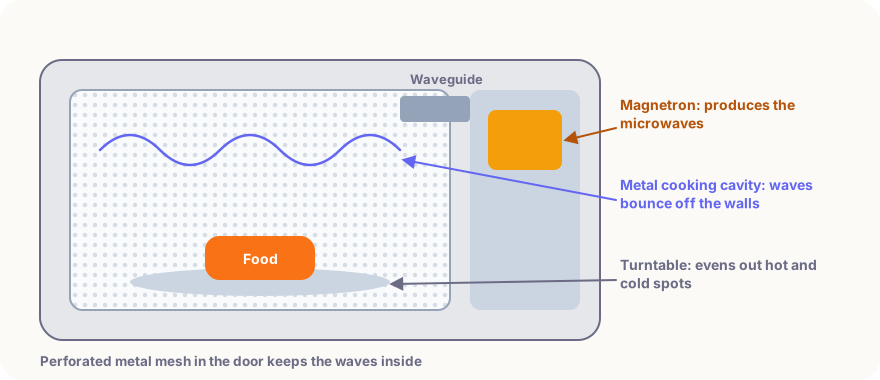
- Magnetron: the heart of the oven, a vacuum tube that converts electrical energy into microwaves. It was first developed for radar during the Second World War.
- Waveguide: a metal channel that directs the waves from the magnetron into the cooking cavity.
- Cooking cavity: its walls are metal. Microwaves cannot pass through metal; they reflect. So the waves bounce around the cavity and reach the food from every direction.
- Turntable: moves the food through different parts of the wave pattern so it heats more evenly.
- Door mesh: the perforated metal layer behind the glass. Its holes are a few millimetres across — far smaller than the 12-centimetre wavelength — so the waves cannot escape. Visible light, with a much smaller wavelength, passes through, letting you see inside.
The secret of heating: dancing water molecules
A water molecule (H₂O) has one oxygen atom and two hydrogen atoms. Oxygen pulls electrons towards itself, so it is slightly negative, while the hydrogen ends are slightly positive. Molecules with oppositely charged ends like this are called polar molecules.
Microwaves carry an electric field that keeps changing direction. Polar water molecules try to line up with the field — and when the field flips, they have to turn.
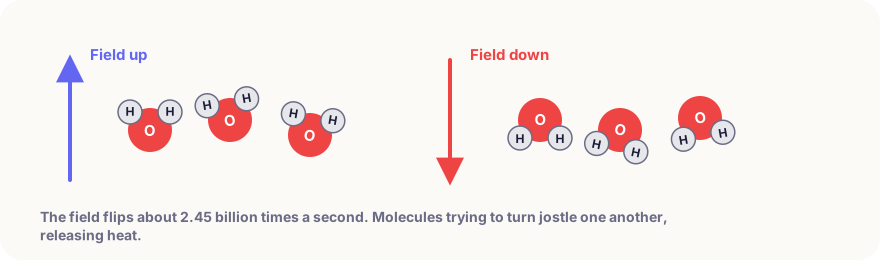
Since the field changes direction billions of times a second, the molecules are constantly trying to rotate. But they are not alone: they bump, rub and jostle against their neighbours. That disorderly motion is exactly what we feel as heat. This kind of heating is called dielectric heating.
Fats and sugars also heat in a microwave, but the mechanism works most strongly in water. That is why foods with a high water content heat up so quickly.
Microwaves don’t cook from the inside out
Contrary to popular belief, microwaves do not cook food from the inside out. They can only penetrate a few centimetres into the outer layers, which heat directly. Deeper parts warm up, just as on a hob, by heat being conducted inwards from the outside.
That is why large, thick items may not heat evenly in a microwave: the edges can boil while the middle stays cold. Stirring or pausing during heating gives the heat time to spread.
Why do hot and cold spots form?
Waves reflected from the metal walls meet each other. In some places their peaks coincide and reinforce one another; in others, a peak meets a trough and they cancel out. The result is a stationary standing-wave pattern inside the oven, creating “hot spots” that heat strongly and “cold spots” that barely heat at all.
The turntable exists to reduce this problem by carrying food through the pattern so every part passes through different spots. Some ovens use a rotating metal “stirrer” to scatter the waves instead.
You can see the pattern with a fun experiment. Remove the turntable and put in a plate of chocolate: it will melt in spots at regular intervals. The distance between melted spots is about half the wavelength — roughly 6 centimetres.
Why does metal spark?
Putting aluminium foil or a gold-rimmed plate in a microwave can cause sparks. Here is why:
- Metals conduct electricity well. Microwaves push the electrons in metal around, creating electric currents.
- At sharp points, thin edges and crumpled foil, electric charge concentrates in a tiny area.
- When the charge becomes concentrated enough, it ionises the surrounding air and a spark jumps. Sparks can start fires or damage the oven.
Not all metal carries the same risk. Smooth, thick metal containers reflect the waves but rarely spark, and some ovens come with metal racks designed to be used safely. The general rule, though, is no metal unless the manufacturer says it is OK.
Why is frozen food hard to defrost?
In ice, water molecules are locked into a crystal lattice and cannot turn easily, so ice heats far more slowly than liquid water. When defrosting, the parts that melt first heat up quickly while frozen parts lag behind — leaving food cooked at the edges and icy in the middle.
That is why the defrost setting switches the magnetron on and off at intervals: during the pauses, heat spreads from the thawed parts into the frozen ones.
Are microwaves bad for your health?
The most common worry about microwave ovens is radiation. Here is what the science says:
| Worry | Reality |
|---|---|
| Food becomes radioactive | No. Microwaves are non-ionising and do not alter atoms |
| Radiation lingers after switching off | No. The waves disappear instantly when the magnetron stops |
| Radiation leaks from the oven | In undamaged ovens, leakage is far below safety limits |
| Nutrients are destroyed | Generally not. Short times and little water can preserve some vitamins better |
The U.S. Food and Drug Administration strictly limits leakage from microwave ovens, measured 5 centimetres from the door, to a level far below anything that could harm people. And radiation weakens rapidly with distance.
The real risks tend to be more mundane:
- Superheated water: water in a smooth cup can pass its boiling point without bubbling, then erupt suddenly when you add a spoon or coffee. Heating in short bursts and placing a wooden stick in the cup reduces the risk.
- Exploding food: eggs in their shells, whole potatoes or food in sealed containers can build up steam and burst.
- Unsuitable plastics: plastics not meant for microwaves can break down when heated. Use containers marked microwave-safe, or glass and ceramics.
An invention born by accident
The story of microwave cooking starts with a happy accident. In 1945 Percy Spencer, an engineer at the American company Raytheon, was working near a magnetron used in radar systems when he noticed that the chocolate bar in his pocket had melted. Curious, he tried popcorn kernels and an egg. The popcorn popped — and the egg exploded.
The first commercial microwave oven went on sale in 1947. It stood almost 1.8 metres tall and weighed about 340 kilograms. Compact household models only became common at the end of the 1960s.
In short
A microwave oven heats food by using waves from a magnetron, which flip direction billions of times a second, to spin the water molecules in food; the friction of those spinning molecules becomes heat. The waves only reach the outer layers, and the inside warms by conduction. Metal edges can spark and ice heats slowly. An undamaged oven is safe: microwaves do not make food radioactive and disappear the instant the oven switches off.
Frequently asked questions
Do microwaves make food radioactive?
No. Microwaves belong to the same family as radio waves and visible light and are “non-ionising” radiation. They cannot change the structure of atoms; they only heat food by making molecules move. Once the oven stops, no radiation remains in the food.
Does a microwave cook food from the inside out?
No — that is a common myth. Microwaves only penetrate a few centimetres into food. Deeper parts warm up as heat is conducted inwards from the outer layers.
Does microwaving destroy nutrients?
Generally not. Because cooking times are short and little water is used, microwaved vegetables can retain some vitamins better than boiled ones.
Is it dangerous to stand in front of a microwave?
An undamaged oven with a properly closing door is safe; the metal mesh in the door keeps the waves inside. Ovens with damaged doors, loose hinges or broken seals should not be used.
Sources
This article is based on peer-reviewed research and publications from trusted institutions, and it is reviewed regularly. How we work →
You might also wonder
All in Everyday Science →
Why Does Ice Float? Water’s Life-Saving Weirdness
Solids are usually denser than their liquids, so why does ice float? How hydrogen bonds make water an exception and keep lakes alive in winter.
Why Do Onions Make You Cry? The Chemistry of Tears and How to Stop Them
Why do your eyes water when you cut onions? The tear gas onions make to protect themselves — and the science-backed ways to chop onions without crying.
Why Does Salt Melt Ice? The Chemistry of Gritting Roads in Winter
Why do we salt roads in winter, how does salt melt ice and why doesn’t it work when it is very cold? Freezing-point depression and its side effects, explained.
Why Does Static Electricity Shock You? The Science of the Door-Handle Spark
Why do door handles shock you, why is it worse in winter and how does a balloon stick to a wall? The science of static electricity and how to avoid it.

Why Does Popcorn Pop? The Physics of a Tiny Pressure Cooker
Why do corn kernels pop, where does the “pop” sound come from and why do some kernels never pop? The physics of popcorn, step by step with diagrams.

Why Is the Night Sky Dark? Olbers’ Paradox and the Age of the Universe
With billions of stars out there, why isn’t the night sky ablaze with light? Olbers’ paradox, the finite age of the universe and cosmic expansion, explained.