Why Does Popcorn Pop? The Physics of a Tiny Pressure Cooker
Why do corn kernels pop, where does the “pop” sound come from and why do some kernels never pop? The physics of popcorn, step by step with diagrams.

Short answer
Each popcorn kernel contains about 14% water and starch, sealed inside a hard, waterproof hull. When heated, the water turns to steam but cannot escape, so pressure builds rapidly. At around 180 °C the hull gives way. The softened starch instantly puffs up like foam and sets as it cools, forming the white, crunchy popcorn we eat.
In this article (9)
First a lone pop under the lid, then a rapid-fire volley — within minutes, small, hard yellow kernels have swollen into white, crunchy clouds. Making popcorn is one of the most enjoyable physics experiments you can do in a kitchen, and every kernel works like a tiny pressure cooker.
What is inside a popcorn kernel?
A kernel that can pop has three key parts:
- The hull (pericarp): a hard, shiny and almost waterproof outer layer.
- The starchy interior (endosperm): most of the kernel, made of tightly packed starch granules.
- Water: trapped among the starch, making up about 13–14% of the kernel’s weight.
The secret lies in this trio. The water is the “fuel” that carries the energy, the hull is the “boiler” that holds the pressure, and the starch is the “dough” that takes shape after the pop.
Popping in four stages
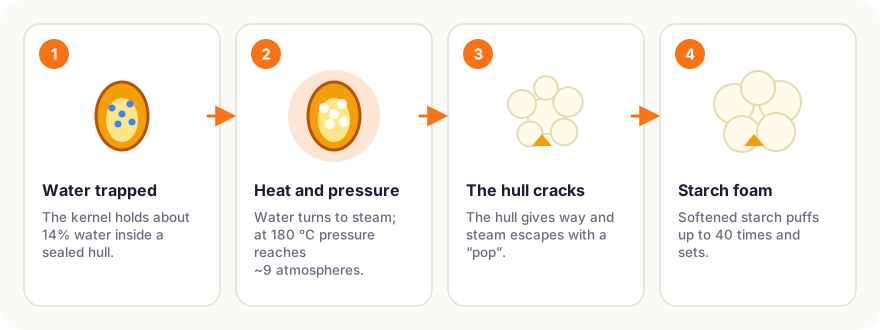
1. Heating
As the kernel heats up, so does the water inside it. Water normally boils at 100 °C, but here it is sealed inside a hull and cannot easily escape as steam.
2. Pressure builds
As some of the water turns to steam, the pressure inside the hull rises quickly. The hot steam also cooks the starch, turning it into a soft, jelly-like mass.
When the kernel reaches about 180 °C, the pressure inside is around nine times atmospheric pressure — roughly four times the pressure in a car tyre.
3. The hull cracks
At some point the hull can no longer take the strain and splits. The pressure drops instantly, the superheated water flashes into steam and inflates the softened starch outwards.
4. The foam sets
The expanding starch becomes a foam full of tiny bubbles. As the hot kernel meets the air and cools, the foam quickly sets solid. The kernel can grow to up to 40 times its original volume. That spongy structure is what makes popcorn so light and crunchy.
The moment of popping, on high-speed camera
In 2015, French engineers Emmanuel Virot and Alexandre Ponomarenko filmed popping kernels at 2,900 frames per second. Their footage held a few surprises.
The critical temperature is remarkably consistent. However fast the kernels were heated, most popped at around 180 °C, with the chance of popping rising sharply as they approached that temperature.
Kernels jump because they grow a “leg”. When the hull cracks, the starch bursting out first forms a small protrusion. When it strikes the pan, the kernel launches itself into the air like a gymnast, jumping anywhere from a few centimetres to a few tens of centimetres.
The “pop” comes from steam, not the hull. Matching the sound to the high-speed images, the researchers found it was produced not by the hull breaking or the kernel hitting the pan, but by steam suddenly being released from inside — much like the pop of a champagne cork.
Why do some kernels never pop?
Every bag leaves a few stubborn kernels at the bottom. There are two main reasons:

- Too little moisture: kernels left out too long or dried too much cannot make enough steam, so the pressure never gets high enough to crack the hull.
- A cracked hull: if the hull has tiny invisible cracks, steam slowly leaks out. Pressure never builds and the kernel just toasts.
That is why storing kernels in an airtight container matters. Some experts say adding a few drops of water to over-dried kernels and leaving them sealed for a day can improve the popping rate.
Does all corn pop?
No. The corn that pops in your pan is a special variety called popcorn (Zea mays everta). Here is how it differs from other types:
| Corn type | Hull | Starch | Does it pop? |
|---|---|---|---|
| Popcorn | Very hard and strong | Mostly hard, glassy starch | Yes |
| Sweet corn | Thin | Sugary and soft | Usually not |
| Field (dent) corn | Weaker | Mostly soft starch | Poorly or unevenly |
The cellulose molecules in a popcorn hull are more orderly and tightly packed, letting the hull withstand higher pressure and conduct heat into the kernel more efficiently.
How does microwave popcorn work?
Microwave ovens heat food by making water molecules vibrate — including the water inside each kernel. Microwave popcorn bags also contain a susceptor: a thin metallic layer that absorbs microwaves and gets very hot, heating the kernels from below like a pan so they pop more evenly.
A snack thousands of years old
Popcorn is not a modern invention. Corn remains found in archaeological digs on the coast of Peru, dated to around 6,000–6,700 years ago, suggest people were already popping corn back then. Indigenous peoples of the Americas used popcorn not just as food but also for decoration and ceremonies.
Tips for better popcorn at home
Understanding the physics helps you get better results:
- Heat quickly: if kernels reach 180 °C fast, more of them pop and the result is fluffier.
- Shake the pan: this heats the kernels evenly and prevents burning.
- Leave the lid slightly open: letting steam escape stops the popcorn going soggy.
- Listen: when there are 2–3 seconds between pops, turn off the heat. Waiting longer burns the bottom layer.
In short
Each popcorn kernel is a tiny pressure vessel holding water and starch. As it heats, the water turns to steam, pressure rises and at about 180 °C the hull cracks. The escaping steam makes the “pop”, while the softened starch puffs up like foam and sets into popcorn. Next movie night, spare a thought for the hundreds of tiny pressure cookers in your pan.
Frequently asked questions
Does all corn pop?
No. The variety that pops well is popcorn (Zea mays everta), which has an especially hard, strong hull. Sweet corn and field corn generally do not pop properly.
Why do some kernels stay unpopped?
Usually because the kernel has dried out too much or its hull has tiny invisible cracks. Either way, not enough pressure builds up inside.
Does the “pop” come from the hull breaking?
A 2015 high-speed camera study found the sound comes from steam suddenly escaping the moment the hull breaks — much like a champagne cork.
How do you keep popcorn from going stale?
Popcorn softens by absorbing moisture from the air. Storing it in an airtight container once it has cooled completely keeps it crunchy.
Sources
- Virot & Ponomarenko (2015) – Popcorn: critical temperature, jump and sound, Journal of the Royal Society Interface
- Grobman et al. (2012) – Preceramic maize from Paredones and Huaca Prieta, Peru, PNAS
This article is based on peer-reviewed research and publications from trusted institutions, and it is reviewed regularly. How we work →
You might also wonder
All in Everyday Science →
Why Does Ice Float? Water’s Life-Saving Weirdness
Solids are usually denser than their liquids, so why does ice float? How hydrogen bonds make water an exception and keep lakes alive in winter.
Why Do Onions Make You Cry? The Chemistry of Tears and How to Stop Them
Why do your eyes water when you cut onions? The tear gas onions make to protect themselves — and the science-backed ways to chop onions without crying.

Why Does Salt Melt Ice? The Chemistry of Gritting Roads in Winter
Why do we salt roads in winter, how does salt melt ice and why doesn’t it work when it is very cold? Freezing-point depression and its side effects, explained.
Why Does Static Electricity Shock You? The Science of the Door-Handle Spark
Why do door handles shock you, why is it worse in winter and how does a balloon stick to a wall? The science of static electricity and how to avoid it.
How Does a Microwave Heat Food? The Physics of Spinning Water Molecules
How does a microwave oven heat food, why does metal spark inside it and is it safe? The science of microwave heating, explained with diagrams.

Why Is the Night Sky Dark? Olbers’ Paradox and the Age of the Universe
With billions of stars out there, why isn’t the night sky ablaze with light? Olbers’ paradox, the finite age of the universe and cosmic expansion, explained.