Why Does Bread Go Stale? It Isn’t Just Drying Out
Stale bread isn’t simply dry: its starch slowly recrystallises. Why bread stales faster in the fridge, why toasting revives it and the best way to store it.
Short answer
Bread goes stale mainly because of starch retrogradation, not because it dries out. During baking, starch granules soak up water and form a soft, disordered gel. As the bread cools and sits, the starch molecules, especially amylopectin, slowly line up again into firm crystals, making the crumb hard and crumbly while moisture moves from the crumb into the crust. Staling happens fastest at fridge temperatures and almost stops in the freezer. Reheating melts the crystals, which is why toast or warmed bread tastes fresh again for a short time.
In this article (8)
A fresh loaf has a crisp crust and a soft, springy crumb. A couple of days later the crust is leathery and the inside is hard and crumbly. Most people assume the bread has simply dried out. Surprisingly, that is only a small part of the story. The real change happens at the level of the molecules in the starch.
Bread is mostly starch
Flour is about 70 to 75% starch. Starch is made of two kinds of molecules built from long chains of glucose:
- amylose, mostly long straight chains;
- amylopectin, larger, highly branched molecules.
In raw flour, starch is packed into hard, partly crystalline granules.
What baking does to starch
When dough goes into a hot oven, the starch granules absorb water from the dough and swell. Above about 60 °C their orderly structure breaks down in a process called gelatinisation. The starch becomes a soft, disordered gel, and that is what gives fresh bread its tender, moist crumb.
Staling: starch slowly recrystallises
As soon as the bread starts to cool, the starch molecules begin to settle back into order. This is called retrogradation.
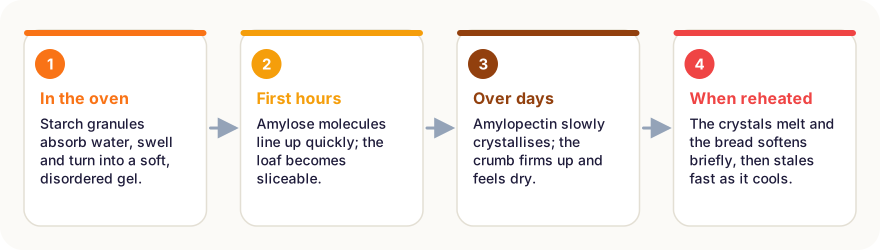
- Amylose lines up quickly, within the first hours. This sets the structure of the loaf and is the reason freshly baked bread is easier to slice once it has cooled.
- Amylopectin recrystallises much more slowly, over days. As it forms crystals, it traps water inside them. The crumb becomes firmer, more crumbly and feels drier, even if the total amount of water has hardly changed.
At the same time, moisture moves from the moist crumb towards the drier crust. The crust loses its crispness and turns soft and chewy, while the inside feels harder.
The experiment that proved it
In 1852 the French chemist Jean-Baptiste Boussingault sealed fresh bread in airtight containers so that no water could escape. The bread still went stale. When he reheated it, it became soft again. If staling were just drying, that would have been impossible. Modern studies using X-rays and other techniques have since shown the starch crystals forming and melting.
Why the fridge is the worst place for bread
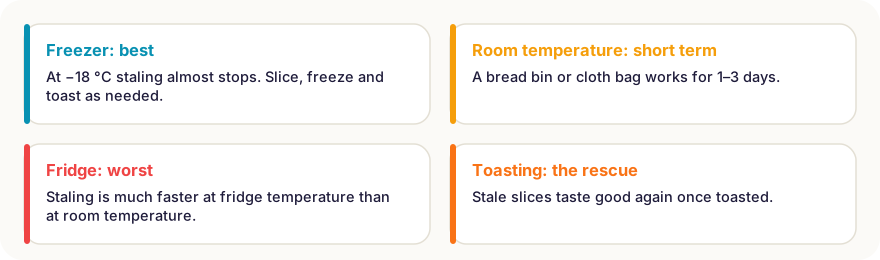
Retrogradation runs fastest at temperatures just above freezing. At typical fridge temperatures of around 4 °C, bread goes stale several times faster than at room temperature.
In the freezer, at about −18 °C, the molecules can hardly move and staling almost stops. That is why freezing is by far the best way to keep bread for more than a couple of days.
Why toast tastes fresh again
Heating stale bread above about 60 °C melts the amylopectin crystals and releases the trapped water, so the crumb softens again. This is why a stale roll warmed in the oven or a slice of toast can taste almost fresh.
The effect is temporary. As the bread cools down, retrogradation starts again, often faster than before, so reheated bread should be eaten straight away.
How bakers slow down staling
Bakers have several tricks to keep bread soft for longer:
- More water and fat in the dough slow down recrystallisation, which is why brioche and soft sandwich bread stay fresh longer than a lean baguette.
- Enzymes such as certain amylases trim the starch chains so they crystallise less easily.
- Emulsifiers bind to starch and get in the way of crystal formation.
- Sourdough fermentation and whole-grain flours also tend to slow staling.
A baguette, with its thin crumb and little fat, is famously best within hours of baking.
In short
- Bread goes stale mainly because starch recrystallises (retrogradation), not just because it dries out.
- Amylose sets within hours; amylopectin crystallises over days and firms the crumb.
- Moisture moves from the crumb to the crust, making the crust leathery.
- Staling is fastest in the fridge and almost stops in the freezer.
- Reheating melts the crystals and refreshes bread temporarily.
Frequently asked questions
Should I keep bread in the fridge?
Usually not. Bread stales several times faster at fridge temperature than at room temperature. The fridge only makes sense in very hot, humid weather to slow mould, and then the bread is best toasted.
What is the best way to keep bread fresh?
Eat it within a day or two, kept in a bread bin or cloth bag at room temperature. For longer storage, slice and freeze it as soon as possible, then toast or warm the slices straight from frozen.
Is stale bread safe to eat?
Yes. Stale bread is not spoiled; it has only changed texture. Mouldy bread is different and should be thrown away.
What can I do with stale bread?
Use it for croutons, breadcrumbs, French toast, bread pudding, stuffing or soups such as Tuscan ribollita and Spanish salmorejo. Briefly sprinkling a crusty loaf with water and warming it in the oven also revives it.
Sources
- Gray, J. A. & BeMiller, J. N. (2003). Bread staling: molecular basis and control. Comprehensive Reviews in Food Science and Food Safety
- Encyclopaedia Britannica – Baking: staling
This article is based on peer-reviewed research and publications from trusted institutions, and it is reviewed regularly. How we work →
You might also wonder
All in Everyday Science →
How Does Soap Work? The Two-Faced Molecule That Cleans
Water alone can’t wash away grease, but soap can. How soap molecules trap oil in micelles, why they destroy some viruses and why 20 seconds matter.
Why Do Apples Turn Brown? Enzymatic Browning and How to Stop It
A cut apple turns brown within minutes because an enzyme reacts with oxygen. What happens, why lemon juice helps, and whether brown apple is safe to eat.
Why Is Glass Transparent When Sand Is Not? The Physics of Clear Glass
Glass is made from sand, yet light passes straight through it. Why glass is clear, why it blocks some ultraviolet, and whether old windows really flow.

Why Does Ice Float? Water’s Life-Saving Weirdness
Solids are usually denser than their liquids, so why does ice float? How hydrogen bonds make water an exception and keep lakes alive in winter.
Why Do Onions Make You Cry? The Chemistry of Tears and How to Stop Them
Why do your eyes water when you cut onions? The tear gas onions make to protect themselves — and the science-backed ways to chop onions without crying.
Why Does Salt Melt Ice? The Chemistry of Gritting Roads in Winter
Why do we salt roads in winter, how does salt melt ice and why doesn’t it work when it is very cold? Freezing-point depression and its side effects, explained.