Why Do Mentos and Coke Explode? The Science of the Soda Fountain
Drop Mentos into cola and foam shoots metres high. It is physics, not a chemical reaction: rough candy surfaces let dissolved carbon dioxide escape all at once.
Short answer
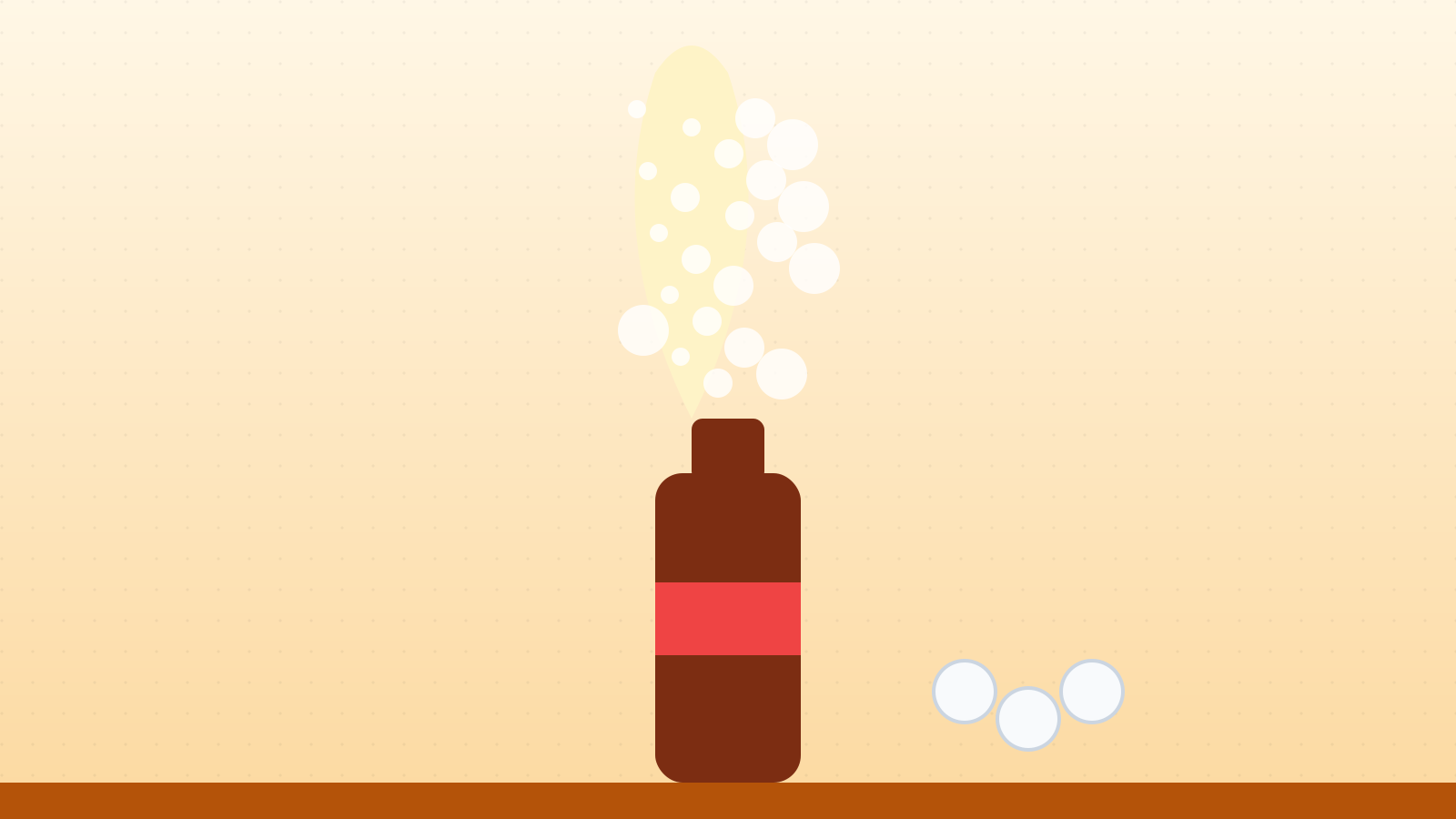
The Mentos and cola eruption is a physical reaction, not a chemical one. Cola is packed with carbon dioxide gas dissolved under pressure. Bubbles need a starting point, called a nucleation site, to form. A Mentos sweet is covered in microscopic pits and bumps that provide thousands of these sites at once, so the dissolved gas rushes out into bubbles extremely quickly. Because the sweets are heavy, they sink fast, releasing gas all the way down the bottle and pushing a jet of foam out of the neck. A 2008 study found that diet cola works best because its sweetener and preservative lower the liquid’s surface tension.
In this article (5)
It is one of the most famous science demonstrations on the internet: drop a few mint sweets into a bottle of cola and a fountain of foam blasts out, sometimes several metres high. Many people assume it is a chemical reaction between the sweets and the drink. In fact, it is something simpler, and more interesting: physics.
A bottle full of gas
Fizzy drinks are made by forcing carbon dioxide gas into the liquid under pressure. While the bottle is sealed, the gas stays dissolved. When you open it, the pressure drops, and the gas starts to escape as bubbles. But it does so slowly, which is why a drink can stay fizzy for a while after opening.
Why so slowly? Because a new bubble is hard to start. To form, it needs a tiny pocket where gas can gather, called a nucleation site. Scratches in a glass, dust or ice cubes can act as nucleation sites, which is why bubbles often stream from the same spots.
Mentos: a bubble factory
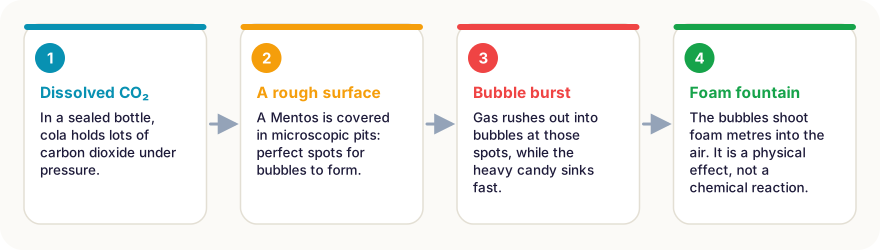
Under a microscope, the surface of a Mentos sweet looks nothing like the smooth candy it seems. It is covered in microscopic pits and bumps. Each of these is a perfect nucleation site. Drop a Mentos into cola and thousands of bubbles start forming on its surface at once.
Mentos are also dense, so they sink quickly to the bottom of the bottle. As they fall, they release gas all the way down. The bubbles rise, push the liquid upwards and turn it into foam, which has nowhere to go but out of the narrow neck as a powerful jet.
What the experiments showed
In 2008, physicist Tonya Coffey and her students at Appalachian State University tested what makes the fountain work. They tried different drinks, different sweets and other materials, measured how high the fountains went and examined Mentos under an electron microscope.
Their findings included:
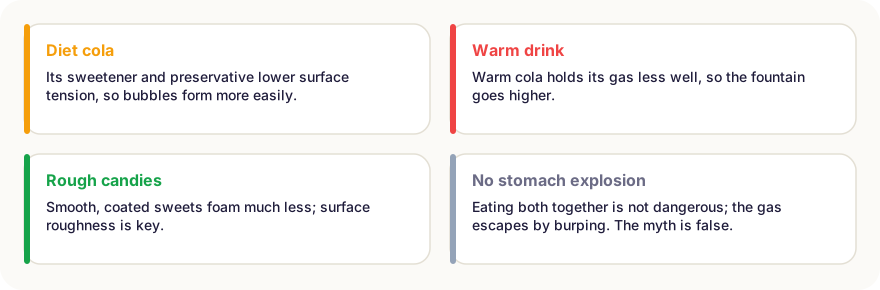
- Surface roughness is the key. Smooth, coated sweets produced much smaller fountains, while rough materials, even sand, worked.
- Diet cola gave the biggest eruptions. Its artificial sweetener, aspartame, and the preservative potassium benzoate lower the surface tension of the liquid, making it easier for bubbles to form and grow.
- Warm cola erupted higher than cold, because warmer liquids hold less dissolved gas.
- The amount of caffeine had little effect, and there was no sign of a real chemical reaction: the drink’s ingredients were essentially unchanged afterwards.
Is it dangerous?
The popular rumour that eating Mentos while drinking cola could make your stomach explode is a myth. In your mouth and stomach, the drink is no longer in a sealed bottle, it is warmed and mixed with saliva, and there is no narrow neck to build up a jet. Any extra gas escapes as burps. The demonstration itself is best done outdoors, standing back, because it is messy.
In short
- The Mentos and cola fountain is a physical reaction, not a chemical one.
- Cola contains carbon dioxide dissolved under pressure.
- Bubbles need nucleation sites; a Mentos surface has countless microscopic ones.
- The dense sweets sink fast, releasing gas throughout the bottle.
- Diet cola works best because its ingredients lower surface tension.
- Eating Mentos with cola is not dangerous; the gas comes out as burps.
Frequently asked questions
Is it dangerous to eat Mentos and drink cola together?
No. The idea that your stomach could explode is a myth. In your mouth and stomach the reaction is far weaker, and the gas simply escapes as burps.
Why does diet cola work better than regular cola?
Diet cola contains the sweetener aspartame and the preservative potassium benzoate, which lower surface tension and make bubbles form more easily. Regular cola’s sugar makes the liquid slightly more viscous, slowing bubble growth.
Do other sweets work?
Rough-surfaced sweets and even sand can trigger fountains, but smooth, coated sweets work much less well. The roughness of Mentos and how fast they sink make them especially effective.
How high can the fountain go?
With a 2-litre bottle of diet cola and several Mentos, fountains of several metres are common. Special nozzles that narrow the opening can make the jet go even higher.
Sources
- Coffey, T. S. (2008). Diet Coke and Mentos: What is really behind this physical reaction? American Journal of Physics
- Encyclopaedia Britannica – Carbon dioxide
This article is based on peer-reviewed research and publications from trusted institutions, and it is reviewed regularly. How we work →
You might also wonder
All in Everyday Science →
How Does Soap Work? The Two-Faced Molecule That Cleans
Water alone can’t wash away grease, but soap can. How soap molecules trap oil in micelles, why they destroy some viruses and why 20 seconds matter.
Why Do Apples Turn Brown? Enzymatic Browning and How to Stop It
A cut apple turns brown within minutes because an enzyme reacts with oxygen. What happens, why lemon juice helps, and whether brown apple is safe to eat.
Why Does Bread Go Stale? It Isn’t Just Drying Out
Stale bread isn’t simply dry: its starch slowly recrystallises. Why bread stales faster in the fridge, why toasting revives it and the best way to store it.
Why Is Glass Transparent When Sand Is Not? The Physics of Clear Glass
Glass is made from sand, yet light passes straight through it. Why glass is clear, why it blocks some ultraviolet, and whether old windows really flow.
Does Hot Water Freeze Faster Than Cold? The Mpemba Effect Explained
A Tanzanian schoolboy claimed hot water freezes faster than cold. Is the Mpemba effect real? The proposed explanations and what careful experiments found.

Why Is Ice Slippery? It’s Not What You Learned at School
Ice is slippery because of a thin, liquid-like layer on its surface and heat from friction, not mainly because pressure melts it. Why some ice is more slippery.