Does Hot Water Freeze Faster Than Cold? The Mpemba Effect Explained
A Tanzanian schoolboy claimed hot water freezes faster than cold. Is the Mpemba effect real? The proposed explanations and what careful experiments found.
Short answer
Usually not. The idea that hot water can freeze faster than cold is called the Mpemba effect, after Erasto Mpemba, a Tanzanian schoolboy who noticed in 1963 that a hot ice-cream mix froze before a cold one. Several explanations have been proposed: hot water loses more mass by evaporation, contains less dissolved gas, has stronger internal currents, and cold water can supercool below 0 °C without freezing. But careful experiments, including a 2016 study that controlled the conditions closely, found no evidence that hot water reaches freezing faster than cold. The effect may appear only under special conditions, and scientists still argue about it.
In this article (5)
It sounds like a riddle: put a cup of hot water and a cup of cold water in the freezer. Which turns to ice first? Common sense says the cold one. But for decades a surprising claim has circulated that sometimes the hot water wins. It even has a name: the Mpemba effect. Is it true?
A schoolboy’s ice cream
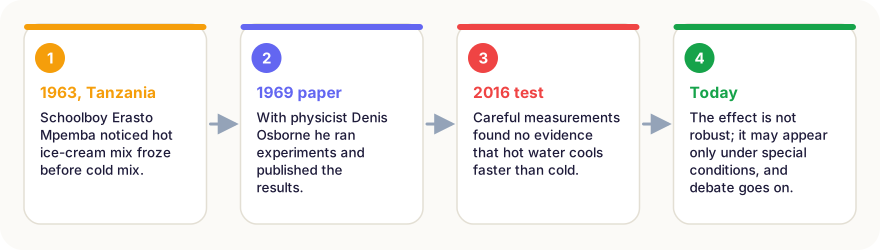
In 1963, a secondary school student in Tanzania named Erasto Mpemba was making ice cream in a cookery class. Short of time, he put his mix into the freezer while still hot, instead of letting it cool first. To his surprise, it froze before his classmates’ cooler mixes.
His teachers did not believe him. But when the physicist Denis Osborne visited his school, Mpemba asked him about it. Osborne was intrigued and ran experiments, and in 1969 the two published a paper reporting that hot water sometimes froze sooner than cold.
The idea was not new. Aristotle wrote about something similar more than 2,000 years ago, and Francis Bacon and René Descartes discussed it in the 1600s. But Mpemba’s story made it famous.
Why it could happen
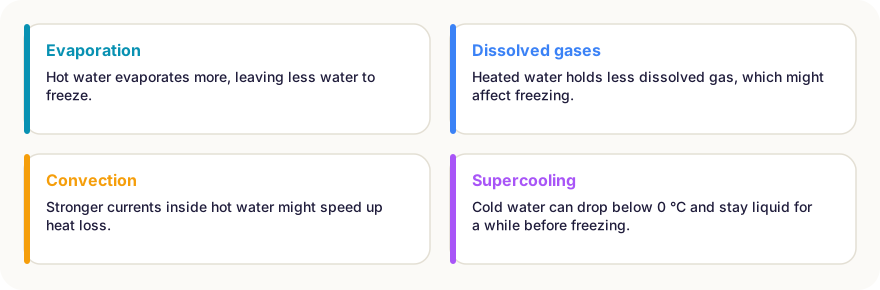
Scientists have suggested several reasons why hot water might sometimes freeze first:
- Evaporation: hot water evaporates faster, so there is less water left to freeze, and evaporation itself removes heat.
- Dissolved gases: heated water holds less dissolved gas, which might change how it freezes.
- Convection: hot water has stronger internal currents, which could carry heat to the surface faster.
- Supercooling: water can cool below 0 °C and stay liquid for a while before ice forms. If cold water supercools more than hot water, it might start freezing later.
- The freezer itself: a hot container might melt frost under it and make better contact with the shelf, cooling faster.
What careful experiments found
The problem is that the effect is very hard to reproduce. Results depend on the size and shape of the container, the type of freezer, where you place the thermometer, and even what counts as “frozen”: the first ice crystal, or a solid block?
In 2016, physicists Henry Burridge and Paul Linden at the University of Cambridge carried out careful measurements under controlled conditions. They found no evidence that hot water cools to 0 °C faster than cold water. Small differences in where the temperature was measured could easily create apparent “Mpemba effects”.
Other researchers have reported effects in special systems, and physicists have shown that similar strange cooling can happen in some carefully designed materials. But for an ordinary cup of water in a home freezer, the best answer is: the cold water normally freezes first.
A lesson in science
Mpemba’s story is still valuable. A student noticed something odd, asked questions even when teachers laughed, and started a debate that has lasted half a century. Testing it properly showed how many hidden factors can affect a simple experiment, and why scientists must control conditions carefully before drawing conclusions.
In short
- The Mpemba effect is the claim that hot water can freeze faster than cold.
- It is named after Erasto Mpemba, who noticed it with ice cream in 1963.
- Proposed reasons include evaporation, dissolved gases, convection and supercooling.
- Results depend heavily on the container, freezer and measurement.
- A careful 2016 study found no evidence that hot water cools faster.
- In a normal freezer, cold water usually freezes first.
Frequently asked questions
Should I put hot water in the freezer to make ice faster?
No. In normal kitchen conditions cold water will usually freeze first, and putting hot liquids in a freezer makes it work harder and can partly thaw nearby food.
Why is it called the Mpemba effect?
It is named after Erasto Mpemba, who as a secondary school student in Tanzania noticed it while making ice cream and, with physicist Denis Osborne, published experiments in 1969.
Why do people throw boiling water into freezing air?
In very cold air, boiling water thrown upwards turns into a cloud of ice crystals and vapour. This happens because hot water evaporates extremely quickly into tiny droplets that freeze instantly; it is not the Mpemba effect.
Is the Mpemba effect real?
It is disputed. Some experiments have reported it, but results depend strongly on details such as the container, the freezer, where the temperature is measured and how “frozen” is defined. Careful studies have generally not found it.
Sources
- Mpemba, E. B. & Osborne, D. G. (1969). Cool? Physics Education
- Burridge, H. C. & Linden, P. F. (2016). Questioning the Mpemba effect: hot water does not cool more quickly than cold. Scientific Reports
This article is based on peer-reviewed research and publications from trusted institutions, and it is reviewed regularly. How we work →
You might also wonder
All in Everyday Science →
How Does Soap Work? The Two-Faced Molecule That Cleans
Water alone can’t wash away grease, but soap can. How soap molecules trap oil in micelles, why they destroy some viruses and why 20 seconds matter.
Why Do Apples Turn Brown? Enzymatic Browning and How to Stop It
A cut apple turns brown within minutes because an enzyme reacts with oxygen. What happens, why lemon juice helps, and whether brown apple is safe to eat.
Why Does Bread Go Stale? It Isn’t Just Drying Out
Stale bread isn’t simply dry: its starch slowly recrystallises. Why bread stales faster in the fridge, why toasting revives it and the best way to store it.
Why Is Glass Transparent When Sand Is Not? The Physics of Clear Glass
Glass is made from sand, yet light passes straight through it. Why glass is clear, why it blocks some ultraviolet, and whether old windows really flow.
Why Do Mentos and Coke Explode? The Science of the Soda Fountain
Drop Mentos into cola and foam shoots metres high. It is physics, not a chemical reaction: rough candy surfaces let dissolved carbon dioxide escape all at once.

Why Is Ice Slippery? It’s Not What You Learned at School
Ice is slippery because of a thin, liquid-like layer on its surface and heat from friction, not mainly because pressure melts it. Why some ice is more slippery.