Why Is Ice Slippery? It’s Not What You Learned at School
Ice is slippery because of a thin, liquid-like layer on its surface and heat from friction, not mainly because pressure melts it. Why some ice is more slippery.

Short answer
Ice is slippery mainly because its surface is covered by a very thin, liquid-like layer and because sliding creates friction heat that melts a little more. Water molecules at the surface of ice are not locked into the crystal as tightly as those inside, so even well below freezing they form a microscopically thin, mobile film. When a shoe or skate slides, friction warms the contact and thickens this layer, which acts as a lubricant. The popular school explanation, that the pressure of a skate melts the ice, does not hold up: a skate lowers the melting point only slightly. Very cold ice is actually less slippery.
In this article (5)
Step onto a frozen pavement and your feet might suddenly shoot out from under you. Skaters glide across rinks with almost no effort. Ice is one of the most slippery things we meet in everyday life. But why? The answer turns out to be more interesting than the one many of us learned at school.
The old explanation: pressure melting
For a long time, textbooks explained that a skate’s narrow blade puts enormous pressure on the ice. Pressure lowers the melting point of ice, so, the story went, the ice under the blade melts and the skate rides on a film of water.
The problem is the numbers. Pressure does lower the melting point, but only a little. Even under a skate blade, the effect is only enough to lower it by a few degrees at most. Yet people slip on ice at −20 °C, and a flat shoe sole spreads its weight over a much larger area than a blade. Pressure melting cannot explain why ice is slippery in most conditions.
The real reasons
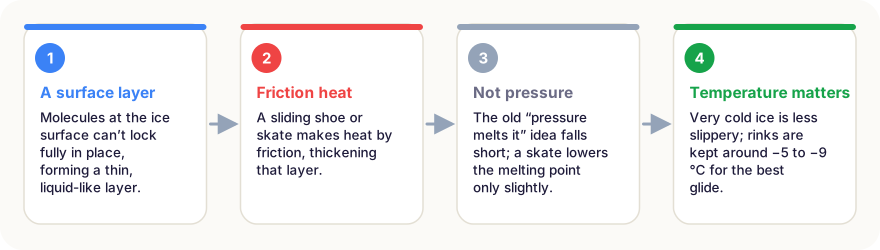
1. A liquid-like surface layer. Inside an ice crystal, water molecules are locked in a neat, rigid pattern. At the surface, molecules have fewer neighbours to hold them in place. They are looser and move about, forming a very thin layer that behaves partly like a liquid, even well below 0 °C. This is called premelting. As long ago as 1850, Michael Faraday suggested such a layer exists, after noticing that two pieces of ice pressed together freeze into one. Modern experiments using X-rays and other techniques have confirmed it.
2. Friction heat. When something slides on ice, friction produces heat at the contact. That heat melts a tiny amount of ice, creating a film of water that lubricates the movement. The faster you slide, the more heat is produced, which helps explain why skating works so well once you get moving.
As physicist Robert Rosenberg summarised in 2005, the evidence favours these effects over pressure melting. Researchers still argue about the exact balance, and studies continue, but the classic school explanation is no longer accepted as the main reason.
Not all ice is equally slippery
Temperature matters. Ice is often most slippery just below 0 °C, where the surface layer is thicker and meltwater may be present. Very cold ice is less slippery because the surface layer is thinner and friction melts less. Speed skating rinks and ice hockey rinks are kept at slightly different temperatures, around −5 to −9 °C, tuned for the best balance of glide and grip.
Staying on your feet
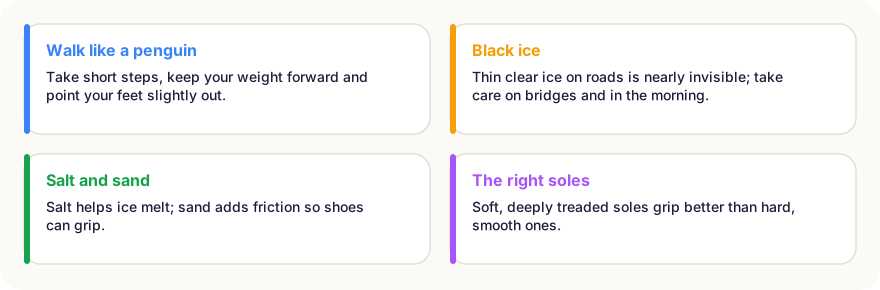
- Walk like a penguin: take short, flat steps and keep your weight over your front foot.
- Watch for black ice: thin, clear ice on dark asphalt is nearly invisible, especially on bridges and in shaded spots early in the morning.
- Salt and sand: salt lowers the freezing point of the water layer, helping ice melt; sand adds friction.
- Choose good soles: soft rubber soles with deep treads grip much better than hard, smooth ones.
In short
- The school idea that pressure melts ice under a skate explains very little.
- Ice has a thin, liquid-like surface layer, even well below freezing.
- Friction heat from sliding melts a little ice and lubricates the movement.
- Michael Faraday proposed the surface layer as early as 1850.
- Ice is often most slippery near 0 °C; very cold ice grips better.
- Short steps, salt, sand and good soles help prevent falls.
Frequently asked questions
Why is wet ice more slippery?
When ice is near 0 °C, the surface layer is thicker and there may be actual meltwater on top. That water film makes it very slippery, which is why ice is most treacherous when it is thawing or when it has just rained on frozen ground.
Is very cold ice less slippery?
Yes. At very low temperatures the surface layer becomes thinner and friction heat melts less ice, so the surface grips better. Ice rinks are kept at carefully chosen temperatures for the best glide.
What is black ice?
Black ice is a thin, clear layer of ice on a road or path. Because it is transparent, the dark surface shows through, making it almost invisible and especially dangerous.
Why does salt help on icy roads?
Salt dissolves into the thin layer of water on the ice and lowers the temperature at which it freezes, so ice melts at temperatures a few degrees below 0 °C.
Sources
This article is based on peer-reviewed research and publications from trusted institutions, and it is reviewed regularly. How we work →
You might also wonder
All in Everyday Science →
How Does Soap Work? The Two-Faced Molecule That Cleans
Water alone can’t wash away grease, but soap can. How soap molecules trap oil in micelles, why they destroy some viruses and why 20 seconds matter.
Why Do Apples Turn Brown? Enzymatic Browning and How to Stop It
A cut apple turns brown within minutes because an enzyme reacts with oxygen. What happens, why lemon juice helps, and whether brown apple is safe to eat.
Why Does Bread Go Stale? It Isn’t Just Drying Out
Stale bread isn’t simply dry: its starch slowly recrystallises. Why bread stales faster in the fridge, why toasting revives it and the best way to store it.
Why Is Glass Transparent When Sand Is Not? The Physics of Clear Glass
Glass is made from sand, yet light passes straight through it. Why glass is clear, why it blocks some ultraviolet, and whether old windows really flow.
Does Hot Water Freeze Faster Than Cold? The Mpemba Effect Explained
A Tanzanian schoolboy claimed hot water freezes faster than cold. Is the Mpemba effect real? The proposed explanations and what careful experiments found.
Why Do Mentos and Coke Explode? The Science of the Soda Fountain
Drop Mentos into cola and foam shoots metres high. It is physics, not a chemical reaction: rough candy surfaces let dissolved carbon dioxide escape all at once.