How Does Lightning Form? Thunder, Bolts and How to Stay Safe
How does lightning form, what causes thunder and how can you tell how far away a strike is? A look inside a storm cloud, explained with diagrams.
Short answer
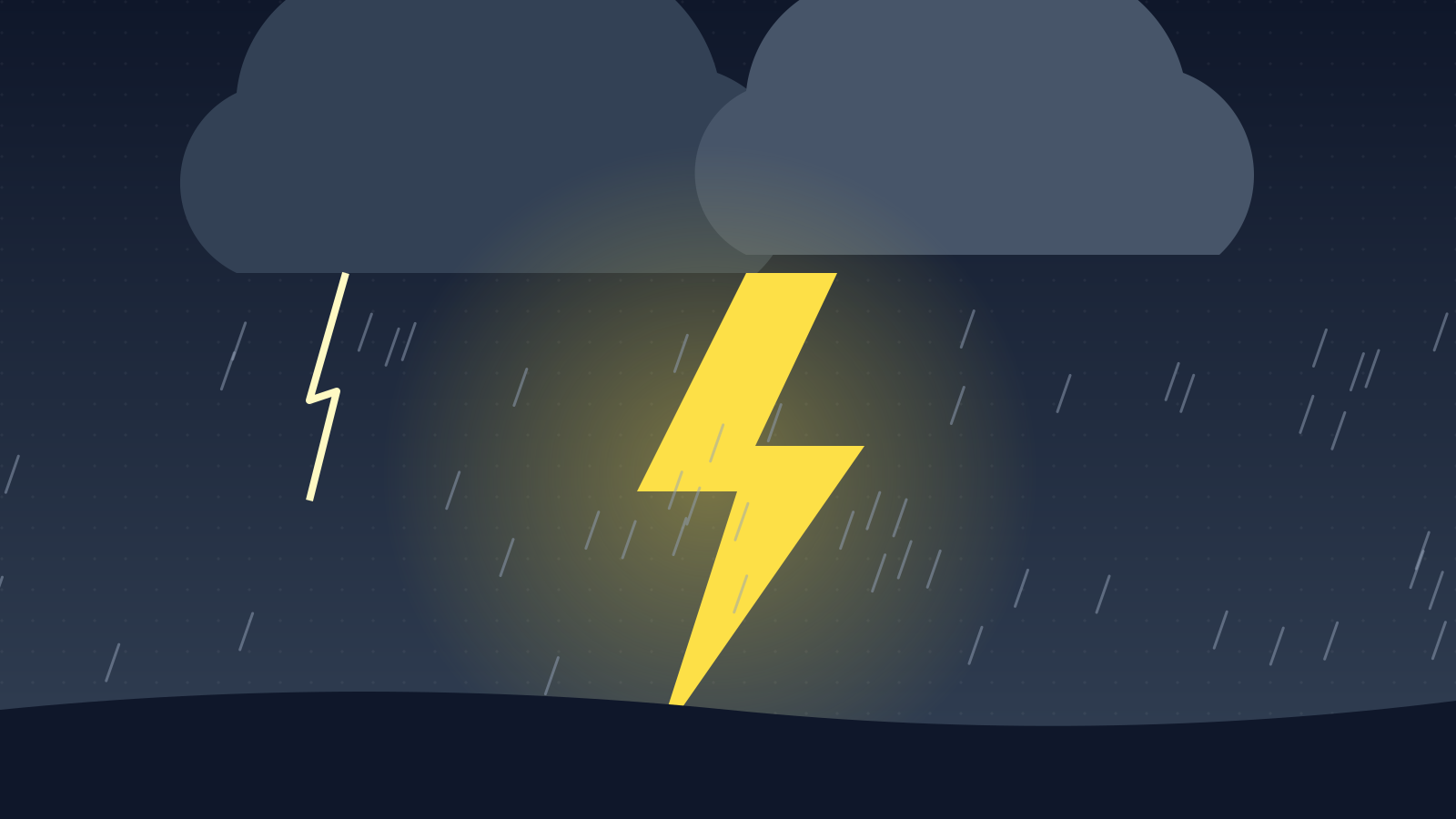
Inside storm clouds, rising air currents smash ice crystals into soft hail pellets. These collisions separate electric charge: the top of the cloud becomes positive and the bottom negative. When the voltage overwhelms the insulating power of the air, a giant electrical discharge occurs — lightning is the part that reaches the ground. The channel heats to around 30,000 °C in a few thousandths of a second, and the sudden expansion of the air creates thunder.
In this article (9)
The sky splits open with a blinding flash, and a few seconds later a roar shakes the ground. Lightning is one of nature’s most spectacular — and most dangerous — displays. Once seen as the weapon of the gods, it is really the discharge of an enormous static electric charge built up inside a storm cloud.
It all starts in a storm cloud
The clouds that produce lightning are called cumulonimbus: towering giants that can reach 10–15 kilometres high. Inside them, powerful currents are at work:
- Warm, moist air rises rapidly upwards.
- As it rises it cools, and its water vapour turns into droplets and, higher up, ice crystals.
- In the middle of the cloud, supercooled water — liquid even below freezing — and pellets of soft hail (graupel) form.
This environment is ready to work like an electrical generator.
How does the charge separate?
In the rising air, small ice crystals are carried upwards while heavier graupel pellets fall. The two collide billions of times, and with each collision electric charge passes from one particle to another:
- Small ice crystals usually gain a positive charge and are swept to the top of the cloud.
- Heavier graupel gains a negative charge and gathers in the lower part of the cloud.
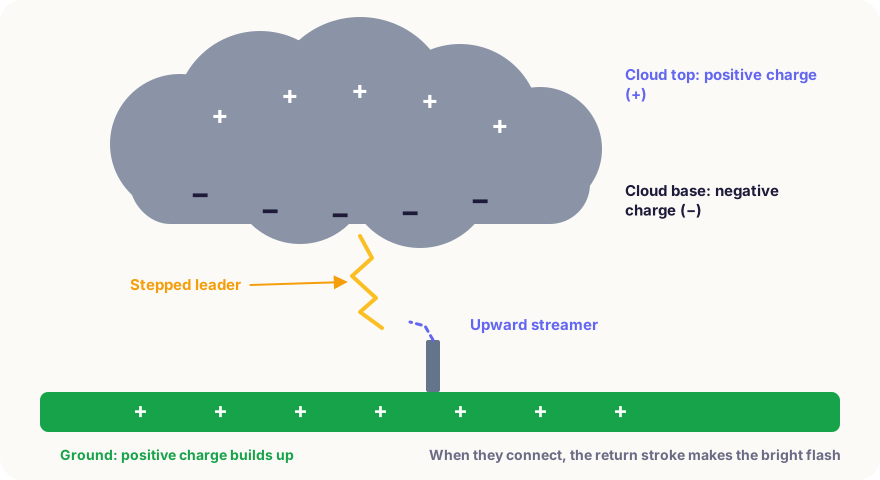
The cloud becomes a giant battery: positive at the top, negative at the base. On the ground beneath, the negative cloud base causes positive charge to build up, following the cloud across the landscape like its shadow.
Lightning’s millisecond journey
Air is normally a good insulator. But when the voltage between cloud and ground reaches hundreds of millions of volts, the air can no longer resist. What follows happens within thousandths of a second:
- Stepped leader: A faint, barely visible channel of electricity zigzags down from the cloud base, jumping tens of metres at a time.
- Upward streamers: As the leader nears the ground, short positively charged channels shoot upwards from tall objects such as trees, buildings, poles — and even people.
- Connection: The moment the leader meets one of the streamers, an unbroken path opens between cloud and ground.
- Return stroke: A huge current surges along this path, lighting the channel up brilliantly. That is the bright flash we see.
A flash rarely ends with a single stroke. Three or four more strokes can travel down the same channel within a tenth of a second, which is why lightning often seems to flicker.
Most lightning never reaches the ground. Roughly three-quarters of flashes happen inside a cloud or between clouds. Cloud-to-ground strikes are the minority — but they are the most dangerous.
What causes thunder?
During the return stroke, the air in the lightning channel heats up to around 30,000 °C in a tiny fraction of a second — roughly five times hotter than the surface of the Sun.
Air heated that suddenly expands explosively, sending out a powerful shock wave. Close by, it sounds like a sharp crack; further away, like a long rumble. The rumble drags on because sound from different parts of a channel kilometres long reaches your ears at different times.
Working out how far away lightning is
Light reaches you almost instantly, but sound travels at about 343 metres per second — roughly one kilometre every three seconds. Count the seconds between the flash and the thunder, divide by three, and you have the distance in kilometres. (For miles, divide by five.)

The count is also a safety gauge. If the gap is less than 30 seconds, the lightning is within 10 kilometres and you should get indoors immediately.
How to stay safe
Lightning can strike as far as 15 kilometres from the centre of a storm, sometimes when the sky overhead still looks clear. The basic rules are:
| Do | Don’t |
|---|---|
| Go into a sturdy building or a hard-topped metal vehicle | Shelter under a tree |
| Wait 30 minutes after the last thunder | Stay on hilltops, beaches or open fields |
| Indoors, keep away from plugged-in appliances and running water | Swim in the sea or a pool |
| If caught outside, crouch with feet together and head down | Lie flat on the ground or touch metal fences |
A car’s protection does not come from its tyres. Lightning that has crossed kilometres of air will not be stopped by a few centimetres of rubber. The real protection is the metal body, which carries the current over the outside of the vehicle into the ground — an effect physicists call a Faraday cage.
Common lightning myths
- “Lightning never strikes the same place twice.” False. Tall buildings, towers and lightning rods are hit many times every year.
- “If it isn’t raining, I’m safe.” False. Lightning can strike kilometres beyond the area where rain is falling.
- “It’s dangerous to touch someone struck by lightning.” False. The human body does not store electrical charge. Giving first aid immediately can save a life.
- “Heat lightning is a different phenomenon.” The silent flashes seen on summer evenings are simply lightning from storms too far away for their thunder to be heard.
Lightning has benefits too
Lightning is not only dangerous; it matters for nature. The extreme heat in its channel splits nitrogen and oxygen molecules in the air, forming nitrogen oxides. Rain carries these into the soil, where they become a natural fertiliser plants can use. Wildfires started by lightning also play a part in renewing some ecosystems.
In short
Lightning is a giant discharge of the electric charge separated by colliding ice and hail inside a storm cloud. A leader descending from the cloud meets a streamer rising from the ground, the channel heats to tens of thousands of degrees, and the expanding air creates thunder. Counting the seconds between flash and thunder tells you both how far away the storm is and when it is time to take shelter.
Frequently asked questions
Does lightning strike the same place twice?
Yes, often. Tall, pointed structures attract lightning. The Empire State Building in New York, for example, is struck more than 20 times a year on average.
Are you safe from lightning in a car?
A hard-topped car with a metal body is a good shelter — not because of the rubber tyres, but because the metal shell carries the current around the outside and into the ground. Convertibles and motorbikes are not safe.
Can lightning strike if you can’t hear thunder?
Thunder can be heard up to about 15–20 km away, and lightning can strike around 15 km from the heart of a storm. In other words, if you can hear thunder, you are within striking distance.
Why is sheltering under a tree dangerous?
Trees are often the tallest point around and attract lightning. When a tree is struck, current can jump from the trunk to the ground and to anyone standing nearby.
Sources
This article is based on peer-reviewed research and publications from trusted institutions, and it is reviewed regularly. How we work →
You might also wonder
All in Earth & Nature →
Why Do Leaves Change Colour in Autumn? The Science of Yellow, Orange and Red
Why do leaves turn yellow or red in autumn, and why do trees drop them? The pigments in leaves, colourful autumns and why America is redder than Europe.

How Do Rainbows Form? Light, Raindrops and the Secret of 42 Degrees
How do rainbows form, why are they curved and why do they appear opposite the Sun? Double rainbows, colour order and why you can never reach the end.

Why Is the Ocean Salty? Where Sea Salt Really Comes From
Why is seawater salty when rivers are fresh? How salt reaches the ocean from rocks and the seafloor, and why some seas are much saltier than others.
Why Is the Sky Blue? Rayleigh Scattering Explained Simply
Why is the sky blue and why are sunsets red? A clear explanation of how sunlight scatters in the atmosphere, and why we see blue instead of violet.
How Do Clouds Form and Why Does It Rain? A Water Droplet’s Journey Through the Sky
How do clouds form, why doesn’t a cloud carrying tonnes of water fall, and how is a raindrop made? The sky-high stages of the water cycle, explained.

What Causes Tides? The Moon’s Invisible Pull on the Oceans
Why does the sea rise and fall twice a day? How the Moon and Sun create tides, why there are two high tides and why some coasts get huge tides and others none.