Why Do We Hiccup? What Causes Hiccups and What Actually Helps
What causes hiccups, where does the “hic” sound come from and how do you stop them? Diaphragm spasms, evolutionary theories and remedies that have been tested.
Short answer
A hiccup is a sudden, involuntary contraction of the diaphragm, the muscle we breathe with. As it contracts, air is pulled rapidly into the lungs; about 35 milliseconds later, the vocal cords snap shut and stop the airflow. The “hic” is the sound of that closure. Eating fast, fizzy drinks, alcohol and excitement can trigger the reflex. Hiccups usually stop on their own within minutes.
In this article (8)
In the middle of an important meeting, in a silent classroom or right after a meal — that uncontrollable “hic”. Hiccups are a reflex almost everyone knows but few of us think about. Scientists understand well how hiccups happen; why they exist is still up for debate.
The anatomy of a hiccup
The star of the show is the diaphragm, a large dome-shaped muscle that separates the chest from the abdomen. Each time we breathe in, it contracts and moves down, expanding the chest so air flows into the lungs.
During a hiccup this regular rhythm is disrupted, and two things happen in very quick succession:
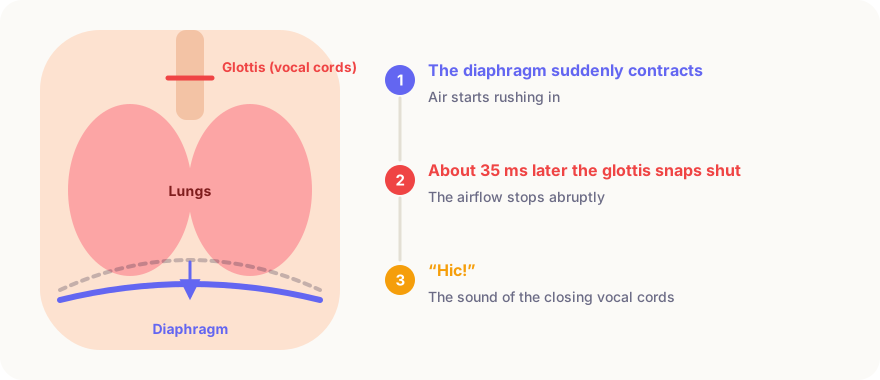
- The diaphragm contracts suddenly. This is a spasm beyond our control; the muscles between the ribs usually contract at the same moment.
- Air rushes in. The sudden contraction starts a powerful flow of air towards the lungs.
- The glottis snaps shut. About 35 milliseconds later, the gap between the vocal cords — the glottis — closes abruptly. The airflow stops and the closing vocal cords make the familiar “hic”.
Hiccups usually repeat between 4 and 60 times a minute, and each person has their own rhythm.
Who is in charge of the reflex?
Hiccups are controlled by a reflex circuit in the brainstem. It has three parts:
- Nerves carrying the signal: especially the vagus nerve and the phrenic nerve. The vagus carries information to the brain from the stomach, oesophagus and throat; the phrenic nerve controls the diaphragm.
- The centre: a “hiccup centre” in the brainstem linked to the regions that regulate breathing.
- The response: commands sent to the diaphragm and larynx.
Stimulating any point along this pathway can set off hiccups — which is why their triggers are so varied.
What triggers hiccups?
The most common causes of short bouts are:
- Eating too fast or too much: a suddenly stretched stomach stimulates the vagus nerve.
- Fizzy drinks: gas in the stomach causes the same stretching.
- Alcohol: it irritates the stomach and affects the nervous system.
- Sudden temperature changes: such as an icy drink straight after very hot soup.
- Swallowing air: chewing gum, smoking or talking while eating quickly.
- Excitement and stress: emotions can affect breathing rhythm.
Why do hiccups exist? Evolutionary theories
Whether hiccups are good for anything is one of science’s curious puzzles, because in adults they seem to have no obvious benefit. But there are clues.
A reflex from the womb
Hiccups appear very early in human development. Babies start hiccupping in the womb towards the end of the first trimester — before regular breathing movements begin. Newborns also hiccup far more often than adults.
Theory 1: clearing air from the stomach
According to a theory proposed by psychologist Daniel Howes in BioEssays in 2012, hiccups are an “air-removal” reflex that evolved in suckling young mammals. Babies swallow air along with milk. The sudden suction in the chest during a hiccup pulls the air bubble from the stomach into the oesophagus, and the burp that follows expels it, making room for more milk.
The theory tries to explain why hiccups seem to be found only in mammals and why they are so frequent in babies.
Theory 2: a trace of gill-breathing ancestors
Another view holds that hiccups are a remnant of an ancient nerve circuit resembling the movement tadpoles use to breathe through their gills. Tadpoles draw water into their mouths and close the glottis so the water goes over the gills rather than into the lungs — a movement strikingly similar to a hiccup.
Theory 3: helping the brain learn to breathe
Research with newborns at University College London showed that each hiccup triggers a distinct wave of electrical activity in the baby’s brain. The researchers suggest these responses may help the infant brain learn to monitor and control the breathing muscles.
None of these theories is settled. Hiccups may simply be a reflex that was once useful and has become unnecessary in adults.
How do you stop hiccups?
There are countless home remedies for hiccups. Most rely on interrupting the reflex circuit somehow. Scientific evidence is mostly limited, but it is possible to see why some might work:
| Method | How it might work |
|---|---|
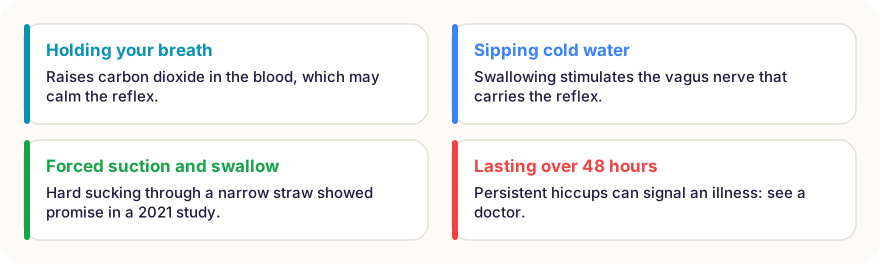
| Holding your breath for 10–20 seconds | Carbon dioxide in the blood rises, which may reduce the diaphragm’s tendency to spasm |
| Sipping cold water | Swallowing repeatedly stimulates the vagus nerve |
| Swallowing a spoonful of sugar | Stimulates nerve endings in the throat and may “distract” the reflex |
| Pulling your knees to your chest | Compresses the diaphragm and may change its rhythm |
| Breathing into a paper bag | Raises carbon dioxide (briefly, and never over the head) |
A 2021 study tested a device that makes you drink water forcefully through a special narrow straw. The method stimulates the diaphragm through strong suction and the vagus nerve through swallowing at the same time. Most participants reported that it stopped their hiccups. However, the study had no control group, so the results need confirming by further research.
There is no reliable evidence that a sudden fright works. A shock disrupts your breathing rhythm, so it may occasionally seem to work by coincidence.
When to see a doctor
Almost all hiccups are harmless and pass on their own within minutes. You should see a doctor if:
- hiccups last more than 48 hours;
- they make eating, sleeping or breathing difficult;
- they come with chest pain, abdominal pain or vomiting.
Long-lasting hiccups can signal an underlying problem such as acid reflux, irritated nerves, kidney problems, certain medicines or disorders of the nervous system. In that case, treatment targets the underlying cause.
The record: 68 years of hiccups
The longest recorded bout belongs to American Charles Osborne, who started hiccupping in 1922 and stopped only in 1990 — about 68 years later. In that time he married, had children and tried to lead a normal life. Thankfully, cases like his are extremely rare.
In short
A hiccup is a reflex in which the diaphragm contracts involuntarily and the glottis then snaps shut. A stretched stomach, fizzy drinks, alcohol and excitement can trigger it. Its evolutionary purpose is still debated: it may help babies clear air from the stomach, or it may be a remnant of a very old nerve circuit. Most hiccups stop within minutes — but persistent hiccups are always worth checking with a doctor.
Frequently asked questions
Why do hiccups stop by themselves?
The nerve signals that trigger the hiccup reflex usually die down after a while. Once the stomach is less stretched or the nerves stop being irritated, the diaphragm returns to its normal rhythm.
Does a sudden fright cure hiccups?
There is no scientific evidence for it. A shock changes your breathing rhythm, so it can sometimes seem to work, but it is not a reliable method.
When are hiccups dangerous?
Hiccups lasting more than 48 hours are called persistent hiccups. They can be linked to acid reflux, nerve problems, some medicines or other illnesses, so you should see a doctor.
What is the longest bout of hiccups on record?
According to records, American Charles Osborne hiccupped from 1922 to 1990 — about 68 years.
Sources
- NHS – Hiccups
- Howes (2012) – Hiccups: A new explanation for the mysterious reflex, BioEssays
- Alvarez et al. (2021) – Evaluation of the Forced Inspiratory Suction and Swallow Tool to Stop Hiccups, JAMA Network Open
This article is based on peer-reviewed research and publications from trusted institutions, and it is reviewed regularly. How we work →
You might also wonder
All in Human Body →
Why Do Fingers Wrinkle in Water? Your Nervous System’s Surprising Trick
Why do fingertips prune after a long bath? It is not just skin soaking up water — it is your nervous system at work. Plus the debate over what wrinkles are for.
Why Do We Yawn? The Science of Contagious Yawning
Do we yawn because we are tired, bored or low on oxygen? The brain-cooling theory and why seeing someone yawn makes you yawn too, explained with research.
Why Does Hair Turn Grey? Stress, Genes and Stem Cells in the Follicle
Why does hair go grey, can stress really turn it white and can grey hair come back? The pigment cells in hair follicles and what new research has found.
Why Are Fingerprints Unique? A Pattern That Begins in the Womb
How do fingerprints form, why do even identical twins have different prints, and what are fingerprints for? The 2023 discovery and the science behind them.
What Causes Brain Freeze? The Secret of the Ice-Cream Headache
What is that sharp pain in your forehead when you eat something cold? How brain freeze happens, why you feel it in your forehead and how to make it stop.
Why Does Your Stomach Growl? Hunger Noises and the Gut’s Cleaning Cycle
Why does your stomach rumble when you are hungry, and does it growl when you are full? Where gut sounds come from and the cleaning cycle of an empty gut.