Why Do Flowers Smell? The Chemistry and Purpose of Floral Scents
Flower scents are chemical messages. Why flowers smell, how petals make fragrance from sugar, why some stink of rotting meat and why roses lost their scent.
Short answer
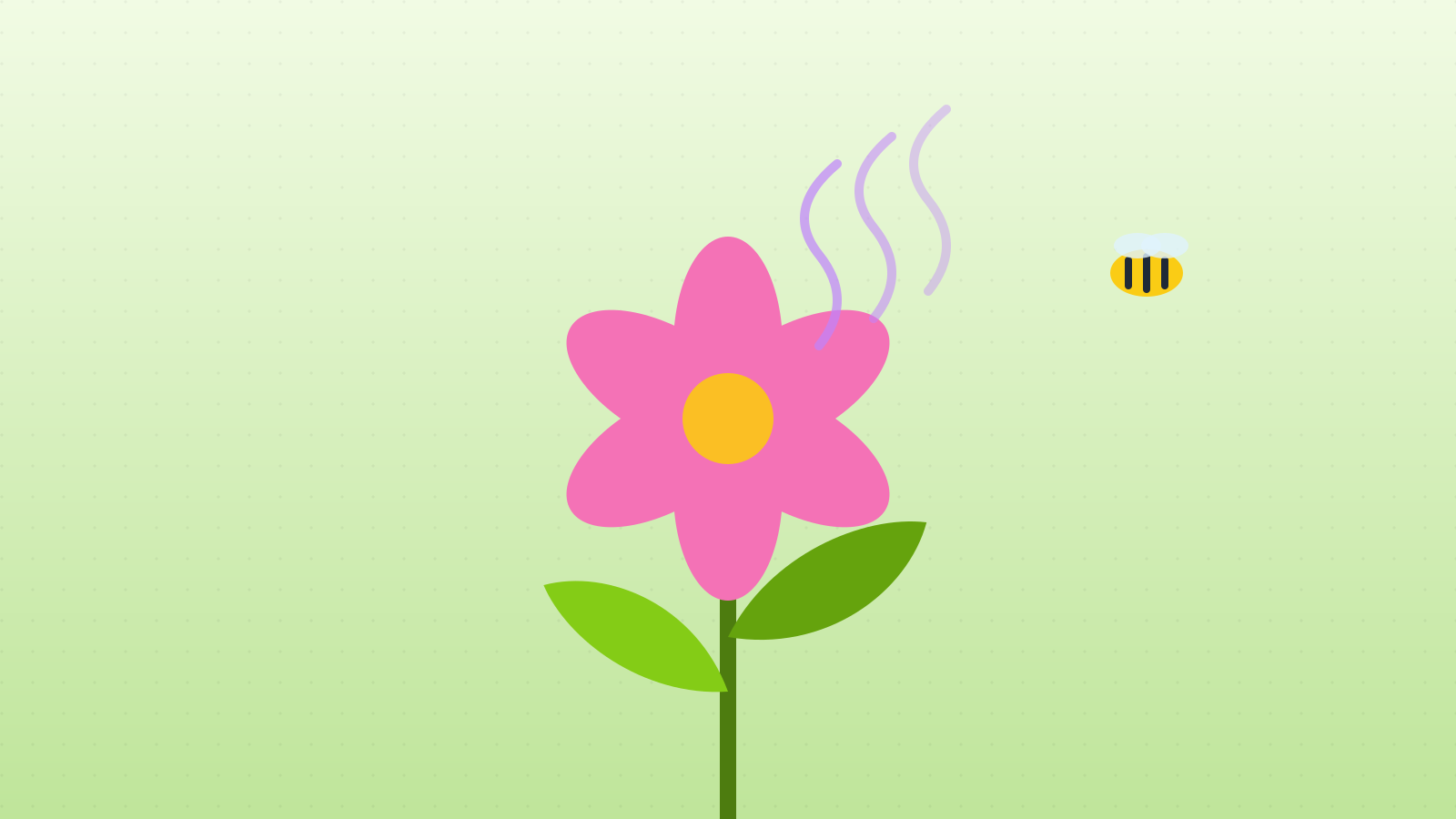
Flowers smell mainly to attract pollinators. A floral scent is a mixture of small, volatile molecules that evaporate easily and drift through the air, acting like an advertisement that guides bees, butterflies, moths, beetles, flies or bats to the flower, sometimes from far away. Each species produces its own blend, which helps attract the right visitors and filter out the wrong ones. Petal cells make these molecules from sugars produced by photosynthesis, using specialised enzymes, and many flowers release scent only at the times their pollinators are active. Some scents also defend the plant by repelling herbivores. Not every flower smells sweet: some imitate rotting meat to attract flies.
In this article (7)
The perfume of a rose, the heavy sweetness of jasmine on a summer evening, the fresh scent of a lime tree in bloom: flower scents are among the most pleasant things in nature. Humans have used them for thousands of years in perfumes, teas and rituals. But flowers do not smell for us. Their scents are chemical messages, aimed mainly at insects and other animals, and they are the result of millions of years of evolution.
A scent is an advertisement
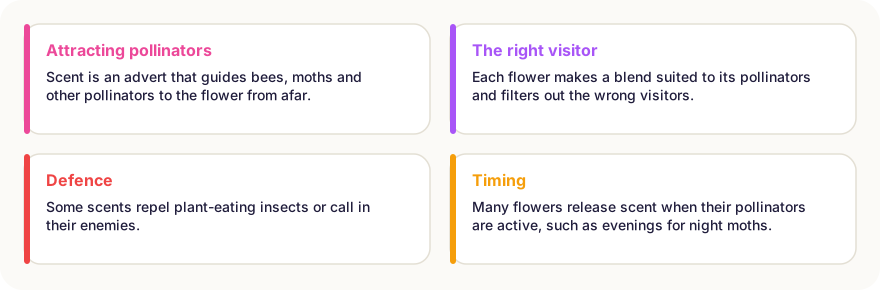
Plants cannot move, so to reproduce, many need animals to carry pollen from one flower to another. Flowers offer a reward, usually nectar or pollen, and advertise it with colour, shape and scent.
Scent has some advantages over colour. It travels on the wind, works in the dark and can be detected from a distance. A bee can follow a trail of scent molecules to a patch of flowers it cannot yet see. Studies show that bees learn and remember floral scents very well, returning to flowers that smelled rewarding before.
According to a widely cited review by ecologist Robert Raguso, floral scent serves several purposes:
- attracting pollinators from a distance,
- helping them recognise the right flower up close,
- filtering visitors, so the flower attracts animals that pollinate it well,
- defending the plant against herbivores, fungi or nectar thieves.
Different perfumes for different visitors
Flowers have evolved scents that match their pollinators’ tastes, a pattern known as pollination syndromes:
| Pollinator | Typical flower scent | Examples |
|---|---|---|
| Bees | Sweet, fresh, often lightly fruity or minty | Lavender, clover, apple blossom |
| Moths (night) | Strong, sweet, heavy, released in the evening | Jasmine, tuberose, honeysuckle |
| Butterflies | Light, sweet, released during the day | Buddleia, phlox |
| Beetles | Fruity, spicy or musty | Magnolia, water lily |
| Flies | Dung, rotting meat or fungus | Titan arum, Rafflesia, carrion flower |
| Bats | Musty, fruity or cabbage-like, at night | Agave, baobab |
Timing matters too. Many flowers release their scent only when their pollinators are active. A petunia pollinated by night moths emits most of its scent in the evening, a rhythm controlled by the plant’s internal circadian clock.
How a petal makes perfume
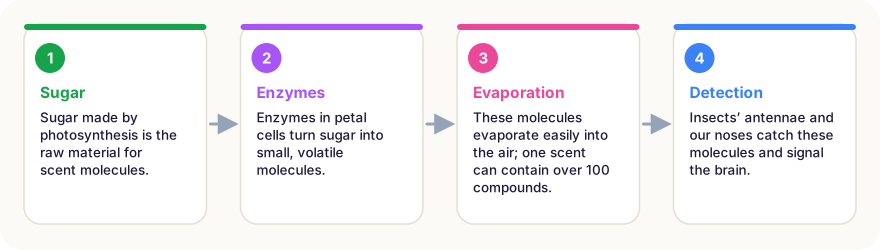
Scent molecules belong to a group called volatile organic compounds: small, light molecules that evaporate easily at normal temperatures. According to a 2013 review by Natalia Dudareva and colleagues, plants make more than 1,700 such compounds, falling into a few main chemical families:
- Terpenes, such as linalool (lavender, many flowers) and limonene (citrus),
- Benzenoids and phenylpropanoids, such as methyl benzoate (snapdragon, petunia) and eugenol (clove-like scents),
- Fatty acid derivatives, which often give fresh, “green” notes.
The raw material is sugar made by photosynthesis. Enzymes in the petal cells convert it step by step into these molecules, which then pass out through the petal’s surface into the air. A single flower’s scent can be a blend of just a few compounds or of over 100. The exact recipe gives each species its signature smell.
Not all flowers smell sweet
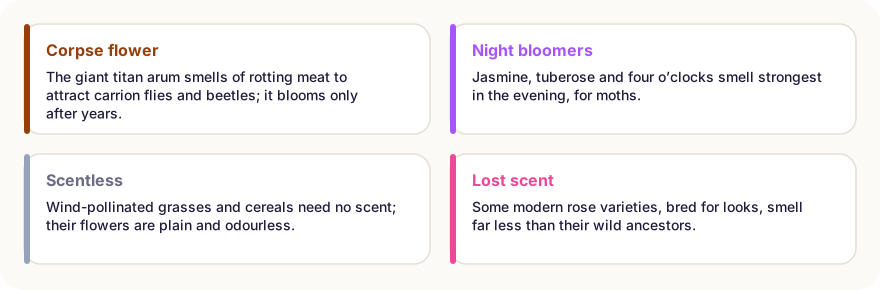
Some flowers rely on flies and beetles that feed on dead animals or dung. These flowers imitate the smell of decay, using sulfur compounds similar to those released by rotting meat. The most famous is the titan arum (Amorphophallus titanum) from Sumatra, which can take years to bloom. When it finally does, it heats itself up to spread its stench further, attracting carrion insects that pollinate it.
At the other extreme, flowers pollinated by the wind, such as grasses, cereals and many trees, have no need to attract animals. Their flowers are usually small, plain and odourless.
Why many roses lost their scent
If you have ever bought a beautiful rose and found it smelled of almost nothing, you are not imagining it. Many modern roses were bred above all for colour, shape and long vase life. Making scent costs the plant energy and depends on many genes. During breeding, scent was often weakened or lost. Researchers are now studying the genes behind rose scent, in part to bring it back.
Scent and us
Humans have long harvested floral scents. Rose oil, from Bulgaria and Isparta in Turkey, is among the most precious perfume ingredients: several tonnes of petals are needed for a single kilogram of oil. Many of today’s perfumes also use synthetic copies of floral molecules, such as linalool, which smells of lavender.
In short
- Flowers smell mainly to attract pollinators such as bees, moths, flies and bats.
- Scents travel on the air, work in the dark and help insects find and recognise flowers.
- Each species has its own blend, matched to its pollinators and released at the right time.
- Petals make scent from sugar using enzymes; one scent can contain over 100 compounds.
- Some flowers, like the titan arum, smell of rotting meat to attract flies.
- Wind-pollinated flowers are usually scentless, and some modern roses lost scent through breeding.
Frequently asked questions
Why do some flowers smell stronger at night?
Flowers pollinated by night-flying moths or bats, such as jasmine and tuberose, release most of their scent in the evening and at night, when their pollinators are active and visual signals work less well.
Why do some roses have no smell?
Many modern roses were bred for colour, shape and long vase life. Scent production uses energy and is genetically complex, so in some varieties it was weakened or lost during breeding.
Do all flowers smell?
No. Flowers pollinated by wind, such as grasses and many trees, do not need to attract animals, so they usually have no scent and no showy petals.
How many chemicals are in a flower’s scent?
It varies widely. Some scents contain just a few compounds, while others are blends of more than 100 different volatile molecules, which is why a flower’s scent is so hard to copy exactly.
Sources
- Dudareva, Klempien, Muhlemann & Kaplan (2013) – Biosynthesis, function and metabolic engineering of plant volatile organic compounds, New Phytologist
- Raguso (2008) – Wake up and smell the roses: the ecology and evolution of floral scent, Annual Review of Ecology, Evolution, and Systematics
This article is based on peer-reviewed research and publications from trusted institutions, and it is reviewed regularly. How we work →
You might also wonder
All in Plants →
What Is the Biggest Tree in the World? General Sherman, Hyperion and Other Giants
The biggest tree is the giant sequoia General Sherman; the tallest is the redwood Hyperion. Meet the record trees and learn why trees cannot grow forever.

Do Sunflowers Follow the Sun? Yes, But Only When They Are Young
Young sunflowers turn east to west each day and swing back at night. Mature ones stop and face east. How the plant’s inner clock and bees explain it.
How Do Plants Drink Water? How Trees Lift Water 100 Metres Without a Pump
Plants have no heart, yet the tallest trees lift water over 100 metres. How roots, xylem and evaporation from leaves pull water up from the soil.

Why Are Leaves Green? Chlorophyll, Photosynthesis and a Puzzle
Leaves are green because chlorophyll absorbs red and blue light. But why would plants waste the most abundant colour of sunlight? The surprising answer.
Are Mushrooms Plants? Why Fungi Are Closer to Animals
Mushrooms grow in soil and don’t move, but they are not plants. Why fungi form their own kingdom, how they feed and why they are closer to animals.

How Do Cacti Survive Without Water? The Desert Survival Toolkit
Cacti store water in swollen stems, use spines instead of leaves, breathe at night and grow roots within hours of rain. How they survive in deserts.