Is There Life on Mars? What We Know, What We’ve Found and What Comes Next
Mars once had rivers and lakes. Is anything alive there now? Clues from meteorites, methane and rovers, why the planet is so hostile and how we search.
Short answer
No life has been found on Mars so far, but scientists have not ruled it out. Billions of years ago Mars had rivers, lakes and a thicker atmosphere, conditions in which microbes might have lived. Today the surface is cold, dry, very thin-aired and bathed in radiation, so if life exists now it is most likely microbial and hidden underground or in ice. Rovers have found organic molecules, seasonal methane and rocks with features that could be signs of past life, but every clue so far also has a possible non-biological explanation. Confirming life will probably require studying Martian samples in laboratories on Earth.
In this article (7)
For more than a century, people have wondered whether anyone, or anything, lives on the Red Planet. In the 1890s some astronomers even believed they could see canals dug by Martians. We now know there are no canals and no little green men. But the question of whether Mars ever hosted life, or still does, is one of the biggest open questions in science, and the search has never been more active.
Mars then and now
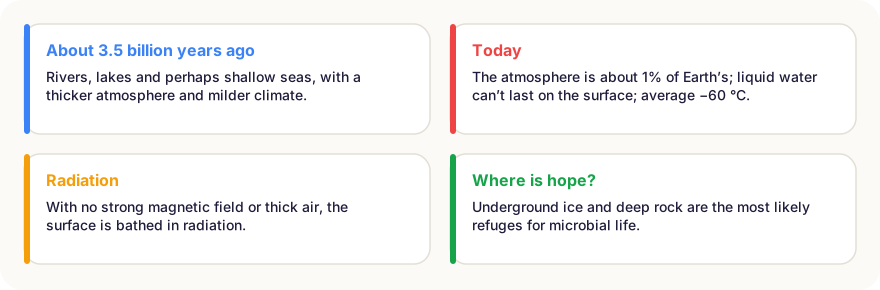
Spacecraft orbiting Mars have photographed dried-up river valleys, deltas where rivers once flowed into lakes, and minerals such as clays that only form in water. Around 3.5 to 4 billion years ago, Mars seems to have been far more welcoming: it had a thicker atmosphere, a milder climate and liquid water on its surface, perhaps for millions of years at a time.
That is important because, at about the same time, life was already appearing on Earth. If the two young planets had similar conditions, it is reasonable to ask whether life could have started on Mars too.
But Mars changed. It is smaller than Earth, and its interior cooled faster. It lost most of its global magnetic field, which had helped protect the atmosphere. Over time, the solar wind stripped much of the air away into space. Water froze, evaporated or seeped underground.
Here is how Mars compares with Earth today:
| Earth | Mars | |
|---|---|---|
| Diameter | 12,742 km | 6,779 km |
| Gravity | 1 g | about 0.38 g |
| Average surface temperature | about 15 °C | about −60 °C |
| Atmospheric pressure | 1 bar | less than 1% of Earth’s |
| Main gas in the air | nitrogen and oxygen | carbon dioxide (about 95%) |
| Magnetic field | strong, global | almost none |
| Liquid water on the surface | oceans, rivers, lakes | not stable today |
Why the surface is so hostile
Life as we know it needs liquid water, a source of energy and certain chemical elements. Mars has the elements, and sunlight or chemical reactions could supply energy. Water is the problem. With such thin air, liquid water on the surface quickly freezes or boils away.
On top of that, there is radiation. Without a thick atmosphere or strong magnetic field, the surface is hit by ultraviolet light from the Sun and high-energy cosmic rays. These can break apart organic molecules and would be lethal for most microbes at the surface.
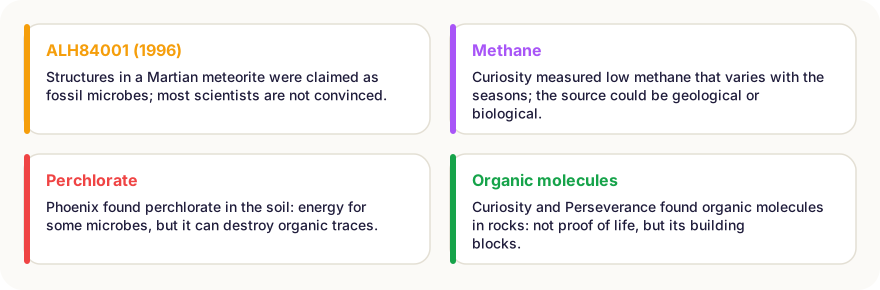
In 2008, NASA’s Phoenix lander found perchlorate in the soil near the north pole. Perchlorate is a salt that can lower the freezing point of water, and some microbes on Earth can use it as an energy source. But it also reacts strongly when heated and can destroy organic molecules, complicating the search for traces of life.
That is why many scientists think the best places to look are underground, where rock and ice provide protection, or in ancient rocks that might preserve signs of past life.
The clues so far
The Viking experiments (1976). NASA’s two Viking landers scooped up soil and tested it for signs of metabolism. One experiment released gas as if something were digesting nutrients. But other tests found no organic matter, and most scientists concluded that reactive chemicals in the soil caused the result.
The ALH84001 meteorite (1996). A rock blasted off Mars by an impact and found in Antarctica caused a sensation when a team led by David McKay reported tiny worm-like structures and minerals that might have been made by microbes. Later studies showed similar features can form without life, and the claim remains unproven.
Methane. On Earth, most methane is produced by living organisms. In 2018, a team led by Christopher Webster reported that NASA’s Curiosity rover had measured very low background levels of methane in Gale Crater that rise and fall with the seasons. The source could be microbes, but it could equally be geological, for example reactions between water and certain rocks deep underground. Some orbiting spacecraft have struggled to detect the methane at all, which remains a puzzle.
Organic molecules. Curiosity and Perseverance have found organic molecules, carbon-based compounds that are the building blocks of life, preserved in ancient rocks. Organic molecules can also form without life, but finding them shows that the raw ingredients survived for billions of years.
Possible biosignatures. In Jezero Crater, Perseverance has studied rocks with unusual patterns and minerals. In 2025 NASA scientists reported that one rock, nicknamed Cheyava Falls, holds features that could be a potential biosignature, a sign that may have been produced by life. They stressed that non-biological processes could also explain them.
How we search
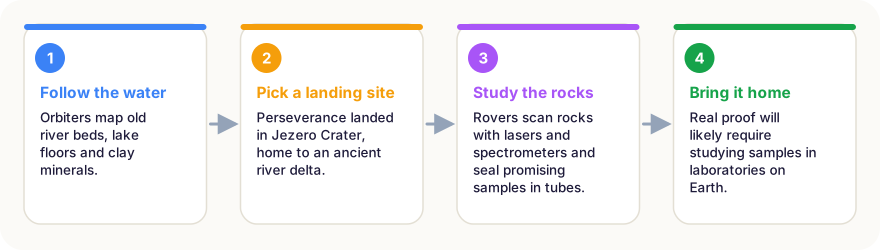
The search follows a clear strategy. Orbiters map the planet to find places where water once flowed. Landers and rovers then visit the most promising sites. Perseverance, which landed in February 2021, was sent to Jezero Crater because it holds an ancient river delta, the kind of place where sediments, and perhaps traces of microbes, would have collected and been preserved.
Perseverance examines rocks with cameras, lasers and spectrometers and seals the most promising samples in tubes. The ultimate goal is to bring those samples to Earth, where they can be studied with instruments far too large and complex to send to Mars. Plans for such a sample return mission exist, but their timing and cost are uncertain. Europe’s Rosalind Franklin rover is also designed to drill up to two metres below the surface, where organic molecules are better protected from radiation.
Life on Mars, or life from Mars?
There is an even stranger possibility. Meteorites like ALH84001 show that rocks regularly travel from Mars to Earth after large impacts. Some scientists have speculated that microbes might survive such a journey inside rock. In principle, life could have started on one planet and spread to the other. There is no evidence for this, but it shows how closely the histories of the two planets may be linked.
Why it matters
Finding even a single fossil microbe on Mars would be one of the most important discoveries in history. It would show that life is not unique to Earth and suggest that it might arise wherever conditions allow, making a living universe far more likely. Finding nothing would also teach us something: perhaps life needs more than just the right ingredients.
In short
- No life has been found on Mars yet, but it has not been ruled out.
- About 3.5–4 billion years ago Mars had rivers, lakes and a thicker atmosphere.
- Today the surface is cold, dry, thin-aired and exposed to radiation.
- Clues include organic molecules, seasonal methane and rocks with possible biosignatures.
- Every clue so far also has a non-biological explanation.
- Confirming life will likely require bringing samples back to Earth.
Frequently asked questions
Could humans live on Mars?
Not without heavy protection. Mars has almost no breathable air, temperatures far below freezing and high radiation. Future explorers would need pressurised habitats, shielding and recycled water and oxygen.
Is there water on Mars?
Yes, mostly as ice, in the polar caps and underground across large areas. Liquid water cannot last long on the surface today because the air pressure is too low, although salty brines may form briefly.
What was the ALH84001 meteorite?
It is a rock from Mars found in Antarctica. In 1996 scientists suggested tiny structures inside it might be fossil microbes. Later work showed they could form without life, and most researchers are not convinced.
Why is methane on Mars interesting?
On Earth most methane is made by living things. Curiosity has measured small amounts that rise and fall with the seasons. It could come from microbes, but also from reactions between water and rock underground.
Sources
- McKay, D. S. et al. (1996). Search for past life on Mars: possible relic biogenic activity in Martian meteorite ALH84001. Science
- Hecht, M. H. et al. (2009). Detection of perchlorate and the soluble chemistry of Martian soil at the Phoenix lander site. Science
- Webster, C. R. et al. (2018). Background levels of methane in Mars’ atmosphere show strong seasonal variations. Science
- NASA Science – Mars
This article is based on peer-reviewed research and publications from trusted institutions, and it is reviewed regularly. How we work →
You might also wonder
All in Space →
How Big Is the Universe? From the Moon to the Edge of the Observable Cosmos
The observable universe is about 93 billion light years across, though only 13.8 billion years old. How that works and how big it might really be.

What Are Comets? Dirty Snowballs, Glowing Tails and Visitors From the Edge of the Solar System
Comets are icy leftovers from the birth of the solar system. Why they grow tails near the Sun, where they come from and what the Rosetta mission found.
What Are Shooting Stars? Meteors, Meteor Showers and Where to See Them
Shooting stars are not stars at all. What makes those streaks of light, why do meteor showers happen on the same dates every year, and how can you see the most?
Why Does Saturn Have Rings? What They Are Made Of and How Old They Are
Saturn’s rings are made of billions of ice chunks, yet they are only metres thick. Where did they come from, why aren’t they a moon, and will they vanish?

Why Does the Moon Look Bigger on the Horizon? The Moon Illusion Explained
A rising full Moon looks huge, yet it is no bigger than when it is high in the sky. Why does our brain inflate it, and how can you prove the illusion yourself?

How Do Solar Eclipses Work? Why the Moon Fits the Sun Perfectly
A total solar eclipse happens when the Moon exactly covers the Sun. Why the fit is so perfect, the types of eclipse, and how to watch one safely.