How Big Is the Universe? From the Moon to the Edge of the Observable Cosmos
The observable universe is about 93 billion light years across, though only 13.8 billion years old. How that works and how big it might really be.
Short answer
Nobody knows the full size of the universe, and it may be infinite. What we can measure is the observable universe: the region from which light has had time to reach us since the Big Bang about 13.8 billion years ago. Because space itself has been expanding all that time, the most distant regions we can see are now about 46 billion light years away, making the observable universe roughly 93 billion light years across. It contains hundreds of billions of galaxies, each with billions of stars. Beyond what we can see, the universe probably continues much further, but its light has not reached us yet.
In this article (7)
Look up on a clear, dark night and you might see a few thousand stars. It feels like a lot. But every one of them is in our own neighbourhood of the Milky Way, and the Milky Way is just one galaxy among hundreds of billions. So how big is the universe, really? The honest answer has two parts: what we can measure, and what we can only imagine.
Climbing the cosmic ladder
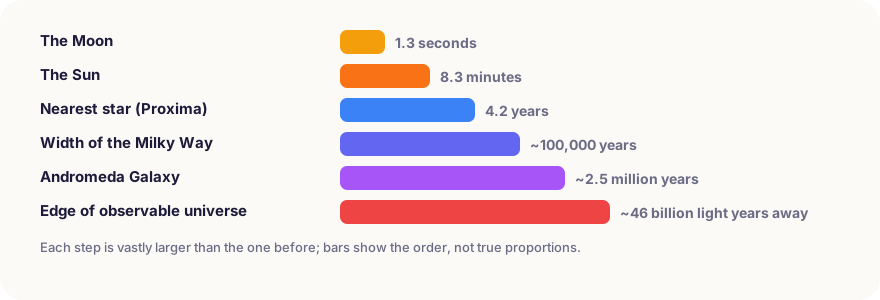
The distances in space are so vast that kilometres become useless. Astronomers use the light year, the distance light travels in a year: about 9.46 trillion kilometres. Light is the fastest thing in the universe, so measuring distance in light-travel time gives a sense of scale.
| Object | Distance from Earth | Light-travel time |
|---|---|---|
| The Moon | 384,000 km | 1.3 seconds |
| The Sun | 150 million km | 8.3 minutes |
| Neptune | about 4.5 billion km | about 4 hours |
| Proxima Centauri, the nearest star | about 40 trillion km | 4.2 years |
| Centre of the Milky Way | — | about 26,000 years |
| Andromeda Galaxy | — | about 2.5 million years |
| Edge of the observable universe | — | about 46 billion light years today |
The Milky Way itself is about 100,000 light years across and contains somewhere between 100 and 400 billion stars. Our nearest large neighbour, the Andromeda Galaxy, is about 2.5 million light years away. When you look at it, you see light that left it when early humans were just beginning to use stone tools.
A universe of galaxies
A century ago, many astronomers thought the Milky Way was the whole universe. In the 1920s, Edwin Hubble showed that some faint fuzzy patches in the sky were in fact separate galaxies, far beyond our own. In 1929, he found something even more astonishing: the farther away a galaxy is, the faster it seems to be moving away from us. The universe is expanding.
Today, deep images from telescopes such as Hubble and James Webb show galaxies in every direction, as far as we can see. Estimates of the number in the observable universe range from hundreds of billions to perhaps two trillion, each typically containing billions of stars.
13.8 billion years old, 93 billion light years wide
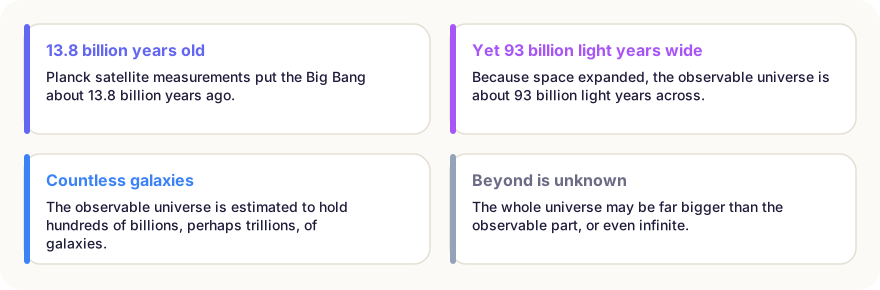
By studying the cosmic microwave background, a faint glow of light released about 380,000 years after the Big Bang, the Planck satellite measured the age of the universe with great precision: about 13.8 billion years.
Here is the puzzle. If the universe is 13.8 billion years old and nothing travels faster than light, surely we can only see 13.8 billion light years in any direction? Yet the observable universe is about 93 billion light years across. How?
Why the universe is bigger than its age
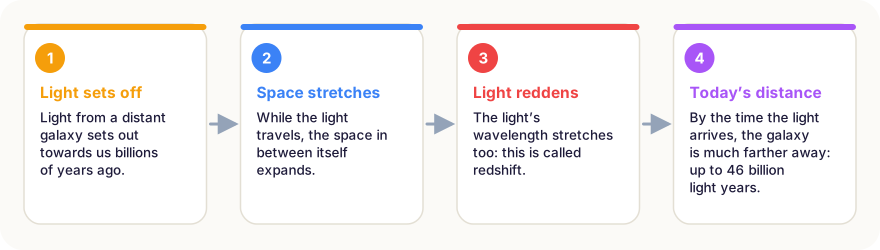
The answer is the expansion of space. When light left the most distant objects we can see, they were much closer to us. During the billions of years the light was travelling, the space between us kept stretching. By the time the light finally arrives, those regions are now about 46 billion light years away.
Expansion does not mean galaxies are flying through space like shrapnel from an explosion. It means space itself is stretching, carrying galaxies apart, a little like raisins in a rising loaf of bread. Nothing moves through space faster than light, but distant regions can recede faster than light because of the stretching of the space between.
The expansion also stretches light itself, shifting it towards longer, redder wavelengths. This redshift is how astronomers measure how far away distant galaxies are and how much the universe has grown since their light left them.
In 1998, two teams studying exploding stars found that the expansion is actually speeding up. The cause, still mysterious, is called dark energy. It makes up about 68% of the universe’s energy content, while ordinary matter, everything we can see, accounts for only about 5%.
What lies beyond?
The observable universe is a bubble defined by how far light has had time to travel to us. It is not the whole universe. There is no sign of an edge or a wall; galaxies seem to continue in every direction just as they do here.
Measurements suggest that space on the largest scales is very nearly flat, which means the universe could be infinite. Even if it is finite, it is at least many times larger than the part we can see. And because the expansion is accelerating, some distant regions will never send light to us, no matter how long we wait.
Making sense of it
If the Sun were the size of a one-millimetre grain of sand, the nearest star would be another grain about 30 kilometres away. The Milky Way would be a scattered cloud of such grains larger than Earth itself, and the observable universe would contain hundreds of billions of such clouds. Our minds struggle with these numbers, and that is part of the wonder.
In short
- The observable universe is about 93 billion light years across.
- The universe is about 13.8 billion years old, measured from the cosmic microwave background.
- It is larger than its age because space has been expanding while light travelled.
- It contains hundreds of billions of galaxies, each with billions of stars.
- The expansion is accelerating, driven by mysterious dark energy.
- The whole universe may be far larger, or even infinite.
Frequently asked questions
Does the universe have an edge?
As far as we know, no. The observable universe has a boundary set by how far light has travelled, but that is a limit of our view, not a wall. The universe could be infinite, or finite but curved back on itself with no edge.
What is the universe expanding into?
According to modern physics, it is not expanding into anything. Space itself is stretching, so the distances between galaxies grow without the universe needing an outside.
How many stars are there in the universe?
Rough estimates suggest something like a billion trillion (10²¹) stars or more in the observable universe, more than all the grains of sand on all Earth’s beaches.
How do we know the universe is 13.8 billion years old?
Mainly from the cosmic microwave background, the faint glow left over from the early universe. Satellites such as Planck mapped it in detail, and combining those measurements with physics gives an age of about 13.8 billion years.
Sources
- Planck Collaboration (2020). Planck 2018 results. VI. Cosmological parameters. Astronomy & Astrophysics
- NASA Science – Universe
This article is based on peer-reviewed research and publications from trusted institutions, and it is reviewed regularly. How we work →
You might also wonder
All in Space →
Is There Life on Mars? What We Know, What We’ve Found and What Comes Next
Mars once had rivers and lakes. Is anything alive there now? Clues from meteorites, methane and rovers, why the planet is so hostile and how we search.
What Are Comets? Dirty Snowballs, Glowing Tails and Visitors From the Edge of the Solar System
Comets are icy leftovers from the birth of the solar system. Why they grow tails near the Sun, where they come from and what the Rosetta mission found.
What Are Shooting Stars? Meteors, Meteor Showers and Where to See Them
Shooting stars are not stars at all. What makes those streaks of light, why do meteor showers happen on the same dates every year, and how can you see the most?
Why Does Saturn Have Rings? What They Are Made Of and How Old They Are
Saturn’s rings are made of billions of ice chunks, yet they are only metres thick. Where did they come from, why aren’t they a moon, and will they vanish?
Why Does the Moon Look Bigger on the Horizon? The Moon Illusion Explained
A rising full Moon looks huge, yet it is no bigger than when it is high in the sky. Why does our brain inflate it, and how can you prove the illusion yourself?
How Do Solar Eclipses Work? Why the Moon Fits the Sun Perfectly
A total solar eclipse happens when the Moon exactly covers the Sun. Why the fit is so perfect, the types of eclipse, and how to watch one safely.