What Are Comets? Dirty Snowballs, Glowing Tails and Visitors From the Edge of the Solar System
Comets are icy leftovers from the birth of the solar system. Why they grow tails near the Sun, where they come from and what the Rosetta mission found.
Short answer
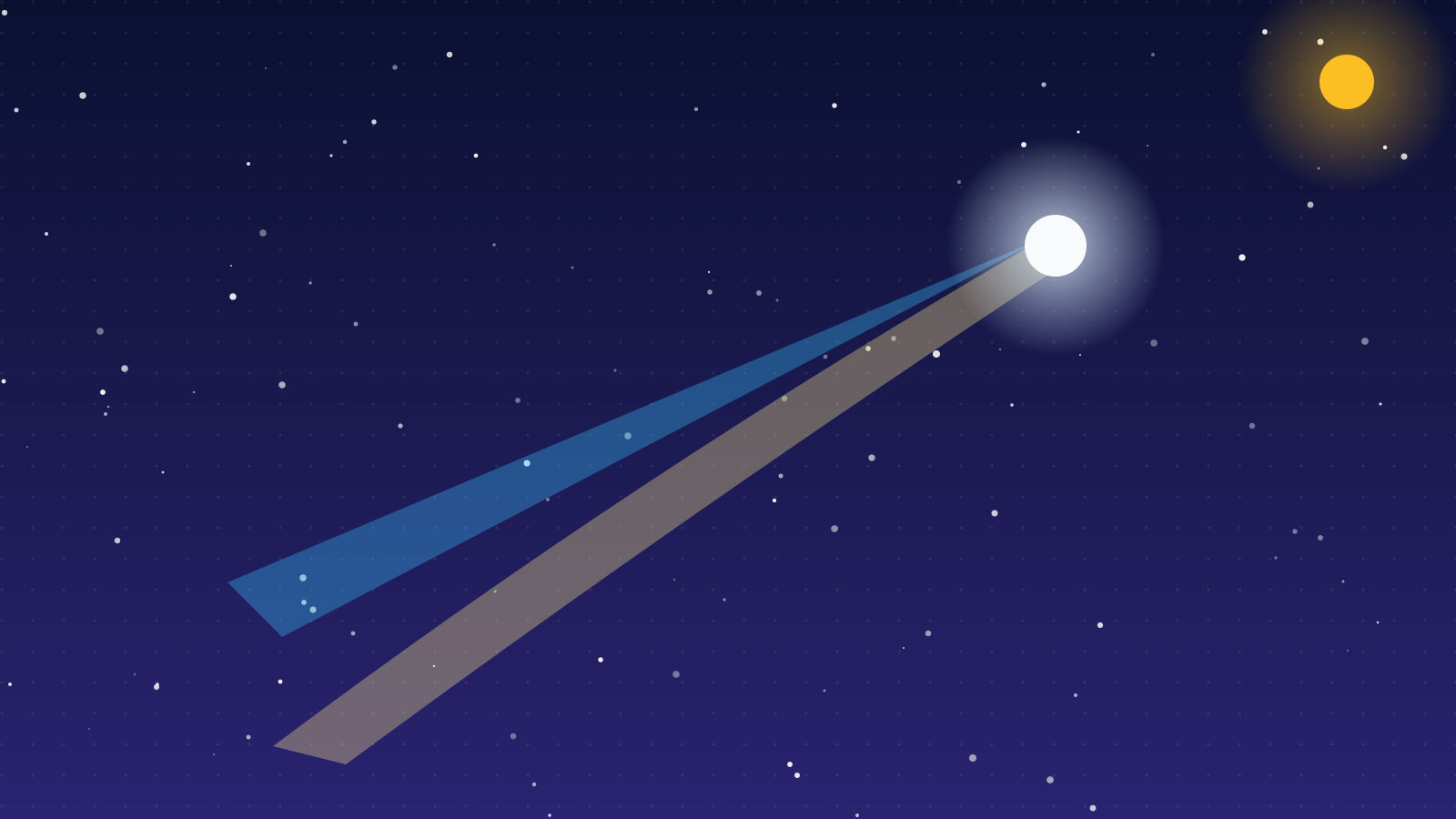
Comets are small icy bodies, usually a few kilometres across, made of frozen water, other ices, dust and rock left over from the formation of the solar system 4.6 billion years ago. They spend most of their time frozen in the distant Kuiper Belt or Oort Cloud. When a comet’s orbit brings it close to the Sun, the heat turns its ice into gas, which releases dust and creates a huge glowing cloud called the coma. The solar wind and sunlight then push this gas and dust into two tails, which always point away from the Sun and can stretch for millions of kilometres.
In this article (8)
For most of history, comets were terrifying. A bright new “star” with a glowing tail would appear suddenly in the sky, and people saw it as an omen of war, plague or the death of kings. Today we know comets are some of the oldest and most pristine objects in the solar system, frozen time capsules from the birth of the planets.
A dirty snowball
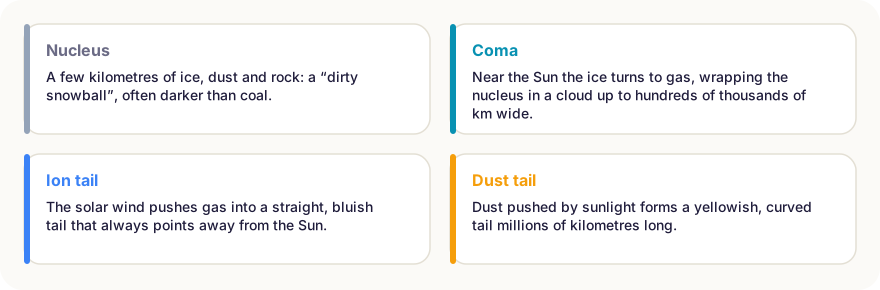
The heart of a comet is its nucleus, a solid body usually just a few kilometres across. It is a mixture of water ice, other frozen gases such as carbon dioxide, carbon monoxide and ammonia, plus dust and rocky material. Astronomer Fred Whipple famously described it in 1950 as a “dirty snowball”. Close-up images have shown the description is apt, though comets are often more “icy dirtball” than snowball, and their surfaces are darker than coal.
When a comet is far from the Sun, it is just a frozen, inactive lump. But as it comes closer, it transforms:
- The coma. Heat makes the ice turn directly from solid to gas, a process called sublimation. The escaping gas drags dust with it, forming a vast, fuzzy cloud around the nucleus, sometimes larger than the Sun.
- The ion tail. Ultraviolet light from the Sun electrically charges the gas, and the solar wind sweeps it away into a straight, bluish tail.
- The dust tail. Dust particles are pushed gently by the pressure of sunlight, forming a broader, curved, yellowish-white tail.
Because both are pushed by the Sun, comet tails always point away from the Sun, not behind the comet. As a comet heads back into the outer solar system, it actually travels tail-first.
Where comets come from
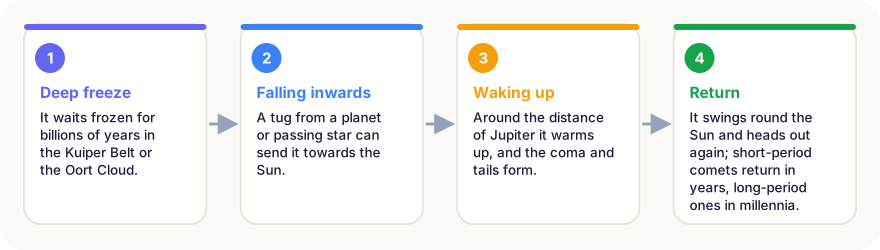
Comets come from two great reservoirs at the edge of the solar system:
- The Kuiper Belt, a disc of icy bodies beyond Neptune, home to Pluto. It supplies many short-period comets, which orbit the Sun in less than 200 years.
- The Oort Cloud, a vast, spherical shell of icy objects thought to surround the solar system up to perhaps 100,000 times the Earth–Sun distance. It is the source of long-period comets, which may take thousands or even millions of years to complete one orbit.
These objects are leftovers from the planet-building disc of gas and dust around the young Sun, 4.6 billion years ago. A gravitational nudge from a planet or a passing star can knock one into a new orbit that carries it towards the inner solar system.
Famous comets

| Comet | Orbital period | Notes |
|---|---|---|
| Halley | about 76 years | Last seen in 1986, back in 2061; source of two meteor showers |
| 67P/Churyumov–Gerasimenko | about 6.4 years | Visited by ESA’s Rosetta mission, 2014–2016 |
| Swift–Tuttle | about 133 years | Its dust creates the Perseid meteor shower every August |
| Hale–Bopp | about 2,500 years | Visible to the naked eye for a record 18 months in 1996–97 |
| Shoemaker–Levy 9 | — | Broke apart and crashed into Jupiter in 1994 |
Halley’s Comet is the most famous of all. In 1705 astronomer Edmond Halley realised that comets seen in 1531, 1607 and 1682 were the same object and predicted its return in 1758. He did not live to see it, but it appeared on schedule, one of the great early triumphs of Newton’s laws of gravity. Halley’s Comet even appears on the Bayeux Tapestry, which shows it before the Battle of Hastings in 1066.
Rosetta: landing on a comet
In 2014, after a ten-year journey, the European Space Agency’s Rosetta spacecraft became the first to orbit a comet, 67P/Churyumov–Gerasimenko. It even dropped a small lander, Philae, onto the surface. Rosetta revealed a strange, duck-shaped nucleus about 4 kilometres long, with cliffs, pits and jets of gas.
One important discovery concerned Earth’s water. Scientists have long wondered whether comets delivered much of Earth’s oceans. In 2015, a team led by Kathrin Altwegg measured the ratio of heavy water (containing deuterium) to ordinary water in 67P’s gas. It was about three times higher than in Earth’s oceans, suggesting that comets like 67P were not the main source of our water. Asteroids may have contributed more.
Comets and meteor showers
As comets travel, they shed dust along their orbits. When Earth passes through these dusty trails, tiny particles burn up in the atmosphere as meteors. That is why meteor showers return on the same dates every year. The Perseids in August come from comet Swift–Tuttle, while Halley’s Comet produces both the Orionids in October and the Eta Aquariids in May.
Could a comet hit Earth?
It has happened in the past and could happen again, although large impacts are extremely rare. In 1994 the world watched as fragments of comet Shoemaker–Levy 9, torn apart by Jupiter’s gravity, slammed into the giant planet, leaving dark scars larger than Earth. Today, astronomers survey the sky to find and track comets and asteroids whose orbits come close to ours.
How to see a comet
Bright comets visible to the naked eye appear only every few years. Recent examples include NEOWISE in 2020 and Tsuchinshan–ATLAS in 2024. To spot one, check astronomy news, find a dark site away from city lights, and look near the horizon just after sunset or before sunrise, where comets often appear when they are close to the Sun.
In short
- Comets are icy leftovers from the birth of the solar system, 4.6 billion years ago.
- Their nucleus is a few kilometres of ice, dust and rock: a “dirty snowball”.
- Near the Sun they grow a coma, an ion tail and a dust tail.
- Tails always point away from the Sun.
- Comets come from the Kuiper Belt and the Oort Cloud.
- Rosetta showed comets like 67P probably did not supply most of Earth’s water.
Frequently asked questions
What is the difference between a comet and an asteroid?
Asteroids are mostly rock and metal and usually orbit closer to the Sun, mainly between Mars and Jupiter. Comets contain lots of ice, come from the cold outer solar system and develop a coma and tails when they approach the Sun.
When will Halley’s Comet return?
Halley’s Comet orbits the Sun about every 76 years. It was last near the Sun in 1986 and is expected back in 2061.
Can a comet hit Earth?
It is possible but very rare. In 1994 fragments of comet Shoemaker–Levy 9 crashed into Jupiter, showing such impacts happen. Space agencies track comets and asteroids that come near Earth.
Are meteor showers related to comets?
Yes. Comets leave trails of dust along their orbits. When Earth passes through a trail, the dust burns up in the atmosphere as a meteor shower, such as the Perseids from comet Swift–Tuttle.
Sources
- Altwegg, K. et al. (2015). 67P/Churyumov–Gerasimenko, a Jupiter family comet with a high D/H ratio. Science
- NASA Science – Comets
- European Space Agency – Rosetta
This article is based on peer-reviewed research and publications from trusted institutions, and it is reviewed regularly. How we work →
You might also wonder
All in Space →
How Big Is the Universe? From the Moon to the Edge of the Observable Cosmos
The observable universe is about 93 billion light years across, though only 13.8 billion years old. How that works and how big it might really be.
Is There Life on Mars? What We Know, What We’ve Found and What Comes Next
Mars once had rivers and lakes. Is anything alive there now? Clues from meteorites, methane and rovers, why the planet is so hostile and how we search.
What Are Shooting Stars? Meteors, Meteor Showers and Where to See Them
Shooting stars are not stars at all. What makes those streaks of light, why do meteor showers happen on the same dates every year, and how can you see the most?
Why Does Saturn Have Rings? What They Are Made Of and How Old They Are
Saturn’s rings are made of billions of ice chunks, yet they are only metres thick. Where did they come from, why aren’t they a moon, and will they vanish?

Why Does the Moon Look Bigger on the Horizon? The Moon Illusion Explained
A rising full Moon looks huge, yet it is no bigger than when it is high in the sky. Why does our brain inflate it, and how can you prove the illusion yourself?
How Do Solar Eclipses Work? Why the Moon Fits the Sun Perfectly
A total solar eclipse happens when the Moon exactly covers the Sun. Why the fit is so perfect, the types of eclipse, and how to watch one safely.