How Does GPS Work? Satellites, Atomic Clocks and Einstein
Your phone finds its position from satellites 20,000 km away. How GPS uses signal timing, why it needs four satellites and why Einstein’s relativity matters.
Short answer
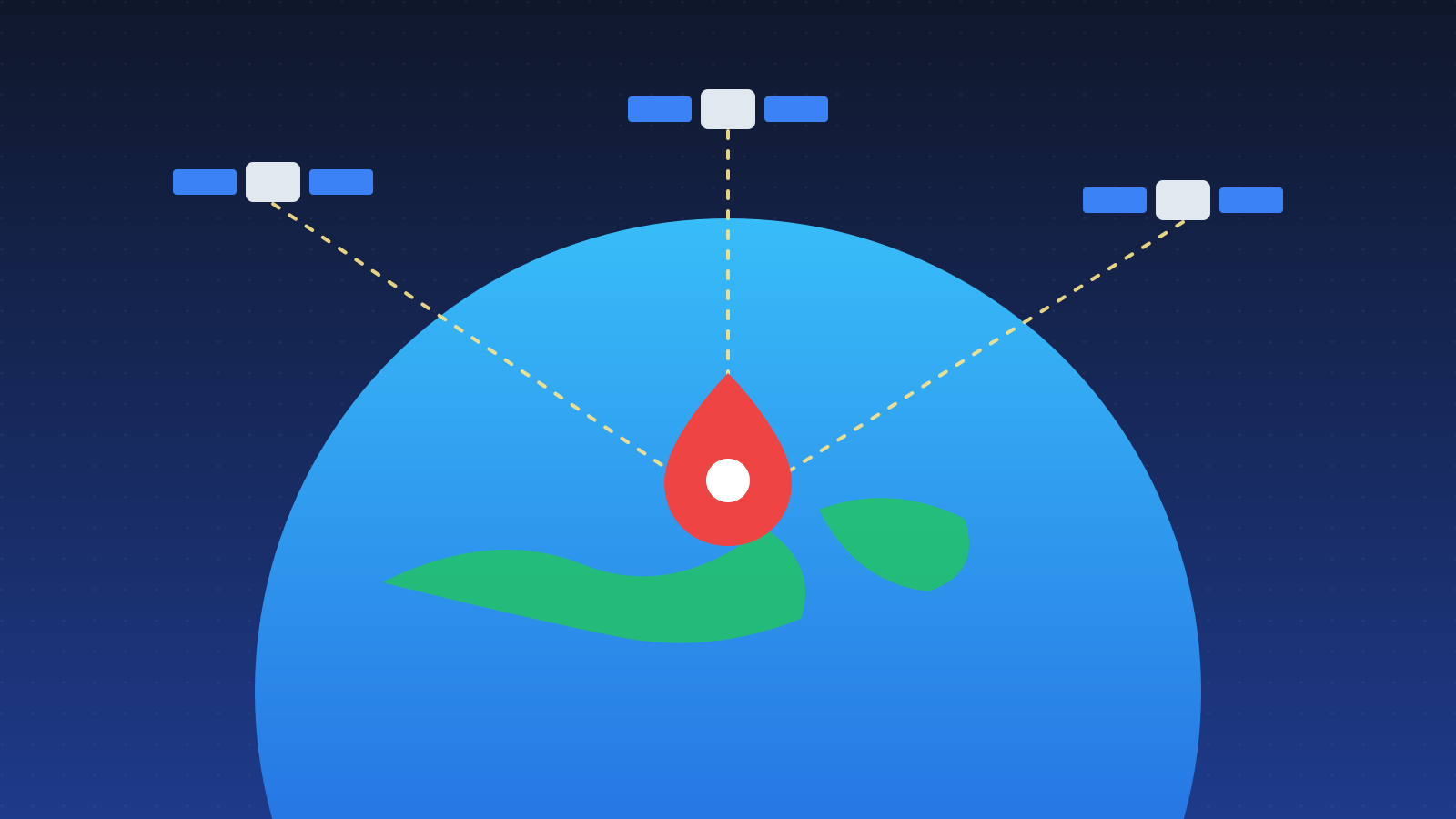
GPS works by timing radio signals from satellites. About 31 GPS satellites orbit Earth at roughly 20,200 km, each carrying extremely precise atomic clocks and constantly broadcasting its position and the exact time. Your receiver measures how long each signal took to arrive; because the signals travel at the speed of light, that delay gives the distance to each satellite. With distances to at least four satellites, the receiver can work out its position in three dimensions and correct its own less accurate clock. Even Einstein’s relativity must be taken into account, or positions would drift by kilometres a day.
In this article (7)
Open a map on your phone and a blue dot appears exactly where you are standing. It seems effortless, but behind it is one of the most impressive systems ever built: a fleet of satellites, clocks accurate to a billionth of a second and a correction for Einstein’s theory of relativity.
A constellation in orbit
The Global Positioning System is operated by the United States. According to the official GPS.gov site, the US Space Force has been flying around 31 operational satellites for more than a decade. They orbit in medium Earth orbit, about 20,200 kilometres above the surface, circling the planet twice a day.
The satellites are arranged in six orbital planes so that at least four, and usually many more, are above the horizon from almost anywhere on Earth at any time.
Each satellite continuously broadcasts a radio signal that contains two key pieces of information: where the satellite is and exactly what time it is according to its onboard atomic clocks.
Distance from time
Radio signals travel at the speed of light, about 300,000 kilometres per second. If your receiver knows when a signal left the satellite and when it arrived, it can calculate the distance: travel time multiplied by the speed of light.
A signal from a satellite 20,000 km away takes about one-fifteenth of a second to arrive. That sounds fast, but for GPS it is a long time, and it must be measured with extraordinary precision.
Why four satellites?
One distance tells you only that you are somewhere on a huge imaginary sphere around that satellite. Two spheres intersect in a circle. A third sphere narrows it down to two points, one of which is usually far out in space and can be ignored. This method is called trilateration.
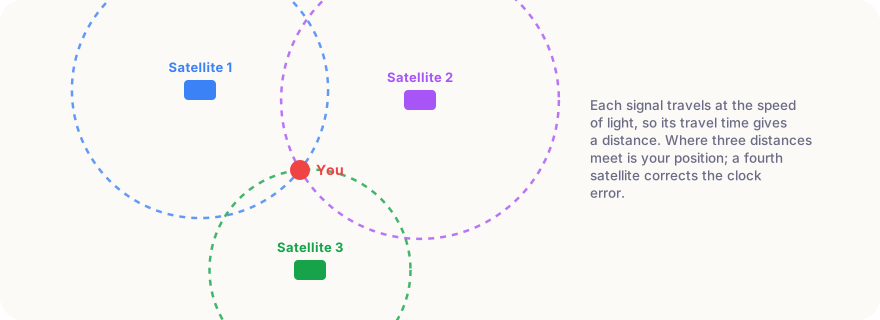
So why do receivers need a fourth satellite? Because your phone does not have an atomic clock. Its clock is much less accurate, and even a tiny error would ruin the distance calculations. By using a fourth signal, the receiver can solve for four unknowns at once: its three position coordinates and its own clock error.
Tiny errors, big consequences
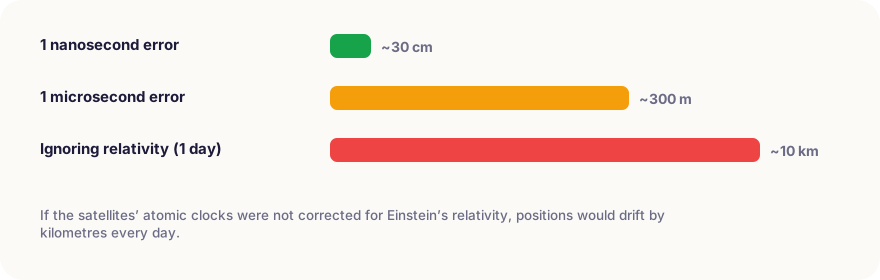
Timing is everything. Because the signals travel so fast, an error of just one billionth of a second corresponds to about 30 centimetres of distance. An error of one millionth of a second would put you about 300 metres off.
That is why each satellite carries several atomic clocks, and why ground control stations constantly monitor the satellites’ clocks and orbits and upload corrections.
Einstein in your pocket
GPS is one of the few everyday technologies that would fail without Einstein’s theories of relativity.
- Special relativity says that moving clocks tick more slowly. The satellites travel at about 14,000 km/h, so their clocks lose about 7 microseconds a day compared with clocks on the ground.
- General relativity says that clocks in weaker gravity tick faster. Up in orbit, gravity is weaker, so the satellite clocks gain about 45 microseconds a day.
The net effect is that the satellite clocks run about 38 microseconds a day fast. Physicist Neil Ashby, who worked on these corrections, has described in detail how they are built into the system. Without them, errors would build up to around 10 kilometres a day.
What limits accuracy?
Under an open sky, GPS-enabled smartphones are typically accurate to within about 5 metres. Accuracy can drop because of:
- buildings and trees that block signals or bounce them off surfaces;
- the ionosphere and atmosphere, which slightly slow the signals;
- the geometry of the satellites in view.
Modern phones improve accuracy by combining GPS with other systems such as Europe’s Galileo, Russia’s GLONASS and China’s BeiDou, by using signals on two frequencies, and with help from Wi-Fi and mobile networks. Specialised equipment used in surveying can reach centimetre-level accuracy.
In short
- About 31 GPS satellites orbit at roughly 20,200 km, broadcasting their position and the exact time.
- A receiver measures the travel time of signals to calculate distances.
- With four satellites, it can find its position and correct its own clock.
- A timing error of a billionth of a second equals about 30 cm.
- Relativity makes satellite clocks run about 38 microseconds a day fast, which must be corrected.
- Phones are typically accurate to about 5 metres under open sky.
Frequently asked questions
Does GPS need the internet or mobile data?
No. GPS signals come directly from satellites and work anywhere with a clear view of the sky. Phones use mobile data only to download maps and speed up the first position fix, known as assisted GPS.
How accurate is the GPS on my phone?
Under open sky, GPS-enabled smartphones are typically accurate to within about 5 metres. Tall buildings, trees and being indoors can reduce accuracy because signals are blocked or reflected.
Is GPS the only satellite navigation system?
No. GPS is run by the United States. Europe has Galileo, Russia GLONASS and China BeiDou. Most modern phones use several systems together for better accuracy.
Can GPS track me?
GPS itself is one-way: satellites only send signals and do not know who receives them. Tracking happens when a device or app shares its calculated position over the internet or a mobile network.
Sources
- GPS.gov – Space segment
- GPS.gov – GPS accuracy
- Ashby, N. (2003). Relativity in the Global Positioning System. Living Reviews in Relativity
This article is based on peer-reviewed research and publications from trusted institutions, and it is reviewed regularly. How we work →
You might also wonder
All in How Things Work →
How Do Aeroplanes Fly? Lift, Wings and a Famous Myth
A jumbo jet weighs hundreds of tonnes, yet stays in the air. How wings create lift, the four forces of flight, and why a popular explanation is wrong.

How Do Touchscreens Work? Why Your Finger Works and Gloves Don’t
Phone screens sense your finger through an invisible electrical grid. How capacitive and resistive touchscreens work, how multi-touch works and why gloves fail.
How Do Rechargeable Batteries Work? Inside a Lithium-Ion Battery
Your phone’s battery moves lithium ions back and forth between two layers. How charging works, why batteries wear out and the habits that make them last longer.

How Does a Fridge Work? It Doesn’t Make Cold – It Moves Heat
A fridge doesn’t make cold; it pumps heat from inside to the kitchen. How the cooling cycle works, why the back is warm and why an open door won’t cool a room.
How Does Wi-Fi Work? Radio Waves, Routers and Why Walls Slow It Down
Wi-Fi sends data through the air as radio waves. How routers encode information, what 2.4, 5 and 6 GHz mean, and why your signal drops in some rooms.
How Do Bats See in the Dark? Echolocation Explained
Bats are not blind, but many hunt in total darkness by listening to echoes. How echolocation works, how fast bats call, and how moths fight back.