How Do Aeroplanes Fly? Lift, Wings and a Famous Myth
A jumbo jet weighs hundreds of tonnes, yet stays in the air. How wings create lift, the four forces of flight, and why a popular explanation is wrong.
Short answer
Aeroplanes fly because their wings create lift. As a plane moves forward, its specially shaped and slightly tilted wings deflect a huge mass of air downwards; by Newton’s third law the air pushes the wing up. At the same time the air flowing over the curved top of the wing speeds up and its pressure drops, while pressure below the wing is higher, and this pressure difference also pushes the wing upwards. These are two descriptions of the same effect. Engines provide thrust to keep the plane moving fast enough for lift to balance its weight.
In this article (6)
Watching a passenger jet climb into the sky can feel like magic. A machine weighing hundreds of tonnes, full of people, bags and fuel, lifts off the runway and stays in the air for hours. Yet the physics behind it is surprisingly down-to-earth, and it all comes down to how wings move air.
The four forces of flight
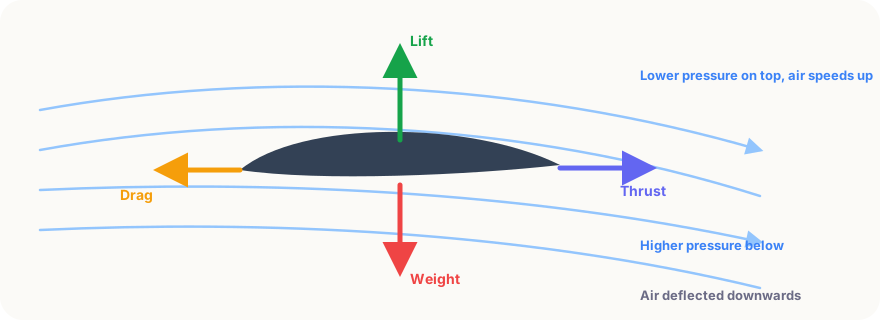
At every moment, four forces act on a plane:
- Weight pulls it down towards the ground.
- Lift, created by the wings, pushes it up.
- Thrust, produced by the engines or propellers, pushes it forward.
- Drag, the resistance of the air, holds it back.
In steady, level flight, lift balances weight and thrust balances drag. To climb, a plane needs more lift; to speed up, more thrust than drag.
How a wing makes lift
A wing has a special cross-section called an aerofoil: rounded at the front, thin at the back and usually more curved on top. It also meets the oncoming air at a slight upward tilt, the angle of attack.
As the plane moves forward, the wing changes the direction of the air flowing around it. Air coming off the back of the wing is deflected downwards. By Newton’s third law, every action has an equal and opposite reaction: if the wing pushes air down, the air pushes the wing up. A big airliner sends tonnes of air downwards every second.
The same effect can be described in terms of pressure. Air flowing over the curved top of the wing speeds up and its pressure falls. Air beneath the wing is slowed slightly and its pressure rises. The higher pressure underneath pushes up more strongly than the lower pressure on top pushes down. This relationship between speed and pressure is described by Bernoulli’s principle.
These are not competing theories. They are two ways of describing the same flow of air, and aeronautical engineers use both.
The equal-transit-time myth
Many textbooks used to explain lift like this: air going over the top of the wing has a longer path, so it must travel faster to “meet up” with the air going underneath at the trailing edge. NASA’s Glenn Research Center explicitly calls this explanation incorrect.
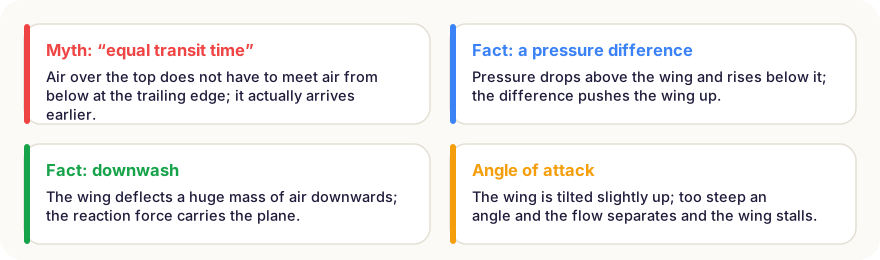
There is no rule that the two streams of air must meet again. In fact, wind-tunnel experiments show that air flowing over the top reaches the back of the wing sooner than the air underneath. The myth also cannot explain why flat or symmetrical wings, and planes flying upside down, can produce lift. The real reason is the wing’s shape and angle turning the airflow.
Speed, size and air
How much lift a wing produces depends on:
- speed: lift increases with the square of speed, so doubling speed roughly quadruples lift;
- wing area: bigger wings produce more lift;
- air density: thinner air at high altitude or on hot days produces less lift;
- angle of attack: a steeper angle produces more lift, up to a point.
That is why planes need to reach high speeds on the runway, why airports in hot, high-altitude cities often have very long runways, and why planes extend flaps and slats for take-off and landing. These devices make the wing larger and more curved so it produces enough lift at lower speeds.
When lift is lost: the stall
If the angle of attack becomes too steep, the smooth airflow over the top of the wing can no longer follow its curve. It breaks away into turbulent eddies, and lift drops suddenly. This is called a stall. It has nothing to do with the engine stopping. Pilots recover by lowering the nose to reduce the angle and regain smooth airflow.
In short
- Four forces act on a plane: lift, weight, thrust and drag.
- Wings create lift by deflecting air downwards; the air pushes the wing up.
- The same effect appears as lower pressure on top and higher pressure below the wing.
- The “equal transit time” explanation is a myth.
- Lift depends on speed, wing area, air density and angle of attack.
- A stall happens when the angle is too steep and the airflow breaks away.
Frequently asked questions
Why do planes need a long runway?
Lift grows with speed. A plane must accelerate to a high speed, often around 250 to 300 km/h for an airliner, before its wings produce enough lift to overcome its weight.
What happens if the engines fail?
The plane does not fall like a stone. It becomes a glider: by trading height for speed, an airliner can glide many kilometres, which gives pilots time to reach an airport or a safe landing spot.
What is a stall?
A stall happens when the wing meets the air at too steep an angle. The smooth airflow over the top breaks away, lift drops suddenly and the plane starts to sink. Pilots are trained to recover by lowering the nose.
Why do planes fly so high?
At around 10 to 12 km the air is thinner, so there is less drag and engines burn less fuel per kilometre. Planes also fly above most weather there.
Sources
- NASA Glenn Research Center – Beginner’s Guide to Aeronautics: What is lift?
- Encyclopaedia Britannica – Airplane: principles of flight
This article is based on peer-reviewed research and publications from trusted institutions, and it is reviewed regularly. How we work →
You might also wonder
All in How Things Work →
How Do Touchscreens Work? Why Your Finger Works and Gloves Don’t
Phone screens sense your finger through an invisible electrical grid. How capacitive and resistive touchscreens work, how multi-touch works and why gloves fail.
How Does GPS Work? Satellites, Atomic Clocks and Einstein
Your phone finds its position from satellites 20,000 km away. How GPS uses signal timing, why it needs four satellites and why Einstein’s relativity matters.
How Do Rechargeable Batteries Work? Inside a Lithium-Ion Battery
Your phone’s battery moves lithium ions back and forth between two layers. How charging works, why batteries wear out and the habits that make them last longer.
How Does a Fridge Work? It Doesn’t Make Cold – It Moves Heat
A fridge doesn’t make cold; it pumps heat from inside to the kitchen. How the cooling cycle works, why the back is warm and why an open door won’t cool a room.

How Does Wi-Fi Work? Radio Waves, Routers and Why Walls Slow It Down
Wi-Fi sends data through the air as radio waves. How routers encode information, what 2.4, 5 and 6 GHz mean, and why your signal drops in some rooms.
How Do Bats See in the Dark? Echolocation Explained
Bats are not blind, but many hunt in total darkness by listening to echoes. How echolocation works, how fast bats call, and how moths fight back.