How Does a Fridge Work? It Doesn’t Make Cold – It Moves Heat
A fridge doesn’t make cold; it pumps heat from inside to the kitchen. How the cooling cycle works, why the back is warm and why an open door won’t cool a room.
Short answer
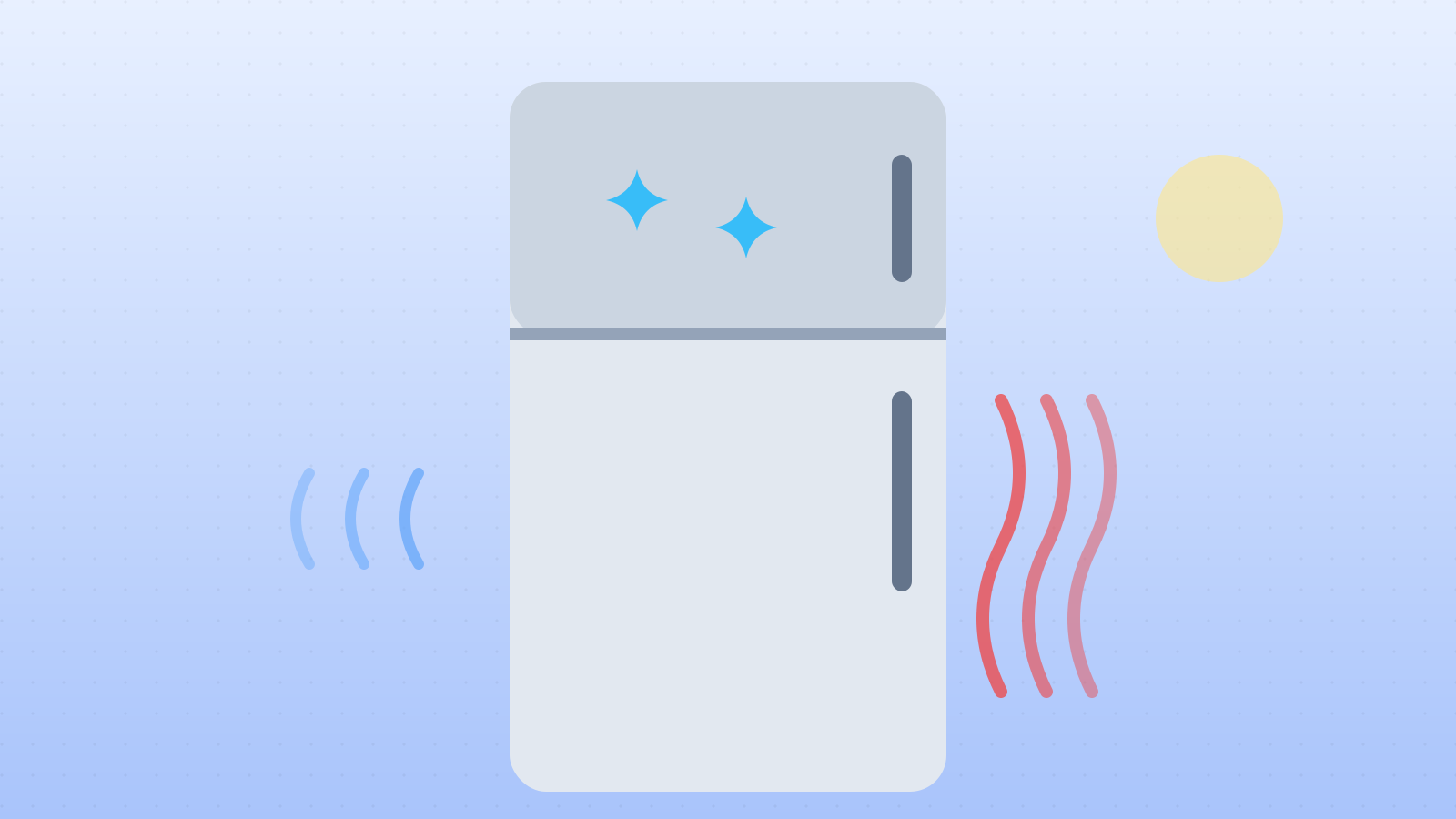
A fridge works by moving heat, not by making cold. A special fluid called a refrigerant circulates in a closed loop of pipes. Inside the fridge, the refrigerant evaporates at a low pressure, and evaporating absorbs heat, so it cools the food compartment. A compressor then squeezes the gas, raising its pressure and temperature, and pushes it through coils at the back, where it releases the heat into the kitchen and condenses back into a liquid. An expansion valve drops the pressure again so the cycle can repeat. That is why the back of a fridge feels warm.
In this article (7)
Open the fridge on a hot day and cold air spills out over your feet. It feels as if the fridge is full of “cold”. But physics says there is no such thing as cold to make. There is only heat, and a fridge is a machine for carrying heat out of a box.
Cold is just missing heat
Heat naturally flows from warm things to cooler ones, never the other way round on its own. Your milk warms up on the kitchen table because heat flows into it from the air. To keep food cold, a fridge has to do the opposite: pull heat out of the cold interior and push it into the warmer kitchen. That takes energy, which is why a fridge needs electricity.
The trick: evaporation absorbs heat
You already know the key effect. When you step out of a swimming pool, you feel cold because water evaporating from your skin takes heat with it. A fridge uses the same principle, but with a special fluid called a refrigerant, which boils at a very low temperature.
The four-step cycle
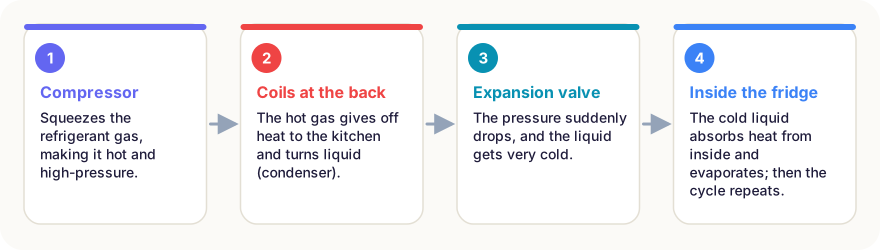
- Compressor. The motor at the bottom of the fridge squeezes the refrigerant gas. Compressing a gas makes it hotter, just as a bicycle pump warms up.
- Condenser. The hot, high-pressure gas flows through the coils at the back or underneath. Because it is hotter than the kitchen, it gives off heat to the room and condenses into a liquid.
- Expansion valve. The liquid is forced through a narrow opening. Its pressure drops sharply, and part of it evaporates, making the rest very cold, well below freezing.
- Evaporator. This cold liquid flows through pipes inside the fridge walls. It absorbs heat from the food compartment and evaporates completely. The gas then returns to the compressor, and the cycle starts again.
A thermostat switches the compressor on and off to keep the inside at the chosen temperature, which is why you hear the fridge hum for a while and then go quiet.
Surprising consequences
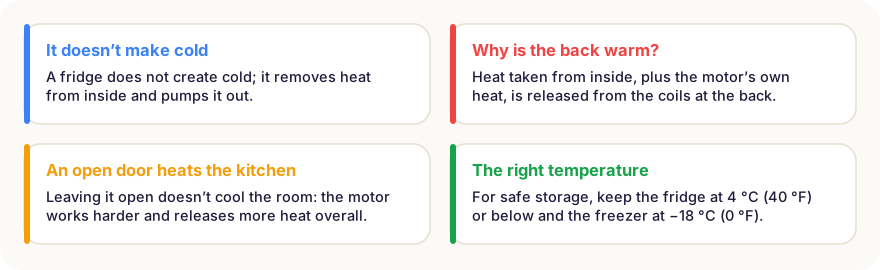
- The back is warm. All the heat removed from your food, plus the heat from the motor, comes out of the coils. That is why fridges need a gap behind them for air to flow.
- An open door heats the kitchen. With the door open, the fridge moves heat from the room back into the same room, while the motor adds extra heat. The net effect is slightly warmer air.
- Same machine, different uses. An air conditioner is a fridge whose “inside” is your room. A heat pump for heating a house runs the cycle the other way, pulling heat from the cold outdoor air into the home.
Keeping food safe
Cold slows the growth of bacteria. Food safety agencies such as the US Department of Agriculture recommend keeping the fridge at 4 °C (40 °F) or below and the freezer at −18 °C (0 °F). Overfilling the fridge blocks the flow of cold air, and frequently opening the door lets warm, humid air in, making the compressor work harder.
From ice houses to ozone
Before electric fridges, people stored food with ice cut from frozen lakes. Mechanical refrigeration spread in the 20th century. Early fridges used toxic gases, then CFCs, which turned out to damage the ozone layer and were phased out under the Montreal Protocol of 1987. Many modern fridges use hydrocarbons such as isobutane, which have much less effect on the climate.
In short
- A fridge does not make cold; it moves heat from inside to outside.
- It uses a refrigerant that absorbs heat as it evaporates inside the fridge.
- The compressor heats the gas; the coils at the back release that heat to the room.
- An expansion valve drops the pressure so the refrigerant becomes cold again.
- An open fridge door warms the kitchen slightly instead of cooling it.
- Keep the fridge at 4 °C or below and the freezer at −18 °C.
Frequently asked questions
What temperature should a fridge be?
Food safety agencies such as the US Department of Agriculture recommend keeping the fridge at 4 °C (40 °F) or below and the freezer at −18 °C (0 °F).
Why does my fridge make noises?
Humming comes from the compressor and fans. Gurgling and clicking are usually the refrigerant flowing through the pipes and parts expanding or contracting as temperatures change.
Should I let hot food cool before putting it in the fridge?
Food safety advice is not to leave cooked food out for more than about two hours. Dividing large amounts into shallow containers helps them cool quickly and safely in the fridge.
What gas is in a fridge?
Older fridges used CFCs, which damaged the ozone layer and were phased out under the Montreal Protocol. Many modern fridges use hydrocarbons such as isobutane, which have far less impact on the climate.
Sources
- US Department of Agriculture (FSIS) – Refrigeration and food safety
- Encyclopaedia Britannica – Refrigeration
This article is based on peer-reviewed research and publications from trusted institutions, and it is reviewed regularly. How we work →
You might also wonder
All in How Things Work →
How Do Aeroplanes Fly? Lift, Wings and a Famous Myth
A jumbo jet weighs hundreds of tonnes, yet stays in the air. How wings create lift, the four forces of flight, and why a popular explanation is wrong.

How Do Touchscreens Work? Why Your Finger Works and Gloves Don’t
Phone screens sense your finger through an invisible electrical grid. How capacitive and resistive touchscreens work, how multi-touch works and why gloves fail.
How Does GPS Work? Satellites, Atomic Clocks and Einstein
Your phone finds its position from satellites 20,000 km away. How GPS uses signal timing, why it needs four satellites and why Einstein’s relativity matters.
How Do Rechargeable Batteries Work? Inside a Lithium-Ion Battery
Your phone’s battery moves lithium ions back and forth between two layers. How charging works, why batteries wear out and the habits that make them last longer.
How Does Wi-Fi Work? Radio Waves, Routers and Why Walls Slow It Down
Wi-Fi sends data through the air as radio waves. How routers encode information, what 2.4, 5 and 6 GHz mean, and why your signal drops in some rooms.
How Do Bats See in the Dark? Echolocation Explained
Bats are not blind, but many hunt in total darkness by listening to echoes. How echolocation works, how fast bats call, and how moths fight back.