How Do Rechargeable Batteries Work? Inside a Lithium-Ion Battery
Your phone’s battery moves lithium ions back and forth between two layers. How charging works, why batteries wear out and the habits that make them last longer.
Short answer
A rechargeable lithium-ion battery stores energy by moving lithium ions between two electrodes. When you charge it, electricity pushes lithium ions out of the positive electrode, usually a metal oxide, through a liquid electrolyte and into the negative electrode, made of graphite, where they are packed between layers of carbon. When you use the phone, the ions flow back to the positive side, and at the same time electrons travel the other way through the phone’s circuits, powering it. A thin separator keeps the two electrodes from touching. Each cycle causes tiny, irreversible changes, so capacity slowly falls over the years.
In this article (5)
Phones, laptops, wireless earbuds, electric cars: almost everything we carry runs on the same kind of battery. Every night, billions of people plug in and refill them. But what actually happens inside when a battery charges, and why does it hold less and less after a couple of years?
A battery is a controlled chemical reaction
A battery has two electrodes: a negative one and a positive one. Between them is an electrolyte, a substance that lets charged atoms, called ions, move through it but blocks electrons. Electrons can only get from one side to the other by travelling through an outside circuit, such as your phone. That flow of electrons is the electric current that powers the device.
In an ordinary disposable battery, the chemicals are used up and that is the end of it. In a rechargeable battery, the reaction can be run backwards.
Inside a lithium-ion battery
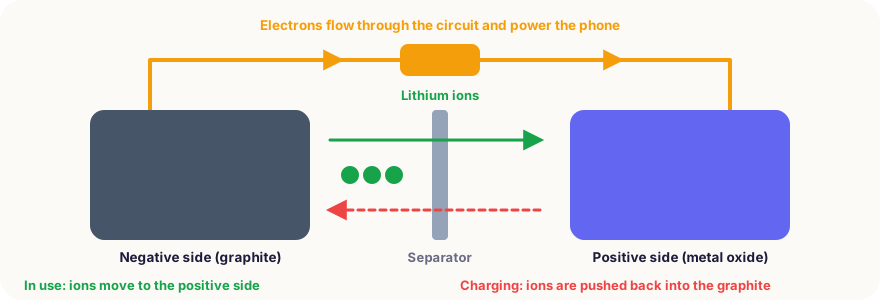
- The negative electrode is usually graphite, layers of carbon atoms stacked like pages of a book.
- The positive electrode is a metal oxide containing lithium, for example with cobalt, nickel, manganese or iron.
- A thin porous plastic separator keeps them apart, and a liquid electrolyte soaks everything.
Charging: the charger pushes electrons into the graphite. To balance the charge, lithium ions leave the metal oxide, cross the electrolyte and slip between the layers of graphite. The battery is now “full”: lots of lithium is stored in an uncomfortable, high-energy position.
Using: when you switch on the phone, the lithium ions flow back to the metal oxide, and their electrons travel through the phone’s circuits to get there. The battery is “empty” when most of the lithium is back on the positive side.
The ions simply shuttle back and forth, which is why some engineers call these “rocking-chair” batteries.
Why lithium?
Lithium is the lightest metal and gives up its electron very readily. That means a lot of energy can be stored in a small, light package. In 2019 the Nobel Prize in Chemistry went to John Goodenough, M. Stanley Whittingham and Akira Yoshino for developing the lithium-ion battery. Sony sold the first commercial version in 1991.
Why batteries wear out
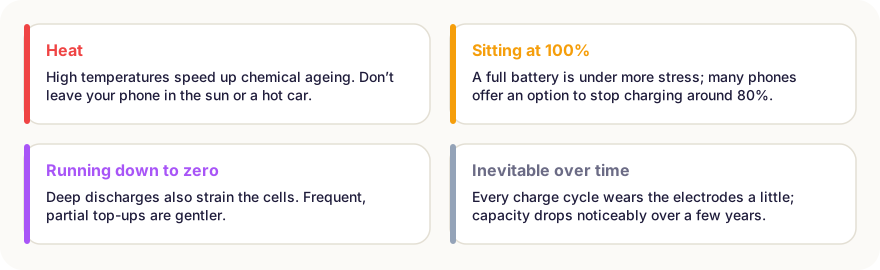
Every cycle causes small, irreversible changes. A thin film called the solid electrolyte interphase grows on the graphite, trapping some lithium so it can no longer move. The electrodes expand and contract slightly with each charge, causing tiny cracks. Over hundreds of cycles the battery holds less charge and can deliver less power, which is why an old phone can shut down suddenly when it is cold or the battery is low.
According to research on lithium-ion degradation, the biggest factors are high temperature, keeping the battery at a very high state of charge for long periods, and deep discharges. That leads to some simple habits:
- Keep your phone out of heat: hot cars, direct sun and pillows while charging.
- Use your phone’s optimised or limited charging setting if it has one, which often holds the battery around 80%.
- Prefer frequent partial top-ups to running it down to zero.
In short
- A lithium-ion battery stores energy by moving lithium ions between two electrodes.
- Charging pushes ions into the graphite; using the battery lets them flow back to the metal oxide.
- Electrons travel through the device’s circuit, providing the current.
- Lithium is the lightest metal, so it stores a lot of energy in a small space.
- Batteries age because of small irreversible side reactions with every cycle.
- Heat, long periods at 100% and deep discharges speed up ageing.
Frequently asked questions
Should I charge my phone overnight?
Modern phones stop charging when full and many can delay the final top-up until you wake up. Keeping the phone cool and using optimised or limited charging settings is more important than avoiding overnight charging.
Is it bad to let the battery reach 0%?
Regularly draining a lithium-ion battery completely adds stress. The phone switches off before the cells are truly empty to protect them, but partial top-ups are gentler than full discharges.
Does fast charging damage batteries?
Fast charging produces more heat, and heat speeds up ageing. Phones manage this by charging fastest when the battery is low and slowing down as it fills, so the effect in normal use is modest.
Why do batteries sometimes swell or catch fire?
Damage, manufacturing defects or overheating can cause a short circuit inside the cell. The electrolyte can then heat up and produce gas, which in rare cases leads to swelling, fire or “thermal runaway”.
Sources
- Nobel Prize in Chemistry 2019 – Press release
- Birkl, C. R. et al. (2017). Degradation diagnostics for lithium ion cells. Journal of Power Sources
This article is based on peer-reviewed research and publications from trusted institutions, and it is reviewed regularly. How we work →
You might also wonder
All in How Things Work →
How Do Aeroplanes Fly? Lift, Wings and a Famous Myth
A jumbo jet weighs hundreds of tonnes, yet stays in the air. How wings create lift, the four forces of flight, and why a popular explanation is wrong.
How Do Touchscreens Work? Why Your Finger Works and Gloves Don’t
Phone screens sense your finger through an invisible electrical grid. How capacitive and resistive touchscreens work, how multi-touch works and why gloves fail.

How Does GPS Work? Satellites, Atomic Clocks and Einstein
Your phone finds its position from satellites 20,000 km away. How GPS uses signal timing, why it needs four satellites and why Einstein’s relativity matters.
How Does a Fridge Work? It Doesn’t Make Cold – It Moves Heat
A fridge doesn’t make cold; it pumps heat from inside to the kitchen. How the cooling cycle works, why the back is warm and why an open door won’t cool a room.

How Does Wi-Fi Work? Radio Waves, Routers and Why Walls Slow It Down
Wi-Fi sends data through the air as radio waves. How routers encode information, what 2.4, 5 and 6 GHz mean, and why your signal drops in some rooms.
How Do Bats See in the Dark? Echolocation Explained
Bats are not blind, but many hunt in total darkness by listening to echoes. How echolocation works, how fast bats call, and how moths fight back.